


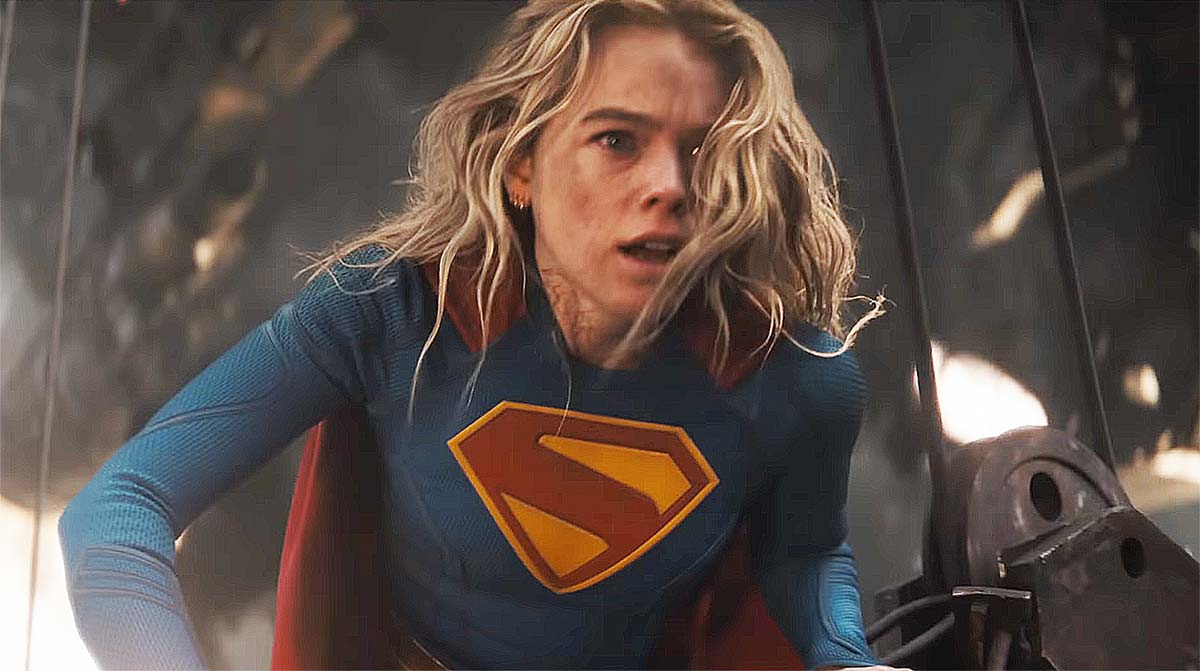
It has been a brutal week for DC Studios, and maybe an even more demoralizing one if you’re the kind of DC fan who keeps convincing yourself the next reset will finally be the one.
“Supergirl” didn’t just disappoint at the box office last weekend. It crashed, opening to roughly $37 million domestically and $68 million worldwide—with reports already pointing to a steep potential $120 million loss for Warner Bros. and DC—and then spent the rest of the week being ripped to shreds online. The pile-on has been merciless: the film’s muddled storytelling, its shapeless direction, and especially its much-mocked final needle drop have all become easy targets. But the backlash has also widened beyond the movie itself, turning into a referendum on James Gunn’s still-nascent DCU, his insistence that the studio would move forward only with fully ready scripts, and the broader creative direction of a reboot that had barely begun to take shape.
That is where things got much darker for DC this week. “Supergirl” did not simply generate a bad box office narrative; it opened the door to a darker reassessment of DC Studios so far, including rougher second looks at “Superman,” “Peacemaker,” and “Creature Commandos.” Some of that was angry, inevitable overreaction, because the Internet loves nothing more than a blood-in-the-water franchise narrative. But disappointed DC fans are also a uniquely combustible audience. They have endured so many false starts, regime changes, abandoned universes, and allegedly fresh beginnings that each new failure no longer lands as an isolated stumble. They hit more like existential body blows about a universe that may not only always play second fiddle but also never live up to its promise.
That is what makes “Supergirl” such a worrisome case, at least for fans (read our review here). Its failure, or wholesale rejection from most non-die-hard audiences, is not just a DC problem. It is the latest, loudest sign that the superhero marketplace has changed dramatically, is alarmingly shrinking, and that the old assumption that audiences will show up for every cape, logo, universe, and promised future installment no longer holds.
The Aftershocks Are The Real Problem
According to Variety, Warner Bros. and DC spent roughly $170 million to produce “Supergirl” and another $120 million to market it. Traditionally, a movie on that scale would need at least $375 million worldwide to break even, though a source close to the film put its breakeven point closer to $300 million. Either way, the math is ugly. The film is reportedly projected to stall at around $100 million domestically and $200 million to $210 million worldwide. This potential loss scenario will keep DC on edge, despite how DC Studios co-chief Peter Safran downplayed it.
READ MORE: The Best Films Of 2026 (So Far)
So the more important question now is not whether “Supergirl” is a box-office bomb (it is), it’s how deep the aftershocks go inside DC Studios, and whether this kind of failure creates the sort of internal damage that does not show up immediately on a release calendar: budget tightening, colder feet around second-tier characters, less patience from Warner Bros. Discovery or any future corporate overseer (Paramount), and a renewed fear that even the new DCU may not be immune to the instability that has haunted the brand for years.
“Supergirl” did not merely open softly. It opened below several recent superhero disappointments that were already treated as genre alarms. “The Flash” opened to $55 million domestically. “The Marvels” opened to $46.1 million. “Morbius” opened to $39 million. “Joker: Folie À Deux” opened to $37.6 million. DC’s first major expansion beyond “Superman” in Gunn and Peter Safran’s new cinematic universe opened worse than some of the very movies that supposedly proved the genre was in crisis.
That hurts DC beyond one expensive film losing money. Gunn and Safran are trying to sell audiences, executives, and Wall Street on yet another new DC beginning after more than a decade of pivots, abandoned plans, tonal whiplash, and regime shifts. The Zack Snyder era gave way to the Jon Berg/Geoff Johns course-correction years, then the Toby Emmerich-overseen Warner Bros. era, then the Walter Hamada years, and now the Gunn/Safran reboot. Even if most audiences could not name every executive involved, they have felt the churn. At a certain point, the uncertainty around the reboot becomes part of the brand.
DC Is Asking Audiences To Trust The Plan… Again
“Superman” was the big relaunch, opening to $125 million domestically and eventually reaching $618 million worldwide. Those returns were treated as a win and a sign that the new DCU had momentum. But Superman is one of the few superhero characters who can still function as a cultural default. “Supergirl” was the harder test, a familiar but less event-sized character whose movie needed to prove that the new DCU could travel beyond its most essential icon. Instead, it has become the first serious stress test for the new regime.
History does not exist in a bubble, and anyone comparing “Supergirl” to Marvel’s early growing pains is ignoring the era that made those growing pains survivable. Marvel Studios could absorb the underperformance of “The Incredible Hulk” in 2008 because “Iron Man” had already created enough goodwill, novelty, and momentum to keep the experiment alive. The theatrical marketplace was healthier then. Superhero films were still ascendant, and the very idea of an interconnected cinematic universe was new enough to feel like a possibility rather than an obligation. Audiences had not yet spent nearly two decades being trained to follow post-credits scenes, multiverse homework, streaming side quests, cameo bait, and corporate roadmaps often disguised as storytelling.
For better or worse, DC does not get to build itself in that world. Its scaffolding has to be created in this one, where a superhero logo no longer guarantees a global audience.
The Biggest Icons Are Fine. Everything Else Is The Problem.
That does not mean every superhero movie is doomed. Certain titles are still bulletproof. The “Spider-Man: Brand New Day” tracking (potential $200 million+ opening) is outstanding; it’ll easily cross $1 billion at that pace. The next “Avengers” movies will almost certainly go gangbusters and post immense, record-breaking numbers. “Deadpool & Wolverine” was enormous. And when those movies hit, the more assured fanboy influencers will inevitably step up to the pulpit to assure the rest of the clan, “See? Everything is fine. Superhero fatigue isn’t real.”
But that argument, which seems to be in denial about the bigger picture, misses the point. The biggest icons can still win. The question is what happens to everything else.
For every “Deadpool & Wolverine,” there are multiple underwhelming performances from the middle of the superhero machine. “Captain America: Brave New World,” “Thunderbolts*,” and “The Fantastic Four: First Steps” all did business, but not amazing superhero business. Not old Marvel business. Not the kind of business that suggests the MCU is still operating from a position of default dominance. All three performed well below earlier post-pandemic Marvel films like “Thor: Love And Thunder” and “Black Panther: Wakanda Forever,” which themselves were already signs that the post-“Avengers: Endgame” era was softer than the imperial phase.
That is the distinction that matters. Superheroes are not dead, but the entitlement around them most certainly is.
Read on for more…

