





We are not sure we’ve spoken to anyone who takes their time choosing their words as serendipitously as Alex Russell. Our conversation was 22 minutes long, but the transcript might make you think otherwise. To be fair, the writer and director of “Lurker,” still one of our favorite films of the year, wasn’t trying to hide anything. Like the great writer he is, he picks his words carefully. And we’re not mad at that.
READ MORE: “Lurker” Review: Alex Russell Masterfully Dissects The Fanatic In Pop Star Fandom [Sundance]
Already an Emmy-award winner for his contributions to Netflix’s landmark limited series “Beef” (The Playlist’s no. 41 series of the Greatest Television Programs of the 21st Century So Far) and a WGA Award winner for “The Bear,” this MUBI acquisition marks his feature directorial debut. But, as he reveals during our interview, he effectively only directed the movie because no one else would. Now, after his first-rate debut, we’re not sure we could imagine anyone else tackling this material.
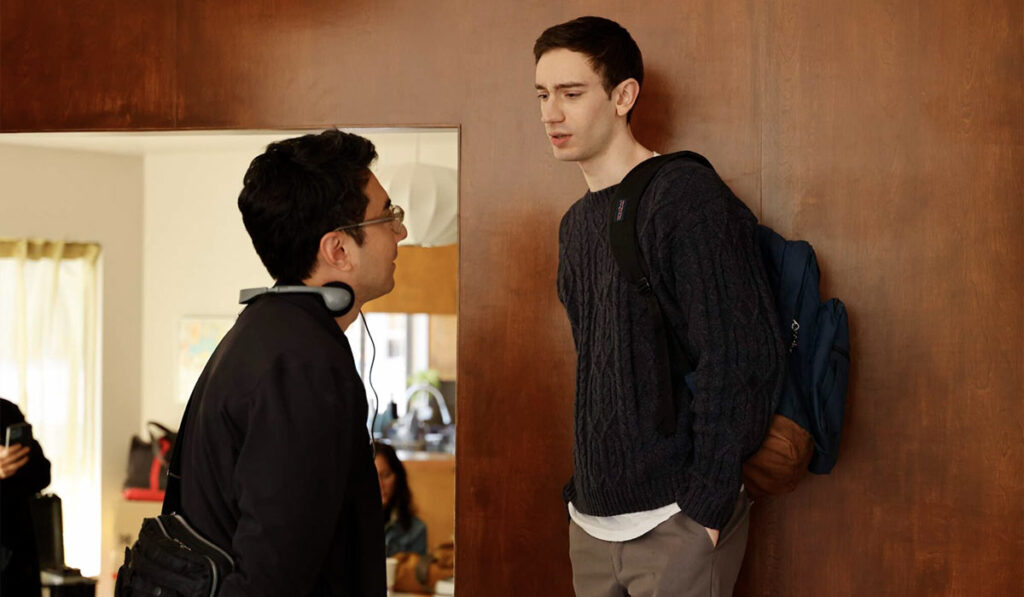
Set in 2018 Los Angeles, “Lurker” follows Matthew (“Becoming Karl Lagerfield’s'” Théodore Pellerin), a twentysomething retail worker with much higher aspirations who finds his way into the social circle of a bubbling up pop artist, Oliver (“Saltburn’s” Archie Madekwe). Intrigued by his artistic choices behind the camera, Matthew experiences the adoring spotlight of a charismatic music star up close and personal. When that begins to fade, Matthew makes some unexpected choices. It’s partially a story many in the music industry have seen time and time again. But then also, it isn’t.
We’re not sure what Russell will direct next, but we’re hoping cinephiles don’t have to wait as long as the four years to get “Lurker” made after it landed on the prestigious Black List in 2020.
Oh, and make sure you see it in theaters.
____
The Playlist: Alex, congratulations on the movie. I’ve been a fan since S,undance, and I’m so glad people are finally getting to see it.
Alex Russell: Yeah, it’s very, very surreal. It’s very weird.
What’s the weird part about it to you?
Just that it’s becoming real, I guess. Just that it’s a real movie and I can see a poster at an AMC, just so it’s unbelievable. And I don’t know, it’s like sinking in now, I guess, but it feels crazy.
I read in your statement that you first had the idea for this in 2020 during the pandemic. That script ended up on the Blaclist. A lot of time passed until you shot it. Were you worried at all that the internet, the fandom culture, the internet culture, the social media culture had changed at all?
No, because even when I wrote it, it was meant to be period. So, I was already writing it in a 2017 sort of era, or I was writing in 2020 as a reflection on a few years ago. So, it actually takes place in 2018, technically. And I just felt like crystallizing it, anchoring it to that time, would allow me to just do what I was going to do. And if more time passed, then it would feel like a time capsule or something.
Were there any specific choices you made for that era that are specific to the time?
Well, it was more about stuff that I didn’t do. I didn’t have to deal with COVID or TikTok or anything like that. And I think that anytime you’re trying to do something modern or zeitgeisty, that it’s trying to hit the mark exactly as it’s happening, you’re always going to miss. So, I think you don’t know when you’re in the eye of the storm what’s kind of emblematic of that era necessarily. And also, it just will feel really dated if you are trying to catch up to the lingo of the time. So, I think setting it in a year where I’m like, “O.K., enough time has passed where I still get that time. I get what it felt like to be pre-COVID Trump era, and that’s just what it was to me.” That’s kind of how I anchored my psychology to the writing of it. I think otherwise I would’ve just gotten lost in the minutia and just so wasn’t about the, it is just so not about the TikToks or whatever the details of the time, it’s about the relationships between the characters, and I just needed to make the world around it feel real.
In terms of the music, did you want it to sound like that era, or was that less important?
Totally, totally. I feel like the music is very 2018 in a way where it’s like, I wouldn’t even be able to tell you what music is like now, but I do feel like Oliver’s music would just fit in perfectly in a 2018 Spotify playlist.
How many songs did you make for the movie?
I think there were four.
How did Kenny Beats come your way as the musical supervisor?
We’ve been friends for a long time, and it was always kind of like if I got to make something, then he would either do the score or the fact that we had original music for this. It was so easy for just us to link up and do all the original songs and do all the score. We sort of have a shorthand about music in general because we just talk about music. And Kenny also has this strange ability to basically be able to make any kind of song of any genre. So, I knew I was in good hands, just being like, he’s kind of like this, maybe, but also just do what you want. And when I sent him to the studio with Archie, it was just a couple of days, and then we had all the songs for the movie.
On first viewing, would you say Archie is sort of a young version of The Weeknd, a little bit? Or did you have another archetype of what Oliver’s character was in terms of as a music star?
There wasn’t one in particular, but I’m really glad that everyone has a different idea of who the main archetype is. And everyone was like, “It’s definitely about this guy.” It was like, “No.” It was important that I disguise the influences so that it felt like a character that could live among artists that people name, but isn’t sort of one-to-one.
But also, you specifically made it so that Oliver’s character is not at a headlining Coachella level. Maybe he’s an undercard, maybe he’s bubbling up. Was that the idea?
Exactly, yes, exactly. I mean, for a few reasons. One of which is that you want to feel like there’s room to grow. You want to feel like a goal of his could be headlining Coachella, and that there may be a number of things in the way of that right now, but you could tell that’s probably something he wants. And I mean, there’s a practical reason, which is making an indie movie. It’s going to be easier to shoot a concert with less than a thousand people in the audience. And I think just the smaller insular DIY nature of this group of friends, he’s still small enough of an artist and a homemade feeling. He can still just have his friend shoot his video, and it’s not going to be like there’s a thousand people involved. And I think that’s part of his appeal and part of what makes him feel somewhat accessible and relatable to someone like Matthew. It is like this person’s just doing whatever they want. This person’s making his music in his bedroom. What if I was in there with him?
You also wrote about how many of your friends are actually in the music world as opposed to the movie industry, which, by the way, is wild to me as someone who’s lived in LA. Usually, it’s very rare for those worlds to sort of intersect. Was their opinion that it was authentic as important to you as any critic review or industry take?
Definitely, but it was not even a question of authenticity. It was really more a matter of “Can I make this a real movie?” I think this is the kind of movie that lives and dies on authenticity. And that if you don’t believe it or Oliver doesn’t feel like a real artist or the way that they’re doing things doesn’t work, you don’t buy anything. So, it was one of those things where I had all the necessary knowledge to make something authentic, but sometimes you’ll see something that sacrifices the authenticity for the story or vice versa, where you’ll have a movie that’s really authentic to youth culture or whatever, but it just is kind of meandering. It doesn’t really go anywhere. Or you’ll have a really high-level structured drama that sacrifices the authenticity and the setting because they don’t know that world. So, I wanted to marry those two things as best I could. And in the first half, you kind of feel like a lot of it feels pretty off the cuff, pretty just guys hanging out, and then the intensity of the drama sort of starts to reveal itself in the second half.
So many scripts make it to The Blacklist, and people love them, and industry even people rave about them, and they never get made for 20 million reasons. Did the fact that you had success with “Beef” and “The Bear” get this across the finish line? Is that how you finally got financing?
It didn’t hurt. It’s hard to tell why things happen.
Exactly. O.K.
But I think it even indirectly probably lent some legitimacy to my operation, especially because I hadn’t directed anything. And it’s not like these things necessarily translate to expertise in directing. In some cases, they’re probably opposing skills, but I think it’s always helpful to be a part of something someone has heard of. And yeah, I think a lot of things started to align by the time I was fully getting it over the line.
At what point did you decide you wanted to direct it? Was that something that had always been a long-term goal of yours?
No. Again, I was saying how surreal this feels. The ceiling for my ambition was being a staff writer on a TV show. I had never imagined anything beyond that until it was put in my head that I could direct this. I actually just had a script, and I was hoping someone else would direct it. And then at a certain point, I had producers tell me, “Actually, you can just do it.” And then I was like, “I can?” And then after that, I couldn’t think about it any other way. And now knowing what it is, it makes sense that I was the one to do it just because again, all the details are something that I have a personal sense of and the sensibility about, I think what makes the movie work sort of moment to moment are they’re subtle things the way a line is delivered or a glance between two people. And I think that’s all an extension of the script that was in my head that may have been interpreted differently by a different director. But long story short, no, it was not at all a part of my ambition. But I mean, there’s no one else who even wanted to direct it, so it wasn’t, it was me versus someone else, it was just me versus the f**king movie doesn’t get made. And luckily, I really was able to just lean on so many people who did know what they were doing, that it made me look like I kind of knew what I was doing, but in reality, I just hired people and cast people.
Which is part of being a director anyway, to bring the people in.
I think it’s most of it.
Do you have the directing bug now?
Absolutely. [Laughs.]
He’s like, “Yes, I have it so hard now.”
And I don’t know if I felt it until I was fully in the edit. There were times when I would wake up at night because I wanted to shift something 10 frames to the left. And that’s when I was like, “Oh, O.K. If I care about this thing, then I guess I am a director.” I feel like the true writers, they just write the script, and they’re like, “I actually am done. Whatever you do, if you betray it, if you execute it on the highest level, I have nothing to do with that.” But I do actually care about every part of the process right up until the very, very last moment that I’m allowed to. And I think that’s probably what the bug is.
I don’t want to spoil the end of the movie, but there’s sort of a twist sort of at the end. And was that something you found organically? If you can remember, where did that come in the gestation of writing it?
Yeah, I can remember because it wasn’t all at once. I think there was a version of the ending in the script where we don’t want to spoil it. [Discusses major spoiler at the end of the film.] And then I was like, “O.K., that’s it. I’m putting that in.” And then the way the actual, and I loved when I thought of it, I was like, “That’s exactly what I was hoping for, because it says it all without having to go through that whole sequence of scenes just seeing [redacted].” A slight inspiration was the end of “Succession” season two, where Kendall goes up there, and he’s been kind of tail between his legs the entire season. And then you just think he’s about to whatever, throw this press conference thing away. But as he’s talking, then all of a sudden he’s like, “My dad was fully aware of all of this, blah, blah, blah,” and “I have the evidence.” And then you cut to Logan, and he’s watching this on the screen.
Yes.
It’s almost like there’s a tiny smile for me. And that implication was so interesting to me. But again, the fact that it ended up taking as long as it did to get made allowed for some of these small revelations to happen, and it would’ve been like a clunkier, I think, version of the ending if it got made easily.
“Lurker” opens in limited release on Friday
Follow Gregory Ellwood on Bluesky
Follow Gregory Ellwood on Threads
Follow Gregory Ellwood on Instagram
Sign Up For The Breakdown Newsletter


