


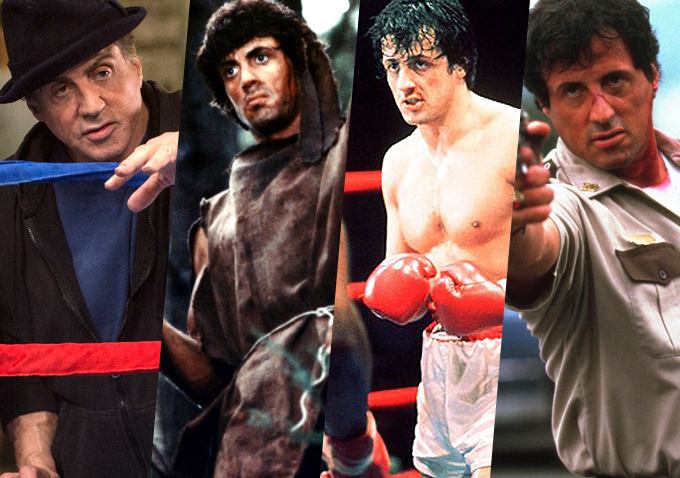
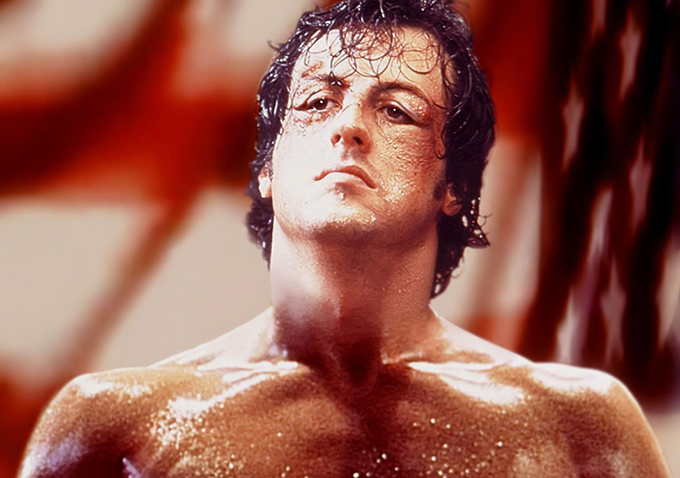
“Rocky” (1976)
“People say ‘Rocky’ is realistic, but I don’t want realism, I want romance. In a way, the movie’s like a classical symphony where it involves you, it hooks you and then it builds to the big finish, the monstrous lancing of the musical boil. That’s my formula.” That’s Stallone talking to Ebert in this aforementioned interview about the formula that helped him create a legendary franchise and turned him into a star. He wouldn’t sell the screenplay until United Artists agreed to let him star as the story’s down-in-the-dumps central figure, and the result is Stallone’s idealism, romantic simplicity, and raw emotions whipped into shape for a heavyweight winner. On a budget of just under a million, the film went on to become a box-office behemoth, earning over $250 million worldwide and becoming the highest-grossing film of 1976. Stallone was nominated at the Academy Awards for Best Actor and Best Screenplay — the only other two people before him to share dual nominations for the same film in those categories were Orson Welles and Charlie Chaplin. In his initial 4-star review of the film, Roger Ebert said that Stallone reminded him of “a young Marlon Brando” and likened Sly’s performance a spiritual companion to Brando’s in “On The Waterfront.” The film spawned a franchise of five sequels, and will be extending its legacy this Friday with “Creed,” the story of the son of Rocky’s greatest foe. But the one in which the infamous Apollo Creed (Carl Weathers) gave Rocky a chance at the title, when Rocky first met Adrian (Talia Shire) and they shared a shy moment before a kiss, where he ran up the steps of the Philadelphia Museum of Art (today known as “The Rocky Steps”) and punched frozen meat as part of his training — this is the one that put Stallone’s name on the map. He showed the world what tremendously sensitive talent lies underneath the gruff exterior in a role that will forever define his career, and rightly be considered the greatest he’s ever pulled off.
“F.I.S.T.” (1978)
Between etching his permanent mark on Hollywood as Rocky Balboa in “Rocky” and “Rocky II” (1979), Stallone co-scripted and starred in this sentimental labor-union story loosely based on Jimmy Hoffa‘s Teamsters. While “F.I.S.T.” sounds like a great vehicle for Stallone to rip off shirts and punch some faces in, it’s a film that, in reality, sees him easing back on the violent action that would be later stapled to his name. The acronym deceptively stands for Federation of Inter-State Truckers, a union designed by Richard Herd‘s Mike Monahan who sees in Stallone’s disgruntled and rebellious Johnny Kovak a true leader of the people. Handling as much injustice as he can take on the loading docks, Kovak leads a riot against the oppressive regime in Depression-era Ohio, which is all the proof Monahan needs before inviting him to create the union. The film’s three-act structure, which at one point leaps ahead in time by about 20 years after F.I.S.T. becomes a two-million-member organization, makes Norman Jewison‘s direction haggard and thinly spread, but the greatest joy one gets from the experience is, indeed, embodied in the blue-collar poise of Sly Stallone, hiding traces of a subdued bellicose nature. His Kovak is partnered with David Huffman‘s Abe, pitted against Peter Boyle‘s impulsive Max Graham, forced into cahoots with Kevin Conway‘s local gangster Vince Doyle, and finally made to battle it out in a hearing opposite Rod Steiger‘s Senator Madison. It’s an impressive string of character actors, and Stallone more than holds his own against all of them. Whether talking about cutting balls off in private meetings, or riling his workers up by utilizing the four letters to their empowered convenience, Stallone shows robust conviction as a leader, during a time when he could’ve just as easily focused on playing just one type of boxer.
“Nighthawks” (1981)
Questions surrounding “Nighthawks” quickly morph into some variation of, “Who wouldn’t want to see Sylvester Stallone running after perps in drag?” Not only are we privileged with this comical gem of a moment in Stallone’s career, but we also get to see him sporting the greatest beard of his acting career as NYPD detective Deke DaSilva. Okay, so it’s no “Serpico,” but there is a certain sense of ’80s relish, a mix of nostalgia and contextual curiosity in the way people acted and dressed, that makes “Nighthawks” something of a cult classic. An obvious help is watching Sly Stallone described as above, partnered up with Lando Calrissian himself, Billy Dee Williams, and going against a German terrorist by the name of Wulfgar who is portrayed by a gentlemanly Rutger Hauer (sporting a hip beard himself in the early parts of the story). DaSilva gets trained in the ways of A.T.A.C. (Anti-Terrorist Action Command, yet another memorable acronym for Stallone to work with) by Nigel Davenport’s Hartman — a lieutenant who looks and talks like he should be discussing the effects of photosynthesis and not terrorism. DaSilva and his partner Fox (Williams) go after Wulfgar after the baddie relocates to NYC. This is now the immediate pre-“Rambo” phase of Stallone’s career, and it’s fascinating to watch him play one of his earliest law enforcers with such puppy-eyed zeal and restraint before personifying the iconic action character who goes off the boil so violently. Take that scene in the subway when DaSaliva has a shot of Wulfgar, but hesitates and doesn’t take it, as proof of something John Rambo would never, ever let happen. On-set stories of Stallone’s clashes with Hauer ended up being exaggerated (boo!) but the on-screen tension the two wrack up might make you think otherwise, making it worth the rental price alone.
“First Blood” (1982)
“Cobra” (1986)
Before the decade was over, and before the system began its failed attempt to market Sly Stallone as a comedic force (like with the dire “Stop! Or My Mom Will Shoot“), the ’80s would bear fruit to what could be the most memorable so-bad-it’s-good Stallone action vehicle. Written by Stallone, “Cobra” follows an LAPD Zombie-Squad officer used as a last resort by regular cops who can’t handle the intensity of the job. Wearing airtight jeans and a black V-neck, sporting signature Aviator sunglasses, chewing on a matchstick, driving around in a modified 1950 Mercury with license plates reading “AWSOM,” and cutting pizza with scissors like a fucking boss, Marion Cobretti (Stallone) was born to become Cobra. Just to put it into perspective, this project came about after Stallone resigned from working on “Beverly Hills Cop” because it was too comedic for his tastes. The result is a film that he might not have thought comedic on paper, but that’s become regarded as something of a cult classic partly due to the laughs it generates when it comes to the dialogue (please, “crime is a disease, and I’m the cure” isn’t the film’s tagline for no reason), the music (Robert Tepper‘s ‘Angel of the City’ number is allowed to play in full over an unforgettable montage featuring, among other things, a photo shoot with robot mannequins) and the bizarrely insane villains screaming about a New World Order. Brigitte Nielsen‘s Ingrid Knudsen becomes a target, and Cobra is assigned as her protector; the pair’s stoic acting styles complement each other in sizzling B-movie campiness. A magnet for the Razzies at the time, “Cobra” is beloved by many Stallone diehards and is famously praised by Nicolas Winding Refn. Re-watching it reminds you just how much of an inspiration it was for “Drive,” in terms of its neon-velvet aesthetics, wardrobe, and killer attitude.
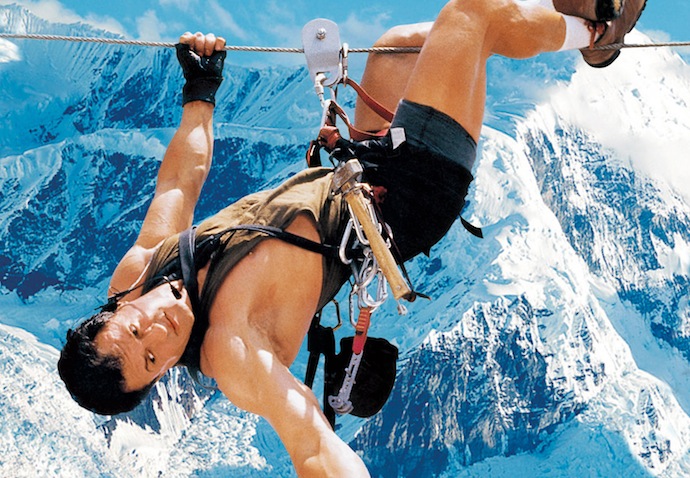
“Cliffhanger” (1993)
Featured in our mountain-climbing feature as a “sublimely, gloriously stupid” piece of work, “capturing a time in American culture when Stallone wasn’t an over-the-hill action hero falling back on his ‘Rocky’/’Rambo’ mythologies to draw a crowd,” “Cliffhanger” is a favorite among Sly fans, and certainly one I remember immensely enjoying as a kid. John Lithgow‘s cantankerous villain Eric Qualen is one of the most immensely enjoyable foes from Stallone’s rogue gallery, and that unpredictable opening sequence featuring Michelle Joyner as the ill-fated Sarah packs enough of an emotional punch to last over the entire running time. Conveying that presence is Stallone’s Gabe Walker, who handles the memory and carries the guilt around with the kind of intensity that became the actor’s signature by the early ’90s. With multiple “Rambo” and “Rocky” sequels behind him, “Cliffhanger” was breath of fresh (mountain) air in terms of Stallone’s filmography, a film set in a rarely tested environment for action, and — according to Stallone himself — something of a comeback role after a few box-office duds. Gaining 20 pounds of muscle and pretending like he totally doesn’t have a fear of heights, Stallone’s Gabe is an ex-mountaineer conned into helping a troupe of nasty villains locate suitcases full of money. It’s unabashedly silly in plot, narrative, and all its efforts to tick every box of possible mountain deaths — including Stallone grabbing a villain’s balls and impaling him on a stalactite. Take all of that and add the physical theatrics and pure-hearted displays of heroism, and you’re obviously dealing with an essential Stallone picture.

