




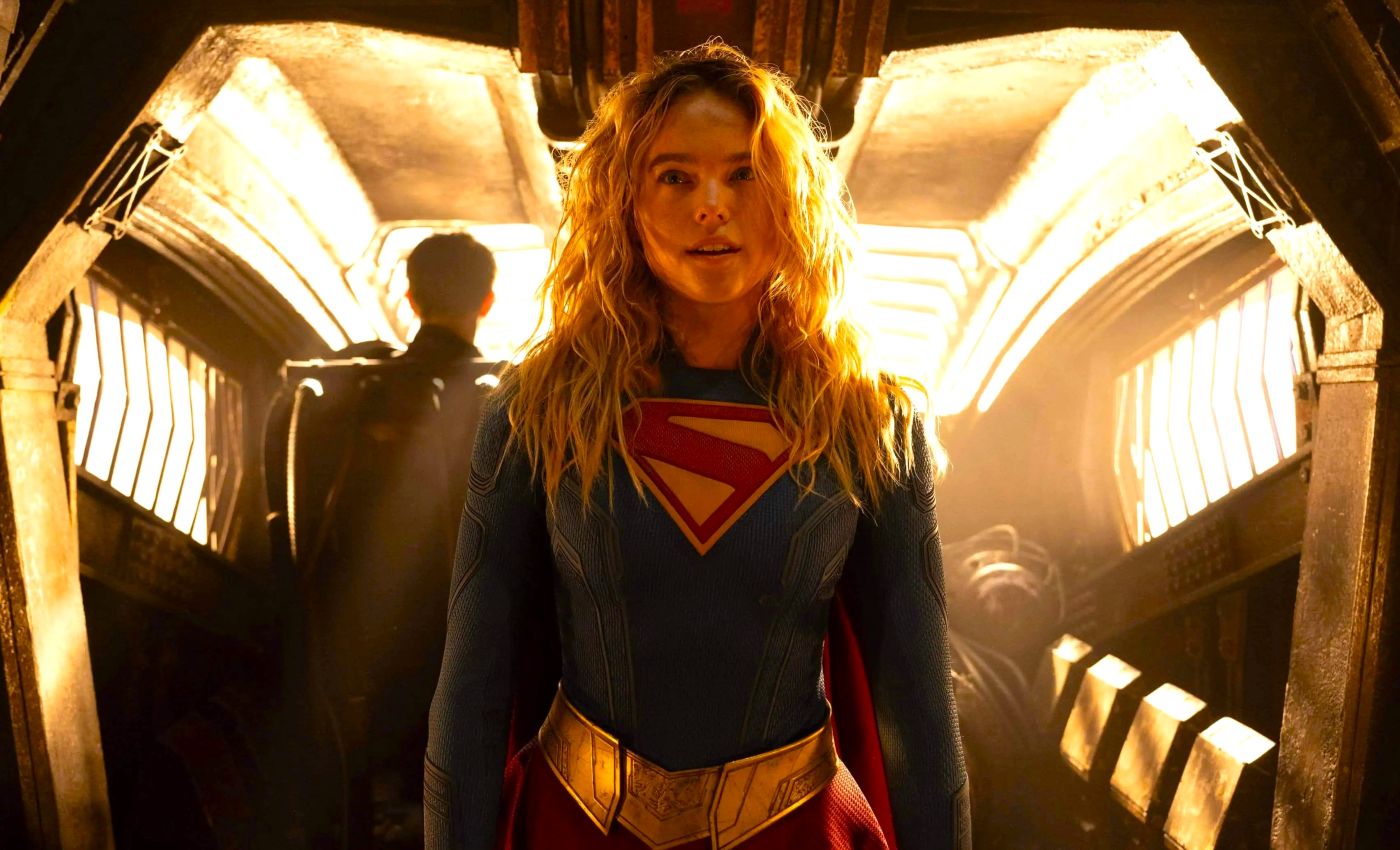
The power of brushing things off is strong with Kara Zor-El (Milly Alcock). Away from her Earth-saving cousin Clark (David Corenswet) in another, far more arid and grungier planet, she drinks, sleeps till late, and cares for the adorable Krypto. Alcock’s spunky and humorous nonchalance, which stands in direct opposition to Superman’s self-serious dutifulness, is director Craig Gillespie and screenwriter Ana Nogueira’s most precious asset in “Supergirl.”
The new chapter in the Super-saga that James Gunn’s “Superman” kicked off last year is set in motion when Kara’s self-imposed isolation and procurement of as little responsibility as possible are threatened when a villain poisons Krypto. There’s no more pressing motivation for her to get involved than keeping the rambunctious pup alive. And she only has three days to travel around the galaxy and obtain the antidote from intergalactic mercenary Krem, played by a nearly unrecognizable and unserious Matthias Schoenaerts under a wild facial design.
As a side effect of her own plight, Kara will begrudgingly forge a sisterly alliance with Ruthye (Eve Ridley), a teenage girl seeking to avenge her family, whom Krem killed. That selfish impulse — Kara cares first and foremost about saving her pet — and the air of cynicism and skepticism that Alcock’s Kara expresses about others, and about herself, offers an intriguing, if not entirely unique, shade to the now overdone tropes around superhuman paladins. In Marvel terms, she is more Tony Stark than Steve Rogers. If only the events that unfold in “Supergirl” and its narrative structure could sustain what’s appealing about her.
Flashbacks to Kara’s departure from Krypton and her initial arrival on Earth provide context for where we meet her emotionally and for her seemingly apathetic attitude, but they also feel reductive and formulaic. These passages quite literally pull you out of the action and create a parallel, much less compelling timeline that touches on expected beats of the tragedy that forced her departure from Krypton. These scenes could have been replaced with a few lines of present-day dialogue. They’re trite exposition vehicles.
What’s commendable is the use of practical makeup and costumes for many of the alien creatures that Kara and Ruthye encounter. One’s eye can recognize when there’s a human under a mask or in a body suit, and that’s a positive. There’s a tangible, perhaps less sophisticated quality to these characters that is welcomed. They have a charm that’s distinct from their hyper-polished, visually pristine CGI counterparts. Some of us appreciate knowing that handcraft was involved in transforming an actor into a fun extraterrestrial.
And then there’s Jason Momoa as Lobo, a cigar-smoking biker outlaw with glam-rock-like black and white paint on his face, whose presence adds star wattage to the picture more than comedic power. Not sure one would notice had he been absent. His interactions with Ruthye, whom the young Ridley plays with an almost regal solemnity, earn a few chuckles based on their disparate demeanors: Lobo is a pleasant brute, and she is a girl on a mission.
The film’s attempts at making an empowering feminist statement beyond the obvious prowess and fearlessness of its protagonists feel shallow and limited to a line where Ruthye questions why Kara’s alter ego is Supergirl and not Superwoman. It lands like an ultra-simplistic estimation of how heroism is admired or perceived in men and women. Another line, also from Ruthye, that declares Kara is kind without needing to be nice, does a better job of pinpointing what makes this Supergirl exciting: she lacks the desire to dedicate her existence to altruism. Through supporting Ruthye, Kara’s arc results in recognizing that even if she doesn’t want to save humanity, she might enjoy being part of it.
Needle drops abound — a slow, dramatic reinterpretation of Jimmy Eat World’s “The Middle” during a slow-motion melee is a standout — yet most choices fail to innovate on the visual elements that have previously populated space odysseys or tales set in fantastical wastelands. Comparisons to “Mad Max: Fury Road” only hurt “Supergirl.” From Krem’s outfit that resembles My Chemical Romance’s attire during “The Black Parade” era to the alien watering hole where Kara and Ruthye meet Lobo, most environments read like a replica of something more interesting done before. Visual personality is in short supply, regrettably.
Still, for a film introducing a heroine whose story is tied to and derived from the prime superhuman, “Supergirl” is mildly enjoyable, if only because of Alcock and Ridley’s banter, Krypto’s scenes, and the few exchanges between goody-two-shoes Clark and the less uptight Kara. By-the-numbers, as the movie turned out, Alcock does capitalize on it to showcase that she possesses the makings of a promising star capable of portraying a character with sharp edges and complicated feelings. Hopefully, she can now fly elsewhere from here. [C]

Freelance Film Critic/Journalist in LA


