





Emmy season can be a strange bird. Shows that shot almost two years ago and aired last summer are up for Emmy consideration now. That is the case with “The Gilded Age,” whose third season debuted almost 12 months ago. But it’s a testament to the Julian Fellowes production that fans are still waiting with bated breath for the fourth season. Especially following a knockout and “shocking” finale. A finale that featured star Morgan Spector front and center.
READ MORE: Morgan Spector has seen scripts for “The Gilded Age” season three but isn’t spilling [Interview]
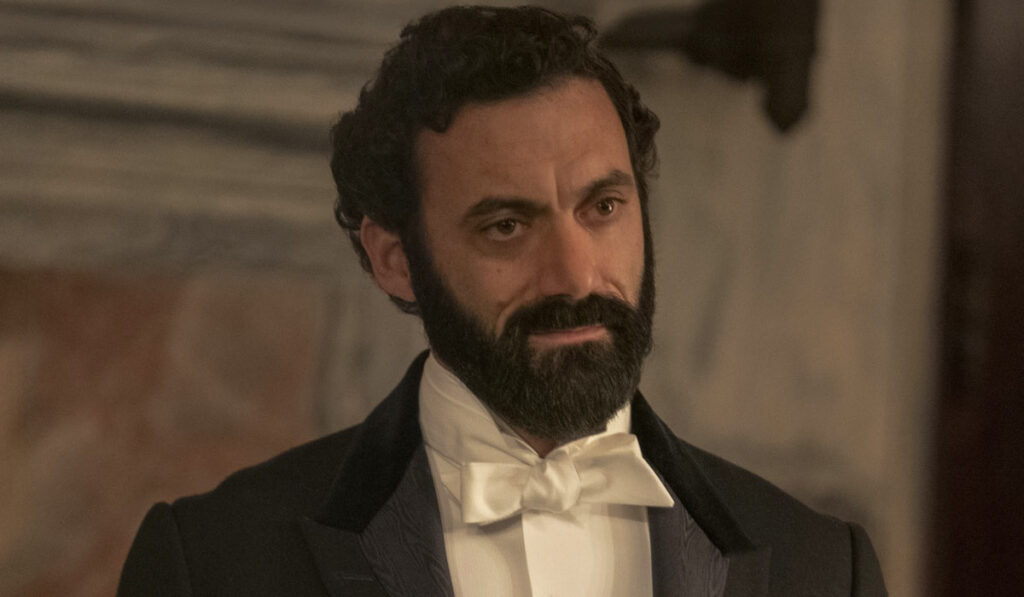
As industrialist George Russell, Spector has been put through the wringer over the show’s first three seasons. This last year saw George’s wife Bertha, portrayed by the incredible Carrie Coon, go around his back and essentially marry off their daughter Gladys, played by the talented Taissa Farmiga, against his initial wishes. But that was just the tip of the iceberg narratively and something Spector appreciated as the series matures.
“I think season three was the season where it was like ‘What if ‘The Gilded Age’ but also plot and stakes?’ And not to denigrate the earlier seasons,” Spector says. “I think they were really good, but I think they were really built around character and these pleasurable conversations and drawing rooms. And season three was sort of like, ‘O.K., now you know these characters, you’re invested in them, we’re going to start to take them out of their comfort zones a little bit.’ And I think it was really good for the show. I think it was easily our most exciting season.”
During our conversation late last month, Spector avoids any spoilers about season four, currently in production, but explains how he and Coon approached that final scene and much, much more.
Please note: There are spoilers regarding the third season of “The Gilded Age” in the context of this interview
This interview has been edited for length and clarity.
_____
The Playlist: So, I’ve had the pleasure of speaking to both you and Carrie previously. Correct me if I’m wrong, but they give you guys all the scripts beforehand, but did you know what George was in for at the end of this season before the season started?
Morgan Spector: No, I didn’t. I think it has varied over the course of the years. But yeah, my memory is that we didn’t have the last two episodes before we started shooting the season.
So, when you got to episode seven and saw that George was shot, did you do a double and say, “Do I have to find out if I’m still on the show?” Were you worried at all?
It’s funny. I assume if I was going to die, they would’ve told me at the same time. You know what I mean? I’ve died in shows before and typically a classy showrunner will be like, “Hey, you’re done. It’s not because you suck. It’s because the story reasons or whatever.” And yeah, so that’s been my experience of getting killed off on a show is that they do tell you because everybody understands it’s the end of your job. But yeah, so that didn’t happen. So, I wasn’t actually worried that George wasn’t going to pull through.
But before you began filming, did showrunners Julian Fellows and Sonja Warfield at least give you a heads up like, “This is where we’re seeing George and Bertha going over this season”?
No. Whether they want us to be or whether they just don’t know yet, I don’t know. But I think the other thing is everybody loves to keep actors in the dark because they don’t want us to get attached to things and then start whining if we don’t like what they do. So, they don’t tell us until the thing is finalized. But yeah.
Out of all the scripts this season, was there one that you got that got you excited?
I mean, I think season three was the season where it was like, “What if ‘The Gilded Age’ but also plot and stakes?” And not to denigrate the earlier seasons. I think they were really good, but I think they were really built around character and these pleasurable conversations and drawing rooms. And season three was sort of like, “O.K., now you know these characters, you’re invested in them, we’re going to start to take them out of their comfort zones a little bit.” And I think it was really good for the show. I think it was easily our most exciting season. And yeah, I mean, something like George getting Shot, it introduces an element of real danger into the show because you think, “O.K., well, maybe anything can happen here.” And that is exciting. That’s a more exciting world to be in on any story.
Then, in fact, anything can happen because at the end of the season, George decides to leave Bertha. Well, we are assuming he’s left for good or for the moment. Knowing who your character is somewhat based on, did you see this coming at all?
Well, my character, in terms of who he is and how he operates in the world, I think he’s more based on Jay Gould than he is Cornelius Vanderbilt. But narratively, we’ve been very intertwined with the Vanderbilts in terms of story. So, they can sort of pick and choose what they want to do, and they also don’t have to be faithful to either story. I mean, it’s totally made up. This is not a guy that’s real. They can play with those amalgams, and they can do whatever they want. I think that even from the end of season two, where Bertha and George have had a conversation about Gladys’ future and then Bertha goes off and makes this agreement with the Duke without consulting George, I thought that this was going to be a big problem between them because George felt one way about it deeply and she felt another way about it deeply. And those are difficult conflicts to resolve. So yeah, I don’t think I was totally surprised that they didn’t figure it out by the end of season three, given how fresh it all was.
So you weren’t surprised that they didn’t wait for that for enough season four or down the road. It made sense that it would happen at this point.
I mean, yeah. It could have gone either way. I mean, he’s had this near-death experience. I think that could mean all I want to do is go back to my wife and fix my family. And it could mean I’ve actually suddenly been introspective and looked at my life in a deep way for the first time maybe ever. I mean, I don’t know if you saw that video of Mark Andreessen, the venture capitalist, talking about introspection, and he was like, “No, I never do it. I don’t do that.” And it’s a waste of time, and that’s not the life I’m leading. I keep going forward. And I think it was really striking. And it’s a striking admission, I think, but it made me think of George because I do think in some way, this is the guy who just keeps going forward and losses vanish in the rearview. That didn’t happen, and it’s just “this.”
But you could make the argument based on some of his decisions that, unlike many of the billionaires or super wealthy today, he does have some moral standards that others don’t. Am I wrong in making that assumption?
No, I think he absolutely does. But I’m sure a lot of the people that you’re talking about also have a moral framework that allows them to see themselves as moral beings, I think, because everybody does. I mean, that’s the thing. As much as we want to think, “Oh, this person is a sociopath or this person is immoral or this person…” The vast majority of people are not like that. They have a framework within which they’re operating where they’re able to think, “O.K., what I’m doing is, if not good, then at least I’m doing the best that I can in the circumstances.” I mean, if you’re the head of a corporation that is legally mandated to maximize profit, you are driven by an incentive structure that does not permit moral behavior particularly. That is a fact. So, they can look at their lives, and I think reasonably say, “Well, what am I meant to do? This is my obligation here.”
Going down that road, what was so interesting about the show, though, and I know I don’t think this was ever the showrunner’s intention, but it has in many ways mirrored what is currently occurring in society.
Absolutely.
But I know what happens next in history in this era, in this Gilded Age. And I’m curious, I don’t know if you guys are shooting season four yet or if you’re anywhere close to finishing…
Somewhere in the middle. Yeah.
So, I’m not asking for spoilers, but in theory the series would start to tackle the pushback in the late 1800s to this Gilded Age from unions, even more than it had been before, and some of these super wealthy trying to stop legislation against them. Does that come up at all? Because that’s basically what’s happening now. I don’t know if you just saw, but they just got 1.5 million signatures in California for the billionaire tax on the November ballot.
Awesome.
Do you see this show going that direction or is it a little more on its own?
I mean, I can’t really tell you. [Laughs.]
I know. O.K.
Yeah. I mean. Look, Julian, when we got that script where I get shot, I was like, Julian predicted Luigi Mangione. How did he do it?
Oh yeah.
But that was also happening in that period. There were these anarchists who believed in the propaganda of the deed, and there were all these things that were happening all over the place. But yeah, I mean, there is pushback, and yeah, I think we probably will get into that, but yeah, I can’t really get into it.
Can you say if you’re happy with the scripts this season four?
Yeah, yeah. I love this season. I think it continues to build on what we did last year. It continues, the sort of human stakes of the world continue to be high. The great thing about a Julian Fellowes show is he builds these huge worlds with tons of different characters, and you get attached to all of them in different ways. And so every few minutes you can be checking in with the highs and lows of a human being that you have come to care about after several seasons. And so yeah, I think we pick up right where three leaves off and continue that trajectory.
Speaking about where season three leaves off, that breakup scene with Bertha pleading with him not to go is one of the most memorable moments of television for me over the past year. And this is the best compliment. It’s so borderline camp, just borderline. You both know what you’re doing, and it’s purposefully close. It’s still grounded, but it’s still like a little wink, a little bit. And I’m wondering, did you guys talk about it beforehand? Did you realize what it could be, or was it just another scene that day?
It was not just another scene that day. It was a scene that we had to figure out a little bit on the fly collaboratively because there were things about … Because we don’t know if we’re going to ever get another season. So that scene was the scene where it was like maybe Carrie and I are saying goodbye to these characters. Maybe these characters are saying goodbye to each other. So, we just wanted to make sure we left it somewhere, and it was written. It was there. It was just like we were doing little massages, little tweaks on it on the fly that day so that we both felt comfortable like, “Hey, if we never see these people again, O.K. They said their piece to each other kind of.” But that quality you’re describing, that’s the joy of the show, you know what I mean? It can’t live from a performance standpoint. It can’t live in verite groundedness. It has to lift a little bit, but you don’t want to feel ridiculous performing it, and you also want to feel like you’ve given it some guts and a body and some stuff. So, that’s the balance. And I think as the show gets more and more stakes and bad things start to happen to these people or continue to happen to these people, that’s the challenge is like, stay grounded, have it be real, but also it is still “The Gilde age” and there is still that little wink because I think if that goes away, then part of the pleasure of the thing is lost for sure.
Going back to that day, you said when you and Carrie were talking, it wasn’t about the staging of the scene, it was about how you guys were emotionally going to handle it. That wasn’t a day where the director was like, “I don’t know how we’re going to do this”?
It was a little bit too text. It was a little bit what’s actually happening. It was a little bit like, “What is it that George can’t let go of and what is it that Bertha thought she was doing? And can these people who are actually so intimate with each other, can they finally speak a little bit more directly to each other about their conflict?” And the trick of that is that they’re not at a place where they can communicate so well that they can actually resolve their conflict because we were maybe leaving them where they were. We didn’t know we had a fourth season yet. We wanted to make sure that we didn’t betray them, because we both love these characters and we both loved their marriage and we both were very proud of the fact that they had this good relationship, this kind of egalitarian, communicative, trusting relationship. And so it was that question of striking that balance of like, “Did we honor that? Did we respect that? And then also did we leave it messy enough that they actually can’t get back to each other?”
Well, I will say fans are super excited to figure out how on earth they even get back together if that even happens.
Me too.
“The Gilded Age” is available on HBO Max.
Follow Gregory Ellwood on Bluesky
Follow Gregory Ellwood on Threads
Follow Gregory Ellwood on Instagram
Follow Gregory Ellwood on TikTok
Sign Up For The Breakdown Newsletter


