


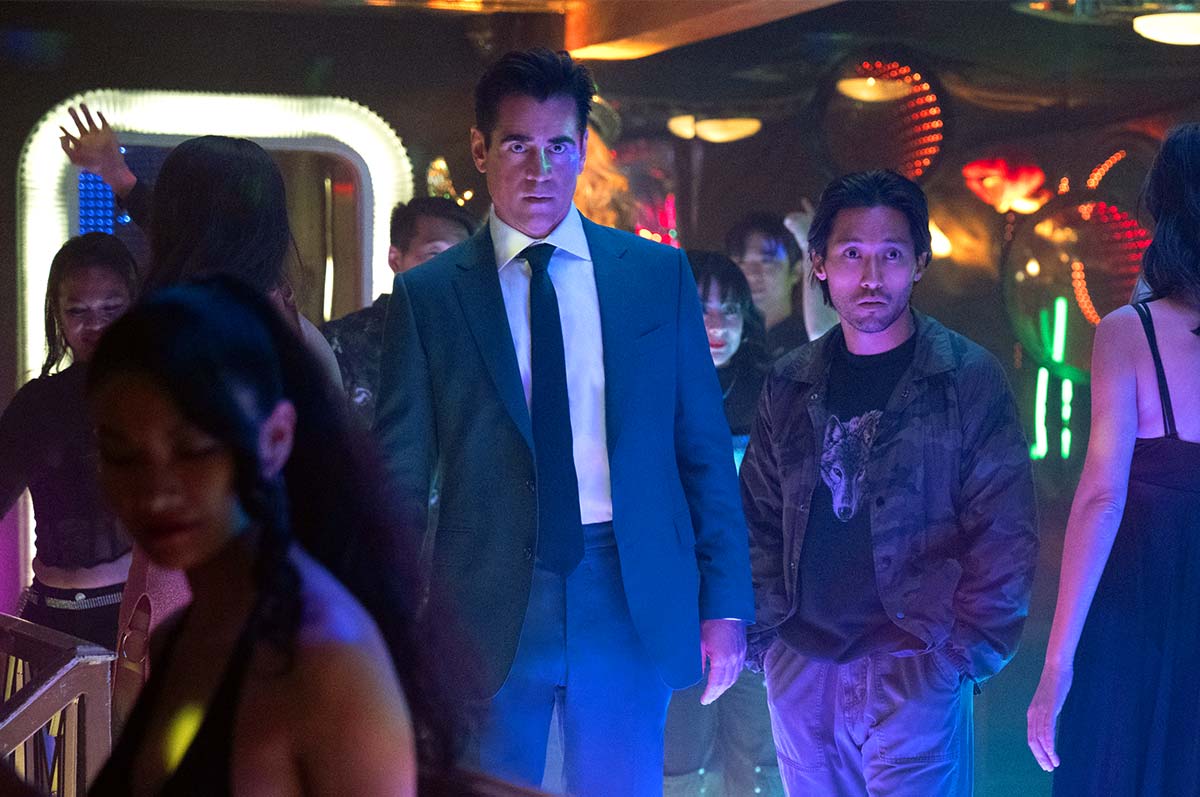
There’s something to be said for how much you can stomach for a single good performance. And Colin Farrell, in possession of his immeasurable star charisma and eclectic range, is very, very watchable. So watchable, in fact, that even after the uneven first season of the Apple TV+ neo-noir mystery series “Sugar,” his innate charm is enough to make you believe that maybe the writing would improve for its follow-up. However, season two struggles to retain whatever interest the first one managed to drum up, despite a more interesting thesis at its center. Created by Mark Protosevich and showrun by Sam Catlin, “Sugar” has the overt style and overarching mystery of gripping, episodic prestige television, but little of the lasting grip.
“Sugar” immediately doubles down on the biggest (arguably preposterous) reveal of season one. Private detective John Sugar (Colin Farrell) is an alien who, along with others, was sent to Earth to observe humanity. However, when the rest of his team follows an emergency directive to leave, John decides to stay. This is partly because he has lost faith in his own kind, but he is also enamored with humanity’s complexities. In pursuit of his missing sister, he starts the season still in the throes of trying to find himself, wondering if he made a mistake by remaining.
For the most part, the series doesn’t stray far from what has already played out. The cast of characters helps, buoyed by new performances from Jin Ha, Raymond Lee, Tony Dalton, Laura Donnelly, Sasha Calle, and Shea Whigham. It’s a shame, then, that so much of the season feels like a wash, rinse, repeat of what has already transpired, just without the late-season reveal of John’s true nature.
The mystery that unfolded throughout the first season felt secondary to its impact on John’s character, both in his connection to the beings he had traveled to Earth with and in the way his proximity to humans, and all of the ugliness that comes with them, began to erode his ability to keep himself separate. “I don’t like violence,” he would often remark, before pummeling a target or finding himself in the middle of a violent standoff. It’s not so much that he grew to enjoy it, but that by the end of season one, he at least understood why humans succumb to it.
The mystery plot in season two, meanwhile, feels as if it could belong to an entirely different show while still letting John taste a sense of absolution and forcing him to further reckon with the insidious ways human nature has rubbed off on him. He tries to protect each of the targets he is helping, even though he was too late for prior victims, and the season keeps testing how far he will go to keep people safe. The case itself is sprawling, moving from missing persons to conspiracies, stolen identities, and environmental weapons of destruction. All of it forces John to contend with whether it is worth trying to help a human race that, in all of its misdoings and mass destruction, has set fire to the very planet he has come to adore.
John finds himself ensnared in the messy lives of two brothers: Danny Moon, an up-and-coming boxer, and his older brother, Ji Moon, whose recklessness has landed him in trouble and forced him to go on the run. The series tries to make us care about the two, but while Ha and Lee are both serviceable in their roles, the mystery is once again an accessory to John’s plight. We care less about the brothers than about how they affect John’s endless pursuit of something more. The same goes for the rest of the supporting characters. Donnelly offers a grounded presence, letting John indulge in more of humanity’s pleasures, with romance becoming more of an option this time around. Dalton provides a strong antithesis to John’s characterization, and he and Farrell create necessary tension. But the character is still flat.
“Sugar” is mostly effective when the camera homes in on Farrell’s face as John reacts to the world with an increasing layer of inquisitive dismay. He’s curious about what’s going on around him while simultaneously put off by what he sees—or what he does.
One of the more glaring issues is that there is rich thematic material to mine from the most basic, fundamental pieces of the story. To the show’s credit, the writing flirts with those ideas, though it often defaults to Farrell’s expressive, wounded gaze to convey much of John’s internal strife. The season is most interesting when it gives itself time to explore the dynamic of an alien who feels alone on Earth. It strikes an intriguing contrast with what we expect from stories involving aliens, perhaps because “Sugar” doesn’t seem especially interested in that idea beyond the outline of its concept.
So often, stories like this look to the stars and wonder if we are truly alone in the universe. “Sugar” turns that premise inward. What happens when proof of galactic life finds itself shouldering the same existential solitude as humanity? As John sits in his empty hotel, or on the edge of the pool, or looks down at the tumultuous, messy lives of L.A. locals, internally admitting that he wishes he had someone to talk to and that he misses his dog, is that greater proof of his assimilation with humanity than his increased proclivity for violence or his adoration of classic film?
As John’s eyes open to the cruelty and horrors inflicted upon the Earth and its inhabitants, the story grows vaguely more interesting. But the pacing keeps “Sugar” from ever becoming true must-watch television beyond the lead performance. There is no doubt that this is a sleek, stylish series that embraces its film noir roots with a reverence that suggests true fanatics behind the camera. Farrell really is remarkable, helping sell some of the show’s most emotional moments. But “Sugar” struggles to maintain interest beyond the big ideas it introduces, too often lost in genre mechanics when it should be spending more time getting to know its supplementary characters. For a series so immersed in what it means to be human, it struggles most to manifest the kind of connection that makes us care beyond fleeting moments. [C]

New England-based Tomatometer-approved film and television critic. Ally is a member of the Boston Society of Film Critics, the Boston Online Film Critics Association, and the Online Film Critics Society. Her writing has also appeared at RogerEbert.com and The Mary Sue.


