


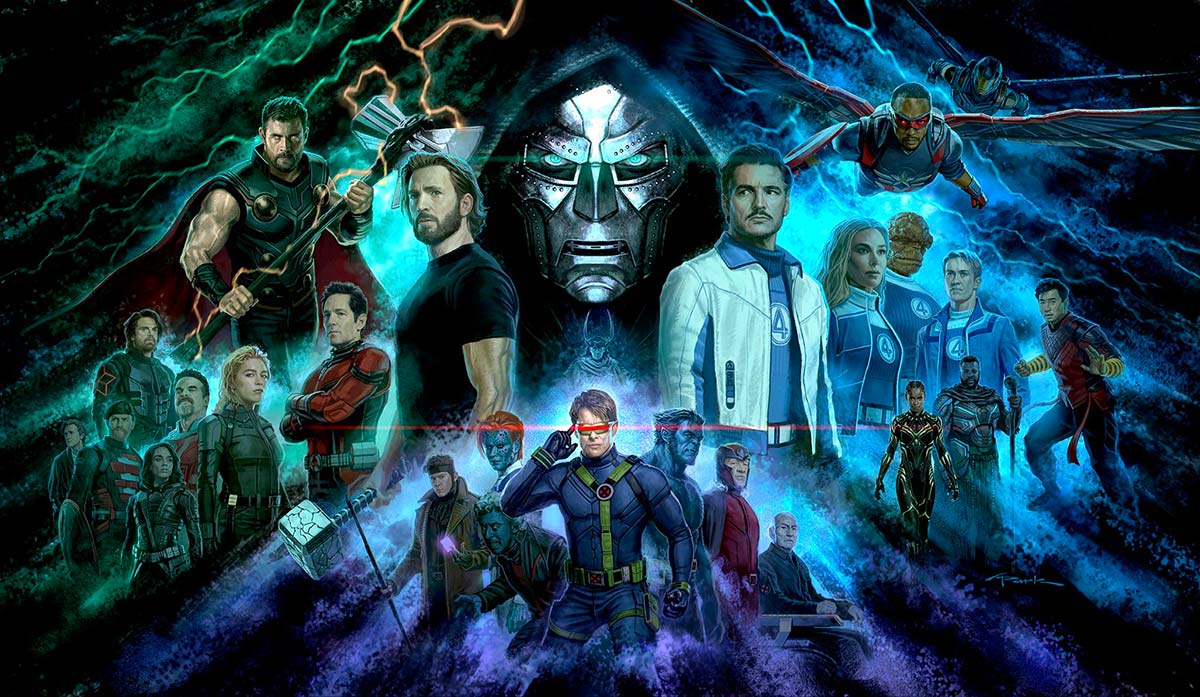
Nearly a decade after “Avengers: Infinity War” arrived in theaters, Robert Downey Jr. and Joe Russo sat down with Comic Book Resources for an extended conversation looking back at the blockbuster—its downbeat ending, Tony Stark’s relationship with Peter Parker, the Guardians crossover, Thanos, and the creative difficulty of balancing so many characters. Inevitably, the retrospective turned toward the much thornier question now facing Downey, Russo, and Marvel Studios: how can “Avengers: Doomsday” possibly follow “Infinity War” and “Avengers: Endgame” without becoming a letdown?
Downey believes the filmmakers have found the “only antidote,” although he naturally stopped short of revealing it. Asked how he is differentiating Doctor Doom from Thanos and the other MCU villains who came before him, the actor suggested that the answer extends beyond his own performance to the film’s structure, its ensemble, and something that will continue into the next Avengers movie.
“I try to feel like I’m in the writing room, but eventually there are so many big shoes to step into that I just have to go, ‘What hasn’t been done as well as it could be done yet?’” Downey explained. “So, we’re always looking for that opportunity. And a lot of it has been some experimentation, and we’ve had our moments of, ‘Let’s shift here.’ But we landed in a place that I think will more than suffice.”
Downey then offered his most intriguing tease, indicating that the filmmakers’ solution is rooted in how “Doomsday” has been constructed and how its characters fit together—not simply in his interpretation of Doom.
“It’s not even about how I executed it. It’s about the way it’s been structured and the other characters,” Downey continued. “There’s something going on in ‘Doomsday’ and forward that is literally the only antidote to, ‘How do you not have these films be a letdown after an “Infinity War” and “Endgame”?’ And boy, have we labored long and hard to bring that.”
Russo acknowledged that “Doomsday” and its follow-up have been harder to make than the brothers’ previous Marvel films precisely because the expectations continue to rise. But rather than attempting to top “Endgame” through spectacle alone, he said the answer was greater emotional sophistication.
“These have obviously been harder than the other ones for that reason, right? As the stakes keep going up,” Russo said. “But emotional complexity is always the answer. You bring emotional complexity to anything, and it enriches it and makes it a fuller experience for the audience. It surprises you.”
Russo then made his boldest claim about “Doomsday,” positioning it as the most emotionally ambitious Marvel film he and his brother Anthony Russo have directed.
“There are a lot of surprises in this, and I think it’s the most emotionally complex of all of them,” Russo added. “In a lot of ways, the most mature of all of them.”
Downey spoke about returning to Marvel with a mixture of pressure and gratitude, acknowledging the criticism the franchise receives when its movies fall short while recognizing how strongly audiences respond when everything works.
“There’s an incredible amount of gratitude we have going into these two—one epic at a time,” Downey said. “‘Doomsday’—just the gratitude to be able to do it, to still be engaging with people who are critical when we fall short, but understand how difficult it is when we get it right.”
The actor also briefly revealed that hearing Alan Silvestri’s Doctor Doom theme on approximately the fourth day of production immediately affected his performance. Downey continued using the music to maintain Doom’s point of view and remain inside the film’s particular tone throughout shooting.
The remarks fit with the Russos’ recent description of “Doomsday” as Marvel’s “phase zero”—a film intended to start the franchise over from scratch without simply leaning on its past. They have also described Downey’s Doctor Doom as a “brand-new character you can’t even guess at,” despite the unavoidable associations created by casting the former Tony Stark as Marvel’s new central villain.
Downey widened the discussion beyond “Doomsday” itself, arguing that Marvel must reconsider how it reaches audiences now that the entertainment landscape has changed from the one that turned “Infinity War” and “Endgame” into global phenomena.
“The whole landscape has changed,” Downey said. “And I think the way we even talk about the legacy of these films and our ambition moving forward is to really zero in on the people that we want to connect with and then let it kind of come out from there.”
Downey acknowledged Disney’s unmatched ability to create what he called a “symphonic effect” around its biggest releases, but said Marvel needs to return to a more fundamental approach—one recalling the uncertainty surrounding the MCU before 2008’s “Iron Man” transformed his career and the superhero genre.
“Disney is the best at the symphonic effect of bringing attention to something, but I think we’ve got to go right back to the beginning,” Downey continued. “It’s almost back to ‘Iron Man’ one: ‘In case you haven’t heard about us, we want you to get excited.’”
Downey did not explicitly say that Marvel has lost its audience, but the implication is difficult to miss. “Doomsday” cannot merely rely on the Avengers name or assume viewers remain as invested as they were when “Endgame” became a global phenomenon. Marvel has to generate that excitement again and convince audiences that another enormous crossover is worth the investment.
Russo similarly described the goal as creating the kind of communal theatrical experience “Infinity War” and “Endgame” delivered—one capable of producing conversation, repeat viewings, and a lasting emotional connection across generations.
“My mission is to just try to deliver the same thing now to another generation,” Russo explained. “We’ve been very fortunate enough, as collaborators, Robert and I, to be able to do this over and over again. And knock on wood, we can do it two more times.”
That last remark obviously encompasses both “Doomsday” and “Avengers: Secret Wars,” which Disney delayed to December 17, 2027. What Downey’s mysterious “antidote” actually is remains guarded, but he and Russo are positioning “Doomsday” as more than an attempt to recreate their previous success: structurally surprising, emotionally more mature, and intended to make Marvel feel exciting again.
“Avengers: Doomsday” opens in theaters on December 18, 2026. Listen to the full conversation below.

