




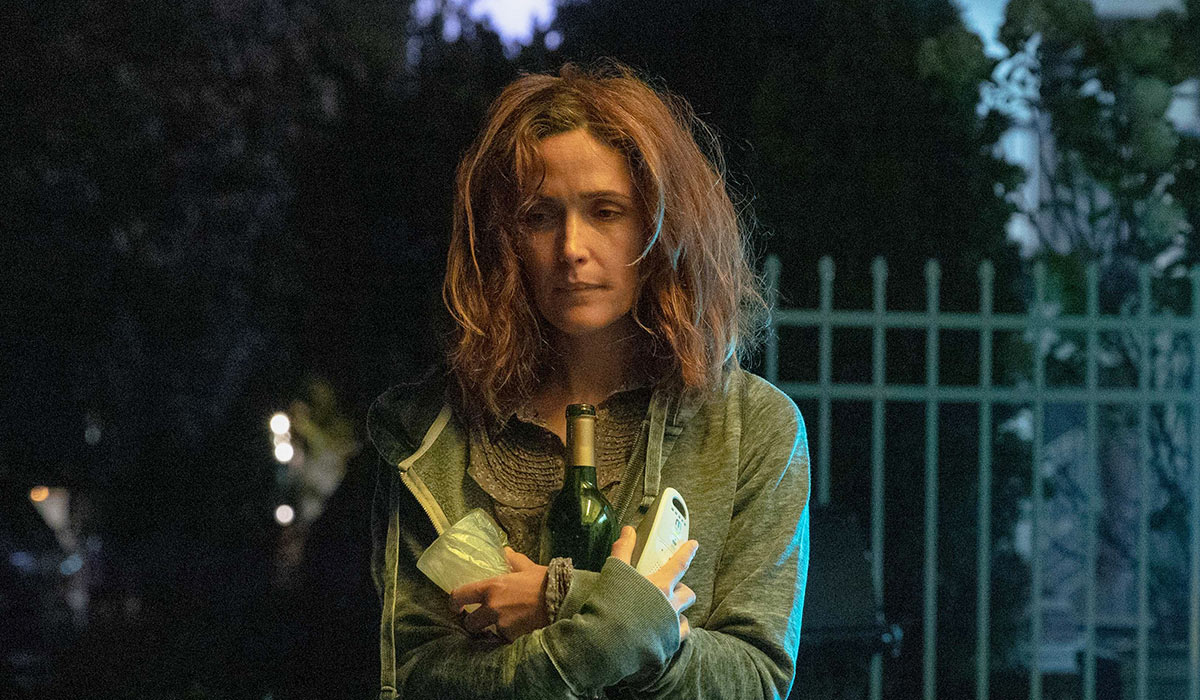
Rose Byrne has been talking to the press about Mary Bronstein’s sublime “If I Had Legs I’d Kick You” since its world premiere in January. She’s traveled to the Berlin Film Festival, the Telluride and Toronto Film Festivals, before landing back home at the New York Film Festival earlier this month. She’s done press days and Q&As, but somehow we stumped her. And in the best way possible.
READ MORE: Oscars 2026: Best Actress Contenders and Predictions
No matter what happens this season, whether she lands a deserved Oscar, SAG, Gotham Award, Spirit Award, or Golden Globe nomination or is celebrated by critics’ groups, Byrne’s performance is already award-winning. She took the Silver Bear for Best Actress at Berlin. That prize put her in elite company as one of the few actors to win acting prizes at both the Berlin and Venice Film Festivals. Yes, in 2000, a very young Byrne won the Volpi Cup for Best Actress for Ciara Law’s “The Goddess of 1967.” You may not have heard of the Australian drama, but it effectively introduced her to the world stage. We asked what it meant to win the Berlin honor 25 years after Venice.
“Oh, well, firstly, you’re so sweet to mention Venice. That was so long ago at this point,” Byrne says. “So you’re the first person to really ask me that. I’m so flattered. That’s very sweet.”
She continues, ” I feel very emotional about it. I feel very emotional about the movie. It’s an extraordinary original voice, and I think it already lives in a league of its own. I think Mary is such a wildly talented filmmaker with a clear vision and a clear voice, and I can’t believe I’m in the movie. Not to sound humble or humble brag or anything. I really feel very protective of the performance and also the character, but I also wanted it to reach the farthest audience it can. And I think A24 has been extraordinary. They knew that this was a really special piece and a really original voice, and they have brilliantly shepherded the film. And now we’re out there and really excited for the film to start reaching an audience beyond what we’ve done at the festivals and so, so forth.”
Over the course of our interview late last week, Byrne explained her enthusiasm for her “anti-authoritarian” character, how the movie plays differently to different audiences, the challenges of unexpected set pieces, therapy for a therapist who doesn’t use her therapist’s advice, and much, much more.
This interview has been edited for length and clarity.
_____
The Playlist: When we spoke at Telluride, you had not seen the movie since Berlin. Have you seen it again yet?
Rose Byrne: You know, Greg, I watched. I wasn’t sure I was going to, but I stayed for the New York Film Festival screening. I was so curious to see how in New York audience would respond, so it was really cool. It was very interesting to see it. Compared to the European audience at Berlin.
What was the difference?
Well, initially, I thought, “Oh gosh, this is playing like a comedy.” They were laughing so much from the start in places where people were never allowing themselves to laugh. And then I was chatting later with Ronnie Bronstein, and he was like, “You know what it is? They just enjoyed it in a way beyond just the tension of the film.” They immediately understood that they could laugh, and New Yorkers just got it far more comedically. But it wasn’t even that they weren’t getting the depth of it. It was just that they were able to enjoy the comedy of it far faster than the European crowd. It was very curious. It was really very interesting.
When you got Mary’s script, did you think it was funny?
Oh yes, of course. No, this character to me had so much potential comedically, and I obviously know it’s very dark humor. It’s a very serious situation that we reveal her to be in, but there was so much potential, and the humor was always on the page. The hamster is described as Jack Nicholson from “The Shining” trying to break out through the wall and trying to break through the box in the car. So, immediately there is a sense of winking and a sense of it’s very, very clever, and it was always there on the page.
One of the things I love about the film is that as it goes on, even with the comedy, and the sort of supernatural element with the hole in the apartment, it feels more and more like a thriller. The tension just grows. Was that inherent to the script, or did you realize it while you were shooting that would be the tone? Or was it a surprise when you saw it?
I think the horror trips were more evident when I saw the final product because it was sort of very humorous in its descriptions of stuff, and very surreal and existential, and playing with a lot of visual ideas. It was very explicit on the page, but I was not sure how it would visually end up being shot, and how you can’t ever account for sound design and all. Those things, the textures of a film. And it’s been so interesting, the response, because some people really see it as a horror film. Other people see it really as a dark, nerve-racking comedy. Other people have seen it as a straight drama. So it’s very subjective, and I’m loving being part of seeing that conversation unfold. I think it’s very unusual. It’s such an original voice.
I think it’s a huge compliment that a movie can play that way for so many people. You’ve spoken before about how this character is based on Mary’s life. Did you give you more background for how she envisioned Linda beyond the script?
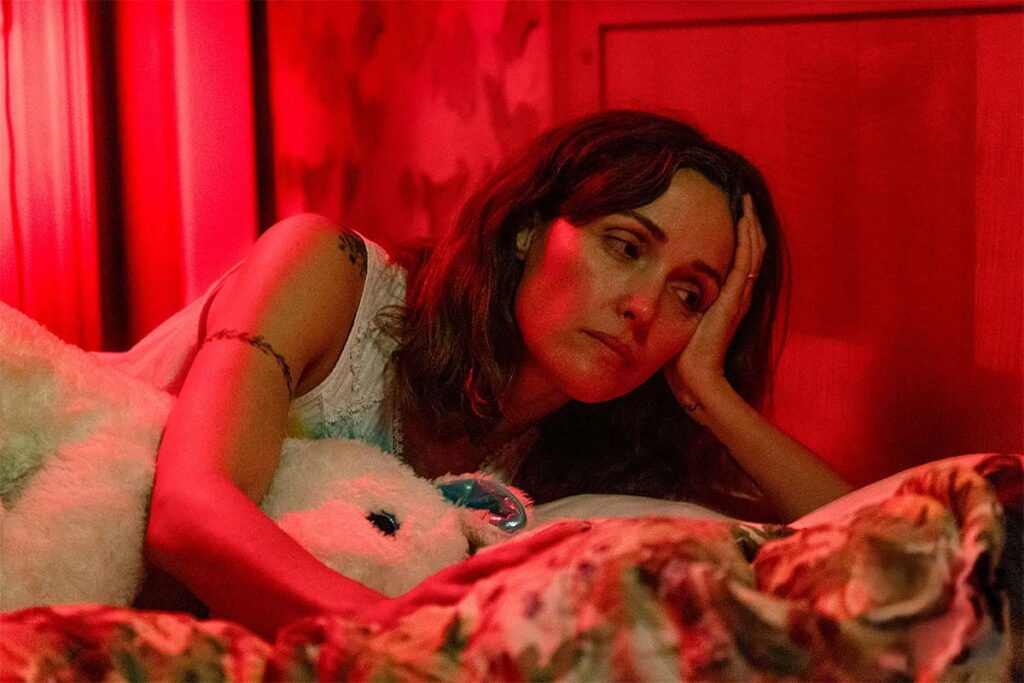
Yes. I mean, the story in the movie is very much inspired by Mary’s experience with her daughter, which she speaks to. And she doesn’t go into too much detail, but it is an experience that she went through, and she did not respond like Linda did. And so it’s like a feeling she’s trying to express of what she went through, I think, is how she speaks to it. And the character is to an extent an avatar of Mary, but at the end it’s really now its own separate entity. And we discussed a lot about who Linda was before and what kind of person she was before this crisis. Her childhood, all these sorts [of things]. Like the homework you don’t ever want to see in a performance, but you want the characters to feel lived in. And it felt to me, Linda has a vicious sort of anti-authoritarian streak and does not like being told what to do or be put in any sort of role, and doesn’t respond well to authority. And that was a really fun, kind of key to unlocking the character
She’s a therapist herself, but she needs a lot of therapy, which, hey, therapists need therapy too. Did you consult any therapists beforehand?
We did. We spoke to a therapist, and we discussed a lot of therapy. I’ve done therapy many times, as has Mary, and we discussed the concept of burnout, which is very common to go through. And that’s what Linda is experiencing, and she really should not be working. She should not be practicing. She should not be advising anybody. And of course, this cyclical nature of your therapist is a therapist who has a therapist who has a therapist, and she gets advice from her therapist, and then she doesn’t take it, but then she’ll reiterate that advice to her patient who doesn’t take that advice. So it’s this very, I think, quite a humorous examination of some of the pitfalls and the traps of therapy that perhaps you don’t always think about. But we also spoke to a lot of mothers who had children with special needs, and that was fascinating to see this huge spectrum of experience and the effect on each of their lives, which was so varied in terms of their own marriages, their careers. And it was, again, just speaking to how diverse it is, that experience of parenting. And it’s obviously a very specific thing. 99% of mothers hopefully will not have a sick child or go through something that Linda’s experiencing. But I think with that specificity, it’s actually reaching more people because I’ve had friends with no kids who absolutely relate to the feelings she’s going through, and men who not necessarily would understand the maternal gravitational weights that you have, but who completely understand the feeling of being a caretaker or watching your own wife go through something or if you are the sole guardian for a child. So, it’s been really unpredictable and spontaneous and so extraordinary to have different people’s reactions, not just necessarily mothers.
Interesting. One of the great choices that Mary makes in the film is that we never see Linda’s daughter’s face. She’s always offscreen or just sort of out a frame. It’s such a technical question, but were there any challenges from your perspective in knowing that you couldn’t do something because it would pull her into the frame?
No, it’s a good question. And honestly, it was very seamless. We had other challenges, technical challenges with big set pieces, and I could speak more to that, but with Delaney Quinn, the brilliant young actress who plays the daughter, I knew the conceit that we would not see her. It was a pretty radical idea Mary had, but she was there obviously for all my scenes. She was my scene partner. She informed every bit of the performance, and it was very seamless. They were so in lockstep, Christopher Messina, our Director of Photography, and Mary. But yeah, it was never an issue. I think they troubleshooted that in many ways. It was pretty practically seamless.
Well, wait, now I need to ask what the other technical challenges were. Was the whole exploding ceiling an adventure?
That was. We only did it twice, but that was a huge set piece. Yeah, it was very complicated. We’re on a sound stage in Williamsburg and getting the beats right, understanding, it was really the prior beats too of building up to how Linda gets into the room and out, just all those sorts of things that you have to sort of reverse engineer before you actually do it. And then obviously it’s the water flooding, there are many different elements going on. That one was a technical day. The hamster was a very big technical day. The tube. That was another big one. And then the sequence on the beach is obviously probably the most challenging because you’re dealing with Mother Nature, who in her most profound sense is completely uncontrollable.
Did you realize it would be this challenging when you agreed to sign on board?
It is so funny. So in the moment, I don’t always anticipate it. And then you’re there and you are doing it. So, it’s more anticipatory. Perhaps the more challenging things for performance are what I’m anticipating, whether it’s the scenes with Conan or the scenes that are huge emotional beats for the character. Yeah, the less technical ones, I suppose, I don’t anticipate. And it surprises you. Something that can be simple can turn out to be a really tricky beat to play, or something that is actually a much more highly emotional scene can come easily. So it’s a little bit unpredictable, but yes, I didn’t anticipate all of it really/
I have two last questions for you. The first is, you are now one of the few actors in the world who have won both the Venice and Berlin film festival actress or actor awards. What did winning Berlin mean to you? Because it was 25 years ago when you won Venice.
Oh, well, firstly, you’re so sweet to mention Venice. That was so long ago at this point. So you’re the first person to really ask me that. I’m so flattered. That’s very sweet. My publicist is sitting on the floor nodding.
Rose’s Publicist: Yes!
She’s very tickled, I think, by the question. It’s very sweet. I feel very emotional about it. I feel very emotional about the movie. It’s an extraordinary original voice, and I think it already lives in a league of its own. I think Mary is such a wildly talented filmmaker with a clear vision and a clear voice, and I can’t believe I’m in the movie. Not to sound humble or humble brag or anything. I really feel very protective of the performance and also the character, but I also wanted it to reach the farthest audience it can. And I think A24 has been extraordinary. They knew that this was a really special piece and a really original voice, and they have brilliantly shepherded the film. And now we’re out there and really excited for the film to start reaching an audience beyond what we’ve done at the festivals and so, so forth. And it’s been great because the festivals are such different audiences. Toronto was like a college crowd, and it played [like] a screaming kind of horror comedy. Berlin was very much more kind of cerebral, very focused, and stoic. New York, again, played a far more enjoyable comedic piece. That’s just been really fun to see the different responses, and it just speaks to the variety within the film.
That sort of ties into my last question for you is what are you hoping audiences take away from the film, and I guess Linda’s journey in the film overall?
I never want to prescribe what someone takes away. I can’t. It belongs to the audience now, and I trust them. I trust what they’ll take away, however they respond. I know it’s an extraordinary film and has such an original voice, and already the response has been beyond my wildest dreams. So, I feel like it’s kind of none of my business at this point. That’s what Mary continues to say, and I really agree with her. I trust the audience, and I trust that the film is…I’m still discovering things about it as a viewer. I think it lives in such ambiguous places that is exciting.
“If I Had Legs I’d Kick You” is now playing in New York and Los Angeles
Follow Gregory Ellwood on Bluesky
Follow Gregory Ellwood on Threads
Follow Gregory Ellwood on Instagram
Sign Up For The Breakdown Newsletter


