


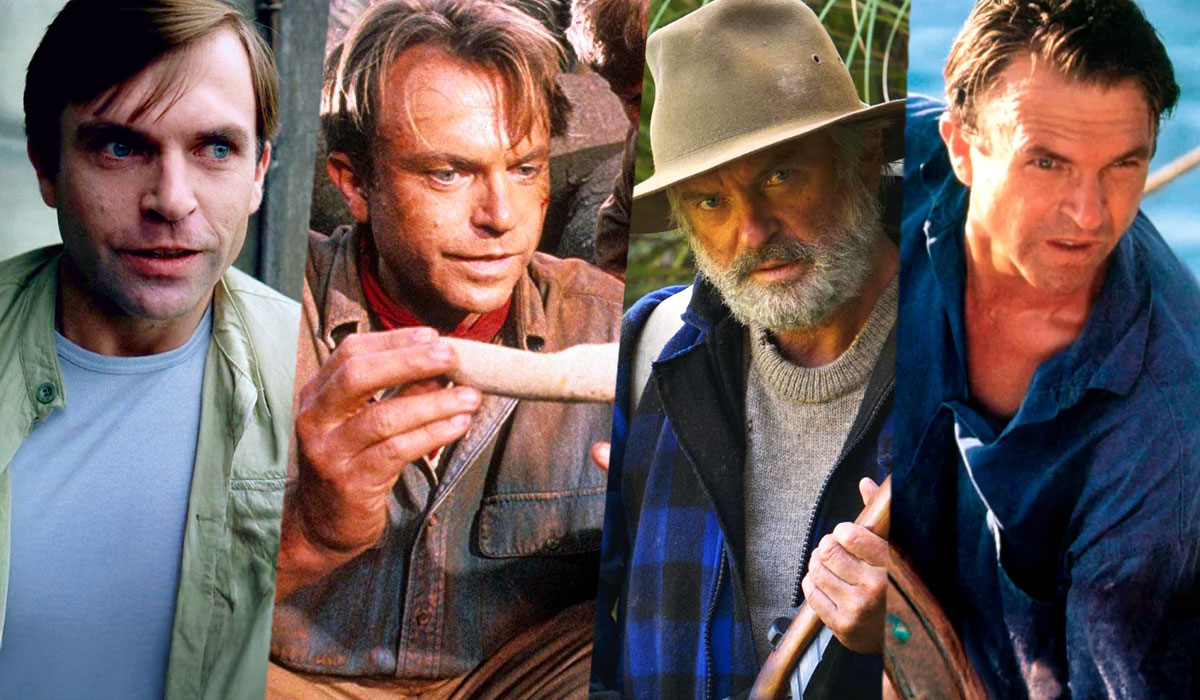
“The Piano” (1993)
Jane Campion’s “The Piano” follows Ada (Holly Hunter), a mute Scottish woman who arrives in 19th-century New Zealand with her young daughter and beloved piano for an arranged marriage to landowner Alisdair Stewart. When Stewart refuses to transport the instrument from the beach, Ada forms an increasingly intimate bond with his neighbor, George Baines (Harvey Keitel), turning the piano into the center of a charged struggle over desire, autonomy, repression, and possession. Neill plays Stewart as a bitter, vengeful, painfully small man whose authority cannot disguise his emotional inadequacy. He believes marriage entitles him to Ada’s affection, obedience, and inner life, then responds with escalating jealousy and cruelty when she refuses to surrender any of them. Neill understands that Stewart’s brutality grows out of humiliation: every rejection diminishes him, while Ada’s awakening becomes an injury he feels compelled to avenge. The performance never excuses his horrifying violence, but it exposes the pathetic wounded pride beneath it. In lesser hands, Stewart might have been a conventional brute; Neill makes him more disturbing, a weak and emotionally stunted man who mistakes ownership for intimacy and cannot accept that love cannot be forced. —RP
“Jurassic Park” (1993)
There is little left to say about Steven Spielberg’s game-changing “Jurassic Park” that has not already been said: it fundamentally altered the scope of Hollywood tentpole filmmaking while introducing audiences to one of Neill’s most beloved characters. What remains remarkable is how much room Spielberg gives his central actors to establish distinct personalities within an action-packed ensemble. The film makes space for Laura Dern’s warmth and conviction, Jeff Goldblum’s eccentric wit, and Neill’s grounded authority as paleontologist Alan Grant. Grant is the beating heart of the movie, a serious-minded scientist who understands both the wonder of what John Hammond has accomplished and humanity’s dangerous tendency to mistake technological capability for wisdom. Neill lends a stately grace to a film where much of the cast spends its time running from, hiding from, or talking about dinosaurs, and he makes Grant’s gradual transformation into a reluctant protector feel completely organic. His initially wary relationship with children develops into one of the film’s most affecting emotional threads, revealing the compassion beneath Grant’s guarded exterior. Neill’s ability to combine intellectual credibility, dry humor, physical courage, and paternal tenderness helped turn an academic character into an enduring action hero. —NL
“In the Mouth of Madness” (1994)
We meet John Trent, the flustered insurance investigator whom Neill plays with remarkable brio and gusto in the third and final installment of John Carpenter’s Apocalypse Trilogy, as he is being committed to a psychiatric facility. The horrifying look in Trent’s eyes suggests that the madness he has witnessed may not be entirely of his own making. “In the Mouth of Madness” follows Trent as he searches for Sutter Cane, an immensely popular but elusive horror author whose disappearance has sparked panic among his readers. The investigation forces Trent to confront blasphemous, unholy sights he might previously have encountered only in nightmares. Carpenter’s film is an unusually smart genre work about the commodification and consumption of horror, as well as one man’s realization that he may be trapped inside a story whose rules he cannot control. Neill captures both sides of Trent’s unraveling with adroit attention to detail: the sophisticated, self-assured professional who prides himself on recognizing deception, and the feral mania that emerges once he has been exposed to something reason cannot contain. His barn-burning lead performance remains one of the most underappreciated turns in Carpenter’s filmography. —NL
“Event Horizon” (1997)
“Event Horizon” gave Neill another opportunity to explore the terrifying spectacle of a rational man surrendering to forces beyond human comprehension. Anderson’s interstellar ghost-ship horror film blends science fiction with the grotesque imagery and metaphysical dread of supernatural horror, and its committed ensemble includes Laurence Fishburne, Jason Isaacs, and Neill as Dr. William Weir, the architect of the titular vessel. Weir initially appears to be a grieving, tightly controlled scientist desperate to recover the ship he created, but Neill gradually allows guilt, obsession, and otherworldly influence to consume him. The film’s most iconic image finds him with a grotesquely mangled face and gouged-out eyes, delivering its most memorable warning: “Where we’re going, we won’t need eyes to see.” Neill had played frenzied delirium before, but he is especially frightening here because the performance begins from such a place of intelligence, sorrow, and composure. His transformation into an instrument of the ship’s evil is all the more unsettling because some trace of the wounded man remains visible beneath the monstrous exterior. Neill approaches the material without hesitation or vanity, giving the film’s pulpy, nightmarish premise complete emotional and physical commitment. —NL
“Hunt for the Wilderpeople” (2016)
Before his career expanded further into large-scale Hollywood projects, Taika Waititi made winsome, deeply felt comedies about the awkward misfits of his native New Zealand, and “Hunt for the Wilderpeople” may be the most conventionally accessible of them. The lovely, off-kilter father-son story is powered by Julian Dennison’s alternately raucous and tender performance as young troublemaker Ricky Baker, but it is Neill’s turn as the gruff, unsentimental Hector that gives the film its real, beating heart. Neill can play crotchety anger in his sleep, and Hec initially seems like Alan Grant’s aversion to children in “Jurassic Park” taken to the nth degree: an emotionally barricaded grouch who wants nothing to do with the defiant boy suddenly placed in his care. But after tragedy sends the pair into the wilderness, Neill gradually reveals the grief, loneliness, and buried tenderness beneath Hec’s brusque exterior. Ricky needs direction, protection, and a father figure, while Hec needs someone capable of drawing him back toward the world. Neill embodies that mutual softening without making it sentimental, allowing affection to emerge through glances, gestures, and reluctant acts of care. It is a performance built around the kind of quiet humanity Neill seemed to carry naturally, both on screen and off. —NL
Honorable Mentions:
Any list limited to ten performances will inevitably leave out major chapters of Sam Neill’s remarkably varied career. His starring role in “Sleeping Dogs,” the first New Zealand film to receive a wide theatrical release in the United States, helped launch his screen career, while his breakthrough in “My Brilliant Career” established him as a commanding presence in Australian cinema. “Reilly, Ace of Spies” made him an international television star and earned him a Golden Globe nomination. His other award-recognized performances included an Australian Film Institute-winning turn in “A Cry in the Dark,” Golden Globe-nominated work in “One Against the Wind,” Emmy- and Golden Globe-nominated work in “Merlin,” and an Emmy-nominated narration of “Wild New Zealand.” He also received major recognition in Australia and New Zealand for “Jessica,” “The Dish,” “The Daughter,” “Hunt for the Wilderpeople,” “Sweet Country,” “Rams,” and “The Twelve.” Beyond those honors, Neill brought memorable menace to “Peaky Blinders” as Major Chester Campbell and made lasting impressions in “The Tudors,” “Bicentennial Man,” “The Horse Whisperer,” “Thor: Ragnarok,” “Peter Rabbit,” and the later “Jurassic” sequels, moving easily between prestige drama, genre filmmaking, broad comedy, and family entertainment without ever treating one form as less deserving of his full commitment.


Rodrigo Perez is the founder and editor-in-chief of The Playlist, which he launched in 2007. He has worked in entertainment journalism since 2000, including at MTV, and has written for SPIN, IndieWire, Pitchfork, Complex, Magnet, and various music, film, and entertainment publications over the past two decades.


