





After January’s spirited street-level jaunt through contemporary Westerosi history in HBO’s “A Knight of the Seven Kingdoms,” we’re back to royal business as usual in the third season of “House of the Dragon.” The tonal shift between these shows is a bit like whiplash. Where “A Knight of the Seven Kingdoms” is light on its feet, “House of the Dragon” is stuffily sluggish; where the former makes a closed circuit in its premiere season, the latter opts for cliffhangers in each of its first two, the second being especially disappointing in terms of payoffs to compensate for delayed gratification.
At least “House of the Dragon” opens its penultimate season seemingly to make up for the bummer finale of season two: Westeros will have war, lots of war, war on land and war at sea, war fought on the decks of naval ships and from the backs of dragons. There is scheming, too, and backstabbing, both literal and figurative. However, “stab” is a dainty way to characterize political executions–an essential ingredient in any campaign to seize power, or frankly, to take power back. Remember, if you will, that everything happening in “House of the series” is consequent to a war of succession instigated by usurpation and sustained by haste. If the series’ disputant characters each have a logical claim to the Iron Throne, none of them have a moral one.
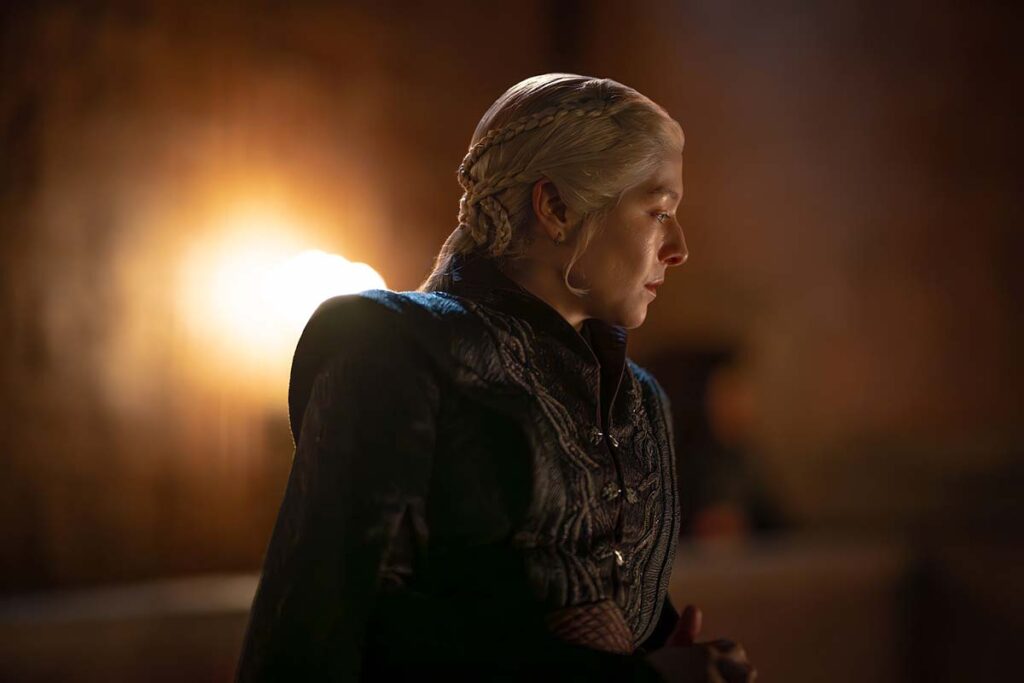
In “A Knight of the Seven Kingdoms,” wake, the events of “House of the Dragon” read as quaintly petty if we’re being generous, and appalling if we’re being honest. What unfolds in the season opener, encompassing a sobering loss of life at military and civilian levels, represents precisely the sort of vainglorious disregard for suffering Peter Claffey’s Ser Duncan considers so distasteful about Westeros’ power hierarchies; power and glory no matter the cost actually tend to cost quite a lot, and with Duncan’s influence still fresh in viewers’ minds–and, not for nothing, with authoritarian power grabs happening all over the world as we speak–the soap opera that drives “House of the Dragon” hits differently. How to reconcile the promise of grand spectacle and melodrama against the reality that all of it is centered on broadly abominable people?
Maybe one or two of the characters here are morally tolerable. Not that characters need to meet a certain contemporary moral standard to be worth watching, of course; we love a good antagonist, someone we can root against while shamelessly rooting for them at the same time. Here is cake. You may have it; you also may eat it. But the joint efforts of Daemon (Matt Smith) and his niece-wife Rhaenyra (Emma D’Arcy) to take the Iron Throne back from Alicent (Olivia Cooke) in the much-extolled “Dance of the Dragons,” that aforementioned succession war, leave a sour taste in the mouth, because combined, none of them care for anything other than position and titles and control, each of which reads like a child’s favored plaything with “A Knight of the Seven Kingdoms” lingering in the rearview.
Again: the season’s commencing extravaganza of maritime warfare is breathtaking. The Triarchy, a $20 name for a military alliance, led by Sharako Lohar (Abigail Thorn), engages the forces of Corlys Velaryon (Steve Toussaint) by Driftmark, where Corlys makes his home, and which Sharako means to turn to cinders. There’s a sub-thread here left hanging, which is a shame; where most every character in this series is motivated by the pursuit of power, she’s compelled by revenge for the massacre of her countrymen in the Stepstones back in “House of the Dragon’s” first season, and in the margins between the palace intrigue and political maneuvering that comprises so much of the narrative’s material. If this is a base motivation, it’s at least a personal one, and Thorn, in her brief screen time, communicates the character’s focused rage well through action.
This battle illustrates a fundamental struggle with watching “House of the Dragon.” However, it is essentially a historical retelling of fictional events, made for a crowd of geek obsessives who know the granular details that fill in the larger sandbox in which the war between Alicent and Rhaenyra’s loyalists is fought. In its third season, this trait is exacerbated; the bloodshed we see over Blackwater Bay is the “Battle of the Gullet,” a major moment in said fictional history. That exact selection of words is used throughout the episode, though not necessarily in the same arrangement, and the significance of the battle in the big picture is lost on an audience that doesn’t pore over Wikis and probably hasn’t read Fire & Blood, the 2018 George R.R. Martin tome that showrunner Ryan Condal has used as the basis for parts of “House of the Dragon.”
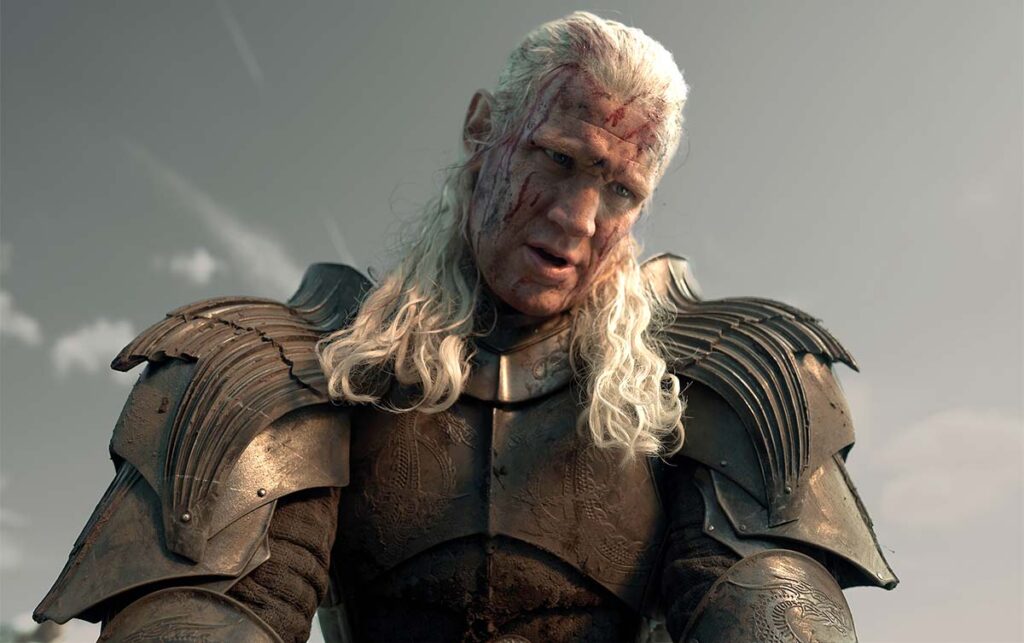
It’s well and good to adapt a source from one medium to another. We do that constantly in the entertainment industry. But nobody seems to have made “House of the Dragons” for a general audience and instead has sought to appeal to the fans, which is a fruitless exercise given that the fans judge products based on how well they hew to their source and not based on whether or not the product hangs together as something greater than “product.” There’s a sense of “House of the Dragon” not being “for” you if you aren’t one of those fans, because there’s a sense of cloudiness about the bits and pieces of each of the show’s plotlines–even in its third season, when clarity should be at its sharpest. [C-]

Bostonian culture journalist Andy Crump covers movies, music, television, politics,, and way too many other subjects for way too many other outlets, perhaps even some of yours: JoySauce, The A.V. Club, Pop Heist, Time, Men's Health, and more. You can follow him on Bluesky and find his collected work at his personal blog. He’s composed of roughly 65 percent beer. Right now, he desperately needs a haircut.

