


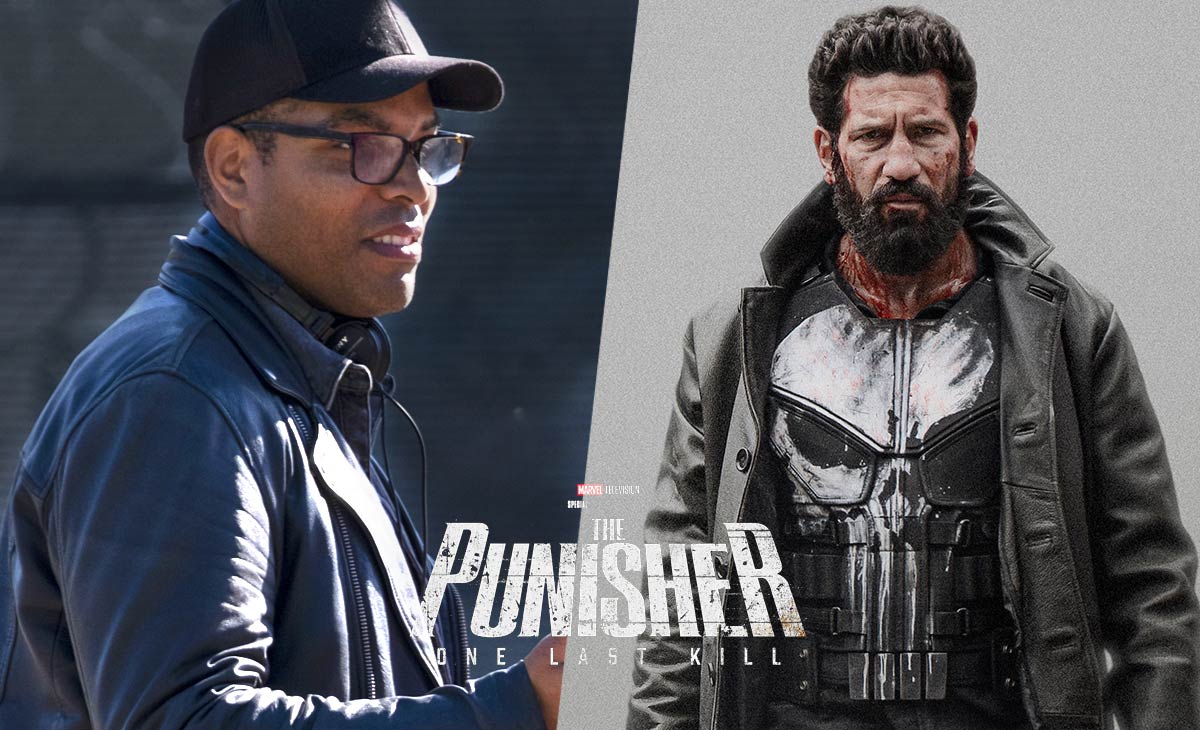
At first glance, Reinaldo Marcus Green might not seem like the obvious filmmaker to bring Frank Castle back into Marvel’s bloodier, street-level orbit. His breakthrough, “Monsters and Men,” was a tense, politically charged drama about police violence and moral responsibility. “King Richard” turned the Williams family story into a study of ambition, control, and fatherhood. HBO’s “We Own This City” dug into institutional rot and the Baltimore Police Department with David Simon’s usual rigor.
But that is also what makes “The Punisher: One Last Kill” interesting. Green is not a filmmaker who treats damaged men as mere genre machinery, and Frank Castle has never been a simple vigilante, at least not when Jon Bernthal plays him. Bernthal has lived with the character for nearly a decade, through Netflix’s “Daredevil,” his own “Punisher” series, “Daredevil: Born Again,” and now this new Disney+ special.
For Green, the route into “One Last Kill” began well before Marvel came calling. It started with Bernthal showing up for “King Richard,” more or less already carrying Frank Castle with him. The two later deepened that collaboration on “We Own This City,” and when Bernthal had an idea for the Punisher’s return, he brought it to Green personally.
In a recent interview with The Playlist, Green talked about Bernthal’s authorship of the special, why he initially questioned whether he was the right filmmaker for Frank Castle, how New York crime cinema shaped the project, and why a live-action Miles Morales “Spider-Man” movie is already on his Marvel wish list.
“The Punisher: One Last Kill” is now available on Disney+.
I caught the special over the weekend, and it’s pretty hardcore. I dug it. Tell me how it came together. I’m assuming some of that had to do with “We Own This City,” which I really loved and think is a little slept on.
No, yeah, I think it actually started before that. It started with “King Richard,” where I cast John Bernthal as Rick Macci. It really started in that cafe in Venice, where he essentially showed up as the Punisher. John had a hood and a pit bull in the front seat. It was great. And I was like, “Wait, what?”
Obviously, I knew he was the Punisher, and I didn’t know he was going to be Rick Macci. So I met him as the Punisher that many years ago, and realized this guy has so much in the tank. And then we went on that journey from “King Richard” to “We Own This City.”
It’s hard for me to say the movie is slept on. “The Wire” was slept on. “The Wire” didn’t take off right away. So, I think there’s a second life, a third life for stuff. You never know when it’s going to hit the consciousness, and if it does, then great. I think we made it for the right reasons, and it lives for the right reasons. It was one of the most important pieces that John and I did together. We became even closer brothers in arms on that one.
When he approached me about the Punisher, to be fair, I wasn’t even sure I was the right guy for it. I was surprised that John was even willing to go on that journey with me, but it was amazing. It just goes to show what he had in mind for the character. This is somebody who’s lived with that character for over 10 years and knew him intimately well, knew who Frank was. This was really his idea. This was his brainchild. So all the credit goes to John. He really cast me as the director in so many ways.
Through our friendship and our working relationship, we were hopefully able to find a character that could bring a lot and bring Punisher fans back in a way that’s full force and fun.
“The long play is to get back into Marvel.“
That’s a real compliment, right? He’s been doing this character for 10 years, and the first person he thinks of is you. And when I think about your career, one of your preoccupations seems to be humanity and flawed men. Who’s more flawed than Frank Castle?
Yeah, for sure. I think that’s definitely at the heart of it. For me, even going into the Punisher, I collected comic books as a kid, my brother and I, and so we loved the Punisher. I didn’t remember it that much, to be fair. It had been 25 years since I had looked at my comic books.
I went back to my mother’s house in Jersey and found the stash in the attic, and we opened up the suitcase where they were stored, and what’s at the top? Punisher. So maybe it was kismet. Maybe it was written that I was supposed to do this. It was this weird thing. Of all the comic books—Superman, Batman, X-Men, everything—the Punisher is sitting at the top of the pile. That’s just very weird.
It felt like, “Okay, this is some higher power speaking to me for joining forces on this one.” John has always looked out for me in my career. He was cast in “We Own This City” before I came onto that project. I think it shows the respect he has for me as a filmmaker.
What was great about this is that I had some distance from the character. I didn’t live with Frank for as long as he had. I’d forgotten a lot of the Punisher storylines and had to go back to it. So I was fresh. I never proclaimed to be an expert. I think in some ways, it’s great to have distance. I had never played an ounce of tennis before making “King Richard.” For me, it’s about perspective. What would make it interesting for an outside viewer who has nothing to do with the Punisher to love this?
I could speak in cinematic terms. I could speak in filmmaking terms with John about that. It was his original conceit. It was his original idea for the character. He had written the early drafts. So for me, it was important to come in with that fresh perspective and say, “This is what’s working. This is what’s not working. This is what is resonating with me. This is not. Let’s move this here. Let’s open this up cinematically.”
And bringing a level of craft to this that I think we have never seen in the Marvel universe, having Robert Elswit, Oscar-winning cinematographer, shoot it is an incredible gift. We want more of it. I think you can tell the difference when you feel and experience the mastery that he lends to his characters.
It’s really a character study. I think that’s what this piece is about. That’s what John brings to it. It’s that humanity. We were able to find the humanity in Frank, or at least try to, for this piece. And that’s where the journey began for me.
How did those conversations with John go? Because you said you weren’t sure you were the right guy for this. What was the emotional way into Frank for you?
It’s because I don’t condone violence. It’s just not who I am. When you think about the Punisher, and you think about that character, it can be a big jump from where I emotionally am as a human being. So it’s all about finding the through line. And look, John as a human being was my through line.
When John, my brother, says, “I want you to do this,” I have to take that seriously. What is it that he sees in me? Also, I’ve been a Marvel fan. I grew up collecting comic books. So it was fun to say, “Hey, I can do this. This is actually really interesting.” It was a daring thing for me in my career, and it showed me where I want to go and how I want to open up. It was a fun challenge.
To have John and to have his backing, that was number one for me. Then it was, “Okay, where’s the character? Where has he been? Where has he been hiding?” All the questions that come up about the series and going on that journey with John.
We also worked very closely with the military community on this. John was friends with Colton Hill, Nick Koumalatsos, and Cody Alford—real ex-military guys who were instrumental in shaping John’s character. We had access. I could talk to these guys. They were on set. So understanding the psychological factors at play with some of these ex-military guys was important.
These are big, strong men who have obviously seen some darkness in their lives, in their personal lives, and I’m sure they’re still seeing it. This is the kind of thing that never goes away. They’re struggling with it still to this day, and somehow, the Punisher speaks to that very essence of who they are as human beings. It’s this really interesting thing where you’re like, “Wait, you guys follow superheroes?” It’s interesting to know that this character speaks to them and their journey, and what they’ve gone through.
It went beyond the military training. That’s one aspect of the skill that they brought to it. Like, “This is how we would do it,” or, “This is how we would go on a raid,” or, “This is how we would stop a threat.” But the emotional side of it, Frank’s PTSD, everything that was going on psychologically, where we find the character, and the depths that he was willing to go in the special—those are the things that I found most interesting.
When I think about my favorite filmmakers, from Spike Lee to Martin Scorsese and all their work in New York City, those were the foundation. Let’s talk about “Mean Streets.” Let’s talk about “Goodfellas.” These are influences on this special. That was the language that I hope we brought to this.
More from this interview on the next page.

