




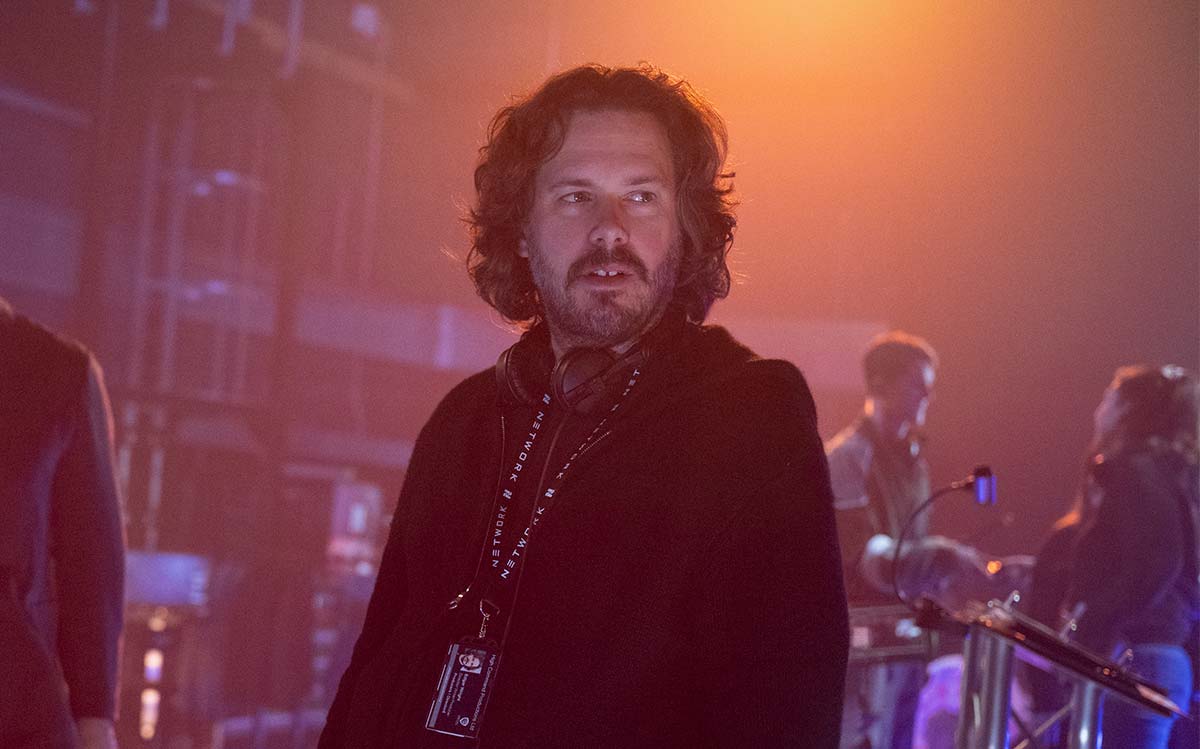
The future isn’t sleek or utopian; it’s loud, televised, and brought to you by your favorite corporate sponsors. In Edgar Wright’s high-voltage new film, “The Running Man,” entertainment has literally become a blood sport. Based on Stephen King’s 1982 novel, this isn’t your father’s dystopia; it’s a world where survival ratings matter more than life itself, and one wrong move can make you viral in all the wrong ways. Glenn Powell stars as Ben Richards, a man framed, hunted, and transformed into TV’s latest disposable hero.
It’s a punchy, adrenaline-fueled reinvention from a filmmaker who loves turning chaos into choreography. Wright trades the candy-coated energy of “Baby Driver” and “Scott Pilgrim vs. the World” for something grittier and sweatier, a survival thriller that feels uncomfortably close to our algorithmic present. It’s wickedly funny, politically sharp, and unmistakably his, even as it veers into darker, nastier terrain.
When Wright joined The Playlist’s The Discourse Podcast to talk about the film, he admitted that staying faithful to King’s intensity was key. “The book is all from Ben Richards’ point of view, and it felt important to keep that,” he said. “The audience should feel like they’re on the game with him. You might get notes saying, ‘What if we cut to what the villains are up to?’ But I think it’s stronger if you stay with Ben. The audience wants to feel like they’re running with him.”
Stylistically, Wright dug deep into the DNA of dystopian cinema without falling into the shadows of its icons. “You look at great films in the genre, ‘Blade Runner,’ for instance, and realize some things are just too done,” he said. Instead, he mined influence from films like “THX 1138,” “Children of Men,” and “Escape from New York,” noting how John Carpenter’s use of real-world architecture helped build a future that felt plausible. He also shouted out Terry Gilliam’s “Brazil” and Paul Verhoeven’s triple crown of sci-fi satire, “Robocop,” “Total Recall,” and “Starship Troopers,” calling them “unimpeachable” examples of how to entertain and indict at the same time.
Still, for all the chaos, this isn’t another Wright mixtape of needle drops and pop cues, as the film relies more on score than a familiar soundtrack. “It didn’t feel like that kind of movie,” he said. “In ‘Baby Driver’ and ‘Last Night in Soho,’ the music is something the characters use; it’s part of who they are. But here, the tone came more from the score. There are a few songs, but it’s mostly atmosphere.”
This project also marks Wright’s first feature shot entirely digitally, a choice born from logistics rather than ideology. “It was a financial decision,” he explained. “We were shooting in so many locations that carrying all the film equipment became unwieldy. It wasn’t taken lightly, but it made sense. And it doesn’t mean I’ve renounced 35mm. I’ll be back, to quote Mr. Schwarzenegger.”
Powell, meanwhile, dove headfirst into the film’s grueling action, insisting that he perform as much of the stunts as possible. “Glenn would do everything if he could,” Wright said with a grin. “We built the action around what he could safely pull off. That first-person perspective, showing it all from his point of view, was essential to how the story’s told.”
And yes, Marvel’s “Ant-Man” came up, the one that got away. For years, Wright was developing the film for Marvel Studios, but left just before production due to the dreaded “creative differences.” Wright handled talking about the experience with good humor. “I didn’t regret leaving,” he said. “I started working on it before even ‘Iron Man’ came out. By the time it was moving forward, the brand and continuity were already locked. The chance to do something really different was going away. So yeah, 12 years later, I’m still on what I call ‘Cape break.’”
As for what’s next, Wright’s plate remains full of rumors, “Barbarella,” with Sydney Sweeney, “Stage 13,” “Set My Heart to Five,” but his only immediate plan is rest. “A lot of those projects are just scripts,” he said. “Filmmaking depends on timing and things beyond your control. I just finished this film two weeks ago, so I’m going to promote it, sleep, and figure it out next year.”
He did, however, confirm that one potential sequel exists. “Well, there is a script for ‘Baby Driver 2,’” Wright confirmed. “But sometimes an idea is more fun to talk about than actually make. Early on, Simon [Pegg] and I joked about doing a ‘Shaun of the Dead’ choose-your-own-adventure version of a sequel where he turns left instead of right, and it becomes a different movie. And we actually started talking about it excitedly in the pub one night about what if he took a different turn, and what if then the movie became more like ‘Invasion of the Body Snatchers’ than like George A. Romero. And some things that like that – it’s almost like you’re writing your own fan fiction, right? But it’s more fun to talk about than actually have to make it.”
“The Running Man” hits theaters November 14, a violent, clever, and unnervingly relevant spectacle from one of genre cinema’s sharpest voices. As Wright put it best, “It’s what you’d call a wild ass ride.”
Listen to the full Edgar Wright interview below.
The Discourse is part of The Playlist Podcast Network, which includes Deep Focus, Bingeworthy, and more. We can be heard on Apple Podcasts, Spotify, Soundcloud, and most places where podcasts are found. You can stream the podcast via the embed within the article.. Be sure to subscribe and drop us a comment or a rating, as we greatly appreciate it. Thank you for listening.

Mike DeAngelo is a film writer, podcaster, and entertainment journalist whose work has appeared in Variety, The Hollywood Reporter, IndieWire, and beyond. He is the host of The Playlist's podcasts The Discourse and Bingeworthy.

