





The reviews are quite good. The notices for his performance are stellar. And yet, Will Arnett, a seven-time Emmy Award nominee and a three-time SAG Awards nominee, is still looking for the spotlight after his fantastic turn in Bradley Cooper’s “Is This Thing On?” And with the film finally hitting theaters and AMPAS members sitting down to catch up on screeners, it may happen sooner rather than later.
Based on the real-life story of British comedian John Bishop, “Is This Thing On?” was first conceived and written by Arnett and his longtime writing partner, Mark Chappell. Bishop was a pharmaceutical rep who took a chance at an open mic night to vent about his marriage that was seemingly falling apart. He received enough positive feedback that he started performing at more open nights and, unexpectedly, he became a massively popular stand-up comedian.
When Arnett sent a draft of what he and Chappell had been working on to his longtime friend and former roommate, Cooper, the Oscar-nominated filmmaker immediately jumped on board. The story had already moved from the U.K. to New York, and Cooper wanted to shift the focus to the relationship between Alex (Arnett), the Bishop-inspired character, and his wife Tess (Laura Dern). Witness to their friends’ separation is Alex’s hilarious longtime buddy, Balls (Cooper), and his wife, Christine (Andra Day). The film became less about Alex’s potential new career path but about revisiting his marriage. As Arnett describes it, “it wasn’t that their love had gone away, it was that they had just stopped taking care of it.”
During our interview late last month, Arnett explained why Bishop’s story spoke to him, what Cooper brought to the project, navigating the arc of an amateur “learning” how to be a good stand-up, and much, much more.
This interview has been edited for length and clarity.
_____
The Playlist: I know that this was inspired by the life of British comedian John Bishop, and I read that you met him randomly. But from when you met him to going into production, how quickly was this process of making this movie?
Will Arnett: It was just a really quick seven years.
Not that quick.
Yeah, I met John in September of 2018 on a canal boat in Amsterdam, having lunch with a bunch of mutual friends. And he told me the story of how he quite literally stumbled into standup comedy at this sort of pivotal point in his life and at the potential disintegration of his marriage. And it really stuck with me. So, from that point to the point that we actually started shooting was just over just about six and a half years.
Did you immediately think, “Hey, this is something that could work as a movie? I turn this into a TV show?”
My first reaction – he told me the story, and I was kind of blown away. So many of the elements that inspired us, him stumbling in all these things, not telling anybody his life, and then eventually hissoon to be ex walking in and seeing him perform, not knowing he was performing that night, that was all real. And that they confronted each other after all of that was real. It really stuck with me, and I remember we had this lunch. And I was working over there, and I spent a couple of days, and I kept thinking about it. I woke up a couple of days later, I was thinking about it, and I came back to Los Angeles, and I called my writing partner, Mark Chapell, and I go, “Hey, do you know this story of this guy? He lives in the UK. Do you know John Bishop? Do you know this? He said, “Yeah.” I go, “the story of how he became a standup.” “Yeah.” “It’s incredible, right?” And he said, “I knew about this story through somebody. I’ve always thought it would make a great film.” I said, “Mark, that’s why I’m calling you.” And so we reached out to John and said that we’d like to maybe take a stab at writing and making it into a film. And he agreed at least initially to meet us. And so I flew over to London, and we sat with him over the course of a few days and talked to him, and that’s how it began. But I always thought this was a film.
Alex, the character you play, is obviously very different from John in many ways. What was your and Mark’s inspiration for him?
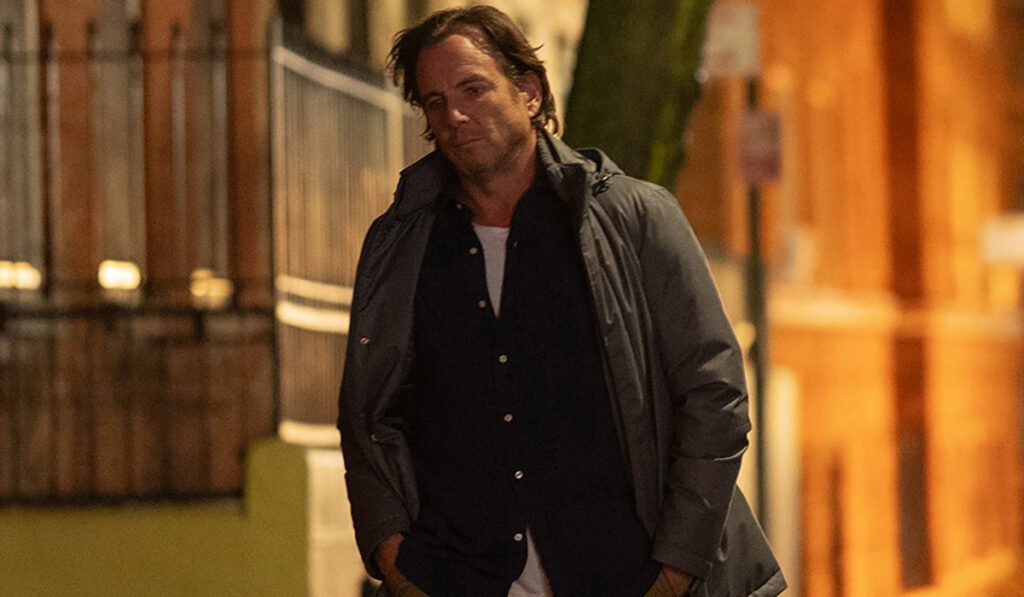
I think we got to a place where even though we liked sort of the tenets of John’s story and how the driver, was that this guy goes to a place and ends up going on stage almost by mistake and tells his truth for the first time, not just to the audience but to himself. I love that idea. And that he started to go back and get relief from that every week. And it started to shift his perspective. I think he had lost perspective in life. Life gets crowded. Kids, things, all this stuff happens, we kind of lose the bigger picture. That was the driver. And, this was a big thing when Bradley came on, which was that it was about these people. Not just John, not just Alex, rather, but also Tess, that they had both gotten away from this thing, and how could they find their way back? How had the communication broken down so much that they didn’t communicate at all? And that they needed to find a way back to that, because it wasn’t that their love had gone away, it was that they had just stopped taking care of it.
Was it almost like it was just easier to not try?
Maybe.
I sort of got that a little bit from the film. It is just easier to not even keep trying.
Yeah, I think, you know, that’s a good point. I think there maybe is a little bit of an element of that. It is almost like a resignation. I don’t know. Maybe this is too hard. Maybe I’m going to have to have conversations that are too hard. Maybe I’m going to have to admit stuff about myself that I don’t really want to admit, or I don’t want to say out loud, or that are too hard for me to say. So, maybe it will be just easier to just let it die on the vine.
One of the interesting things in that context, though, is if someone just reads the log line for this movie, they might think it’s a comedy or a romantic comedy, but that’s not the tone at all. It is a serious film with people going through serious things. Was that something you and Mark talked about writing the screenplay? Was that inherent to your original idea?
I think there were always elements of it there. I think that probably one of the reasons that, after writing a couple drafts, that I showed it to Bradley was because I knew that it was missing something. “What are we missing here about going deeper and really exploring these serious issues?” And I gave it to him because I wanted his thoughts on it, because I respect him so much as a filmmaker, and I knew that he would give me a really thoughtful response to what we had. So, when he called and said, “I want to do it,” and he called me up a week later and he said, “If you’ll let me, I want to direct this and I want to help with you guys in the rewrite,” I thought, “Wow, yes, great.” I knew that he was going to be able to help us really dig into those moments and elevate all of that stuff on an emotional level. And certainly it bore out to be true.
In that context. Was Balls always in the screenplay, or was that a character he created to play?
No, Balls was always there, but Bradley brought a really fresh angle to Balls in a way that was just so delightful in every way. And it was actually Bradley who ultimately helped transform Balls into kind of the idiot who says the resonant thing. Who unwittingly gives you the answer that you’d been searching for, that maybe people who seem more grounded [would know]. That answer was eluding them, and he just kind of says it out loud when he says, “Yeah, I know I’m often confused. I’d just rather be confused with her.” And that just hits Alex like an anvil and a piano and another anvil on the head.
This isn’t the first time you’ve done anything dramatic, but I feel like it’s the first time where you are at the forefront of it. Having written it, having been invested in it for so long, were you more nervous to do this than other projects, or is it the same sort of level of anxiety anyone would have?
Just regular old anxiety? Yeah, regular old. I tried not to get in my head about sort of the buildup to it in that way. Ultimately, I wanted it to feel really authentic. I’ve done some dramatic stuff. I created a show on Netflix 10 years ago that had some dramatic elements, but I’ve always had the luxury of playing a lot of characters who were kind of heightened and are living in a heightened world. And I knew that trying to inhabit a character who felt very real, who was going through a real emotional metamorphosis, if you will, in a way that’s obviously not melodramatic. You don’t want it to be modeling you. I want it to feel like somebody you can really connect with, and all those little moments. And it’s not just those moments, the silences, all those things that feel really like you’re capturing somebody behaving in that way, and you’re really seeing somebody go through it in that way. That’s not demonstrative. That was, for me, the objective. To do that in a way that felt really genuine, and then you do see him in these moments, even during this standup, to see him track not just development or maybe slight development as a standup, but also see his emotional development through the standup as well. And then have those scenes with Laura where they really reveal a lot. Yeah, it was daunting, but it was a challenge that I really welcomed, and at this age, it was funny to be able to go and have a similar experience that Alex was having with standup .
It’s hard to write bad comedy. I mean, in theory, it isn’t, but it’s hard to maybe write it and then chronicle Alex’s upward trajectory. How did you all pull that off? If I were to see the script, would Alex’s stand-up sets be almost word-for-word? Or did you overshoot, and Bradley fashioned it in the editing room?
It is pretty close. There are a few moments that we took out. Certainly, in the first set, there’s an extension of a joke that we told that we went back and forth, and we just kind of decided Alex wouldn’t tell this joke at this point. He wouldn’t have the facility to do it. But yeah, it’s a really good point. We always knew we had this very narrow target of tracking, of seeing this guy the first time he goes on, what is that experience? How do you, A, in the writing, and B, in the performing, how do you play a guy who’s going in front of a crowd for me as a performer in front of a crowd as though he’s never been in front of a crowd? And to try to tell a joke in a way that somebody who’s never told a joke in front of a crowd would tell a joke in front of a crowd. All those kinds of things. It was something that we spent a lot of time on, especially in prep when I was doing standup. That was what I was working on in prep was finding that balance and then tracking it through all those sets.
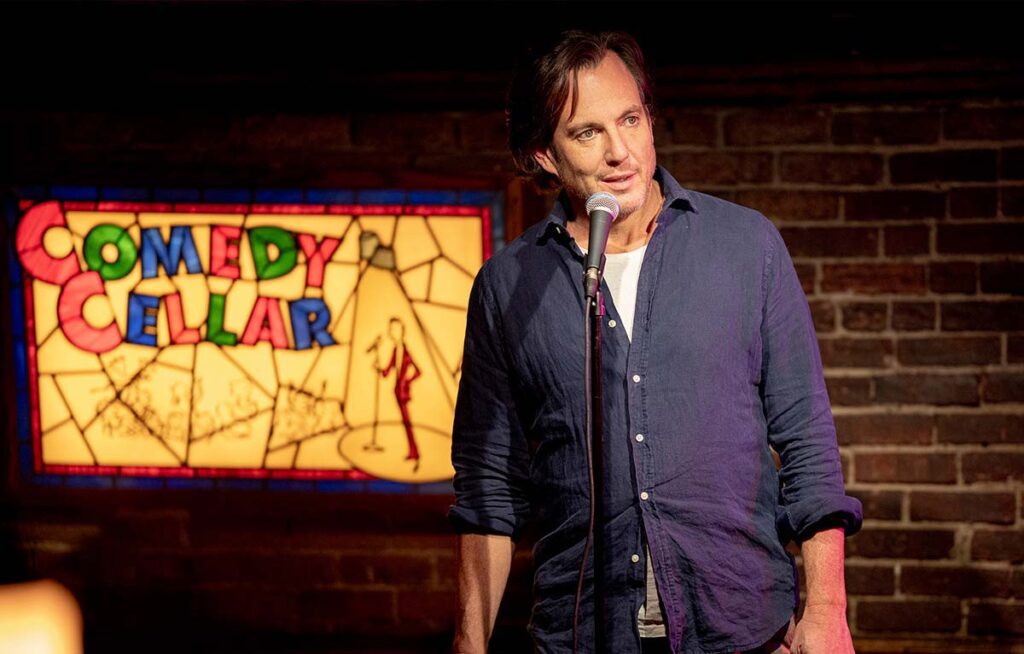
The first time he goes, he’s just standing there. The next time he sort of holds onto the mic, then he takes the mic off the stand, and then he’s leaning on the mic. Those are the physical parts of it. And in terms of the dialogue, when Liz, who is the real manager of the Cellar tells him that you’ve got to write, you’ve got to write. We see him having a cup of coffee at his kitchen table, and he is writing about dad bods. And then later, when he is doing the set after the birthday party, he is talking about his wife seeing the radiologist. And then the crowd laughs, and then it occurs to him this joke that he has written, and he says it, and you see him access that, and you’re like, “Wow, maybe he is developing all that stuff.” But that’s all scripted, yeah.
“Is This Thing On?” opens in New York and Los Angeles on Friday. It opens nationwide on January 9.
Follow Gregory Ellwood on Bluesky
Follow Gregory Ellwood on Threads
Follow Gregory Ellwood on Instagram
Sign Up For The Breakdown Newsletter


