


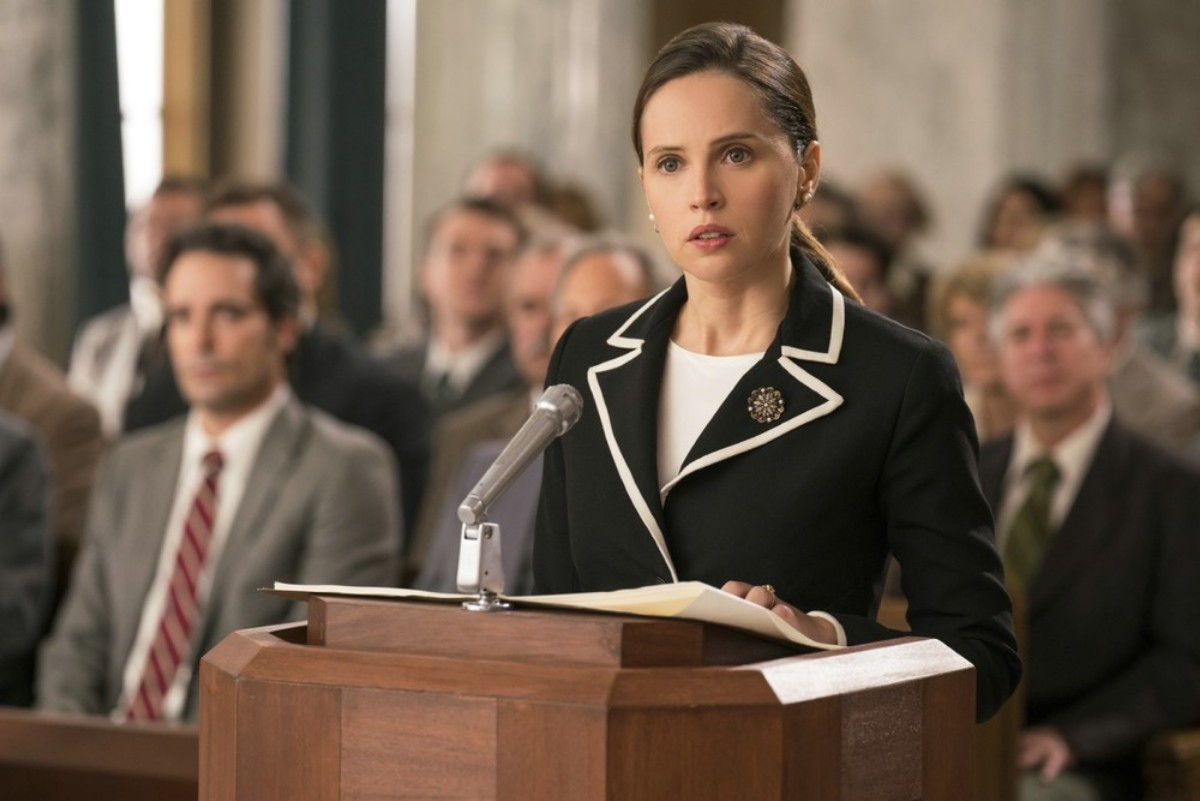
When I interviewed Felicity Jones about her role in Mimi Leder’s “On the Basis of Sex” it’s subject, Ruth Bader Ginsberg, had fallen a few weeks prior and broken a rib. Miraculously, the Supreme Court justice was working a few hours later. It prompted Jones, who starred in “Star Wars: Rogue One,” to note, “Yeah, Ruth Bader Ginsburg has the force in her too.” Who knew that just a few weeks later Ginsburg would have non-cancerous tumors removed from her lung and participate in a crucial Supreme Court vote later that day? That’s why the life of the “Notorious R.B.G.” has been the subject of both a hit documentary and this Focus Features release.
Having spoken to Daniel Stiepleman, the film’s screenwriter and Ginsberg’s nephew, earlier in the season, it was a delight to reconnect with Jones who recently wrapped production on Tom Harper’s “The Aeronauts” which reunited her with her “Theory of Everything” co-star Eddie Redmayne.
_____
The Playlist: I’ve seen every single movie that I could see this year and the only movie that I bawled at the end was this movie. And I didn’t expect it to happen, it just did. And I won’t say why…
Felicity Jones: Fantastic.
I don’t know what reaction you’re getting from people who’ve seen the movie, but…
Oh, thank you. Well, I mean we don’t want to make people cry, but we do want to make people cry. [Laughs.]
I spoke to the screenwriter a couple weeks ago and he had said they sent you the screenplay I think on a Friday and that by Monday you had said, “Yep, I’m on board.” Is that true?
Yeah, well they said, “The film’s about to fall apart so we need to know really quickly if this is a yay or a nay.” And it was definitely a huge “Yay.” I’d been looking for something like this since “Star Wars,” something that I could really believe in and get behind. I’d wanted to do a film that was about someone and their career and how they navigate that career but also had all this humor and humanity in it. So I could easily say yes. I think I read it in a couple of hours and I’d said yes, so it was a real no-brainer.
Is the fact you’d already played a real person before make it easier to just say yes too?
Well, Ruth Bader Ginsberg is so beloved and I feel that as well. I am a huge fan of hers, so in some ways, it was quite hard because it’s quite difficult to play someone you adore because you have to bring all the edges and the idiosyncrasies. And I wanted to be true to that, so at first, it was really intimidating to be taking on, rightly so, someone who’s such an icon and someone that I have such a deep, deep respect for. So, I just knew I had to really do my homework.
What did that homework entail?
Well, I mean you don’t want to do an impersonation of someone, you want to inhabit their essence. But I do feel that I like to change my own appearance as much as possible. I like to shift myself physically. It’s a bit like [in the U.K.] we have this show called “Stars in Their Eyes” where people become pop stars and they walk in one way as themselves and they walk onto a stage and they’re someone else. And that’s sort of what’s lovely about being an actor is that you go into the makeup trailer and you’re sort of this bedraggled person, and then you come out and you’re Ruth Bader Ginsberg. And that’s all about the wigs, the contact lenses and having teeth capped and all those little physical changes that take you closer to being that person so that when you get to set you can kind of really fly and play because you know that you’ve done all that external preparation.
Does the discomfort of having something like teeth caps and wearing a wig all day, does it help you focus more in a way?
Definitely. I find the less I’m Felicity the more interesting it is. I love that feeling of being someone else and I love being Ruth. I just love the humanity that she brought to everything and playing someone who actually was very angry. You know, there was constant injustice. She was such an outsider on every single level, not only because of her faith, her gender, but also where she was from. So, that was a big part of it, finding her public voice and her private voice and listening to her in court. She has a much more kind of TransAtlantic accent and you just hear these little moments of Brooklyn vowel sounds coming out when she gets angry or frustrated. All those details. And similarly when she’s at home she kind of can kick back and let more of her real self out. It was so important in showing just how a 1950s environment was very much against her. It was a very patriarchal situation that she was going into and she had to be really mindful of how she did that?
Were there any audio recordings, even video that was helpful? Because when I think of seeing footage of her in the past it’s mostly court stuff in the ’70s.
We obviously know so much about Ruth from 1993, basically when she obviously became so much in the public eye. But before that, it was a lot of piecing information together and that’s where I had to be really creative in thinking about ‘Who is this person before they became the icon?’ So, that was about listening to those early recordings of her in court to understand how she had to behave in public to get her message through. And part of that was not making herself in many ways a threat or a danger, is that she used reason and she channeled her anger to say ‘This is the truth and this is why you need to change what you’re doing. But then equally, someone we’re not like that all the time and there are moments where we get frustrated and obviously then privately you want to see a different side to her. But it was fascinating also seeing the early recordings of her with [her husband Marty played by Armie Hammer]. There’s some really wonderful footage of them on their honeymoon and I could really see the way that she has this incredible posture, the way she holds herself. The shyness that they have as young people was really special and so much of the playing of her was how she in some ways overcame that shyness and let her public persona take control if she trusted her words then she didn’t need to feel so shy and so fearful.
Did you meet beforehand?
Yes, we did. We went to Washington to meet her and we were waiting nervously outside her office to go in. This was before we started shooting, and initially, she just couldn’t take her eyes off of me.
Was there anything that she told you in the meeting? Little tidbits or anything that helped?
I knew that we had her blessing because she had given notes on every single draft of the script.
Yes, I heard about her notes on the script.
To the point, did you hear that she didn’t want to see any more versions because she had read every single one? [Laughs.]
Oh, Daniel kept saying is that most of her comments were like “I would not have ever said this legalese like this.” It was mostly changing items like that, but that’s funny.
Yeah, exactly. And I knew going into it that she had seen “Theory of Everything” and that she wanted me to play her, so it wasn’t as though I was going in trying to kind of win her over. It was more just building trust as two human beings, spending time together and being in her apartment. I have always been incredibly moved by her and moved by her that she’s a good person that’s managed to be successful in the world. Sometimes we don’t always feel like that. It feels like people in power aren’t as principled as she is, so that’s why I think her fame just increases year after year because we trust her. And she does nothing to gain, you know, she’s not a politician. She’s not someone who’s trying to get really rich or really famous. She cares about the country and she cares about equality.
When I talked to her nephew she’d already seen the movie three times. I have no idea how many times she’s seen it at this point, but did that make you feel like, “O.K. she’s seen it that many times she really does like it” and that you succeeded?
Well, when she said to Daniel “I couldn’t imagine anyone else playing me,” then I knew that I had her stamp of approval, which is what you’re looking for ultimately. You really are. I didn’t take it on lightly. I knew that really the only person who could play Ruth Bader Ginsberg is Ruth Bader Ginsberg, so I was filling some pretty big shoes but I did. I’m just so glad that she really is proud of the film and I’m proud of what we made. Apparently, she’s been telling her friends to go see it, so she’s doing some early marketing for us as well.
My last question is I know you recently finished shooting ‘The Aeronauts” which focuses on hot air balloons but how much time were you actually in a hot air balloon?
Well, it moves between them when they’re on the ground and then when they’re up in a balloon but there was a lot of time where I was hanging off balloons, where we were 2,000 feet up in the air doing sequences.
Oh, I assumed it was all CG.
No, no. I mean, a combination of blue screen and shooting stuff for real, but we had such an adventure. I’ve never had an experience like it. There were a lot of bumps and bruises that we came out with at the end.
Were you afraid of heights beforehand or no?
No, no. I actually had a fantastic stunt crew and a support team who made it all seem so much easier and were really encouraging. And I absolutely loved it. I love doing that stuff once you feel that you’re prepped. And I’d been doing all this aerial training and trapeze, so I felt really confident and comfortable being out there just letting it fly.
“On the Basis of Sex” is now in limited release.


