


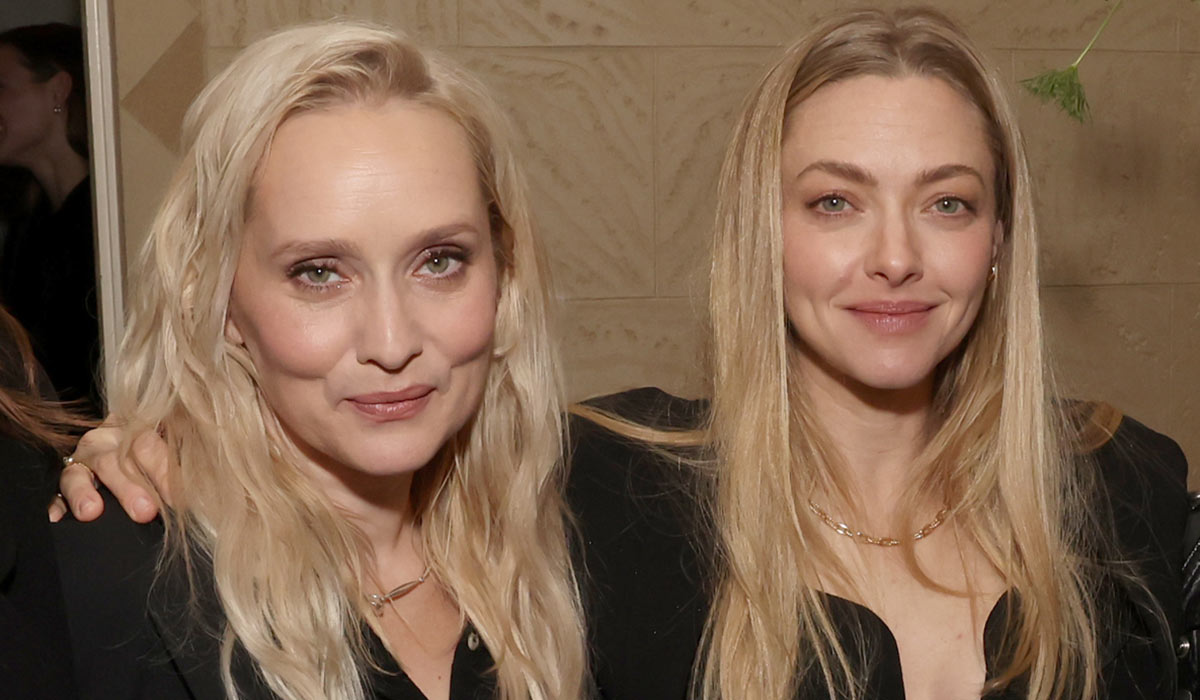
We’re not sure Mona Fastvold would describe herself as fearless, but we will. During our conversation last week, she was quite forthcoming about the difficulties of crafting a massive production such as “The Testament of Ann Lee” on a relatively limited, independently financed budget. And how she’d shoot 17 to 18-hour days with the main unit and then the second unit, to allow them to rest. And how she dived into making a film that is essentially a musical, without that being her original intent. Oh, and set in the 1700s, no less. All filmmaking is gutsy, but that’s really gutsy.
Co-written by her partner and “The Brutalist” director Brady Corbet, “Testament” tells the life story of Ann Lee (a superb Amanda Seyfried), a working-class English woman who became the spiritual leader of an offshoot of the Quaker known as the Shakers. She guided them across the Atlantic to America, where they thrived until their “radical” beliefs found their religion in the crosshairs of their conservative neighbors. Fastvold collaborates with Oscar-winning composer Daniel Blumberg to depict the Shakers’ love for song and choreographer Celia Rowlson-Hall to capture their spontaneous dancing. The result is a unique vision that’s hard to forget, and as it heads to theaters, she knows it won’t be for everyone.
“Ultimately, love it or hate it, it is that conversation,” Fastvold says she’s looking for. “If you’ve got nothing to say, it would break my heart. But if you have something, if it sparks that, even if it’s aligned to your own relationship to faith or whatever it is, or to movement, or if it’s just that you want to go and dance with some of your friends afterwards, that would be great.”
And, you just might. Or wonder what the boundary-pushing Fastvold and career-defying Seyfriend will do next.
This interview has been edited for length and clarity. You can watch the full discussion embedded in this post.
_____
The Playlist: When I saw it in Toronto, I was watching this film, and I know that you and Brady have figured out ways to make these epic films on incredibly small budgets, but I’m watching all of the choreography, everything that’s going on there. And I just was sort of blown away. What is your guy’s secret sauce to sort of pull this off?
Oh, I wish it was a secret sauce. It just really kind of is just – it’s out of necessity. What am I going to do? I desperately wanted to tell this story. I didn’t want to compromise on the epic, you know Ann Lee had an epic story. She deserved for it to be told that way. I felt that way strongly. And [producer] Andrew Morrison and Brady really just were so supportive of that and agreed with me in that. So, we just had to find ways of creating that. And I think for me, it really is about having great producing partners and being a producer as well on the films, knowing, really understanding my budget, my schedule, and being very clear and honest about that plan. I’ll say, “Yes, we’re going to build this house. We’re going to burn it down. We’re going to have stunts. We’re going to have a hundred extras. We’re going to have horses. We’re going to have nudities. We’re going to have a whole scene. We’re going to do all these things on that day. We’re going to spend a lot of money on that.” But we’re going to rehearse the hell out of it in advance and know what the plan is, of course, and make sure it’s safe. And then on other days, we are going to have a focus puller, a loader, a cinematographer, my lead actor, and a van. And that’s all I need, and maybe three sheep. And that’s it. That’s all we’re going to do. Or I’m going to build this set. And that set is going to be three walls, and I’m not going to change my mind and say, “Oh no, actually I need 360. We have to rethink this.” So, I think it’s about really knowing what you want as a director and being able to prep in a way where you can visualize your entire film so that you don’t have to say, “Oh s**t, I need to change my mind about this. I wasn’t right about this sequence. It needs to be done in a different way” Or “I should have had a set that was 360 instead of…” Things like that. You need to really get to a point in your prep where you really, really see it, and in the screenwriting process.
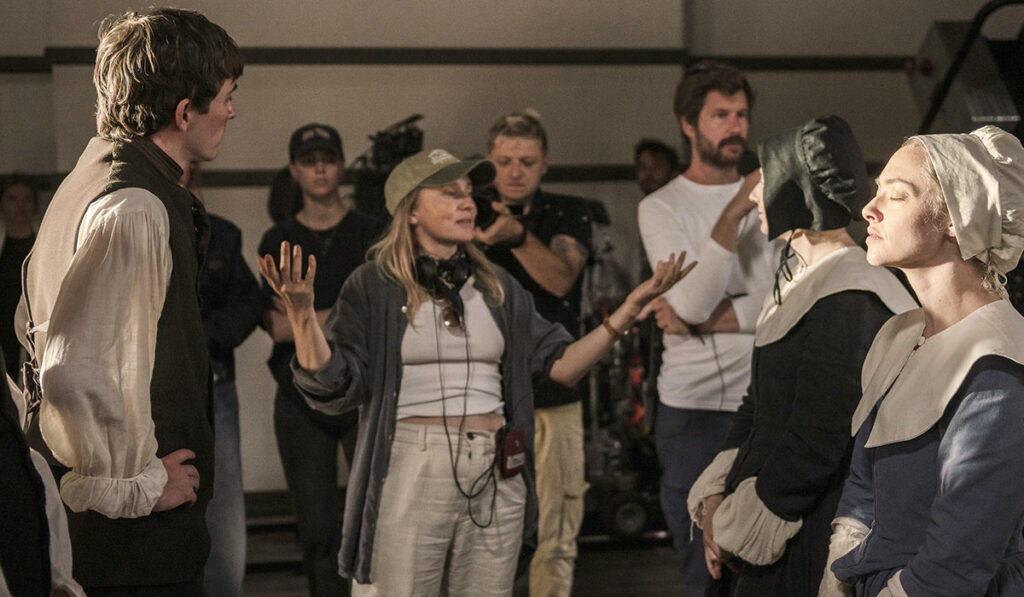
So that way, you can actually build a film that is epic and sweeping in this way, but for this budget. But it’s hard. It’s not comfortable. And I wish that I had more to give to my crew because it’s really challenging for them, especially challenging for me. I would work … I have days that I’m working…me and my cinematographer were working 17-18 hour days because we would jump from main unit to second unit to give the rest of the crew a break, but we can’t take that break. So, we’re pushing ourselves to the very limit, and I probably can’t do this forever because it’s aged taking years of my life already.
Taking years of your life!
Yeah.
But in that context, you’ve written the script, you know you’re going to shoot this, you’ve prepped as much as you can. Was there one sequence that was the toughest to pull off, or what your vision of it was?
Yes. The boat. The boat was…How the heck do you do that on this budget? It isn’t done because the ways that you’re supposed to do this is just not available on this budget. So, we had to say, “O.K., we have to track down a real boat somewhere because we can’t afford to build it. Take that out of the equation.” O.K. So, we finally, after months and months and months of searching, find this boat in Sweden. There was a financial structure in Sweden. We have Film i Väst that made it actually possible for us to even shoot in Sweden. But then that boat had to stay docked for our sequences because we have rain towers and effects and everything like that. And I can’t have another boat out to sea following that boat. That’s absolutely out of the question as well. So, there’s only like a few specific angles that work to shoot.
![‘The Testament Of Ann Lee’ Review: A Divine Amanda Seyfried Shines In Mona Fastvold’s Musical Parable [Venice]](https://cdn.theplaylist.net/wp-content/uploads/2025/11/06094856/TTAL_SG_00067_v2-1024x588.jpg)
And the only way to shoot in those angles and for it to be beautiful is for us to put up the sails. And there’s only a very specific group of people who can do that because this is a period replica down to the handstitch materials and the sails and the hammocks. So, I had to try and track down these people to put the sails down for us. So, there’s so many things that could go terribly wrong, and it was so challenging to do it. I also had another ship, a smaller period ship that we took out to sea, and then a little set that we built in Hungary that we flooded completely with water. And then the hope is, of course, that you put all of this together and somehow it’s going to work. And then there’s model work in there as well. And then there’s actors pretending like they’re at sea, moving, pretending like they’re falling left and right with the waves. It’s incredible. As you’re doing it, it demands an incredible amount of trust from the entire team, the performers, and everyone behind camera that it’s not going to be absolutely ridiculous. And that when we cut it together, it’s going to feel like a tiny snippet of “Titanic” if I’m lucky.
And it did. It looked seamless. That’s what’s so impressive about everything you guys have pulled off. I do want to go a little bit back to the beginning. I know that you were inspired while making “World To Come” by a Shaker song that you had heard. When you were just stating the idea, was it always to do it as a semi-musical, or did that come later on in the process?
Well, I knew that there was going to be a lot of music and movement in the story because they worshiped through ecstatic song and dance, the Shakers. And that was part of what really drew me to it as well, because I wanted to continue my collaboration with [composer] Daniel Blumberg, and I wanted to collaborate more with Celia Rowlson-Hall, who was also a really old dear friend of mine. And I love her work, and her work on “Ma” is so beautiful. So, I wanted to deepen that collaboration. So, I was excited about that, but I was resisting the genre because it terrified me. So, I kept calling it a film with a lot of music and movement pieces. I kept calling it all kinds of other things. And then Brady eventually just said, “It’s a damn musical moment, I just call it what it is. You have to accept that.” And then I was like, “O.K., I guess that is what it is.” And I think that it’s just actually going to be so much music and movement that it will never stop in a way. And then in the end, now, because I kept on, I worked so closely with Daniel and with our sound mixer. He mixed the entire – like the score and everything in the film was mixed by Steve Single, and there’s no separation between the world and the music. There are gestures of movement that sometimes turn into large dance piece or movement pieces, or there’s little melodies that turns into song or there’s pieces that never do so. And there’s sound design that is actually improvisational, singers, performers, and there are sound effects like rain or stomping or movement that are part of the integral parts of the score. So for me, when I look at the film now, I see it almost, I see it more like an opera where the music never stops. It’s just the music, and the movement is just through the entire piece.
I have to ask in that context, you cast Amanda, who’s incredible as Ann, and obviously, you knew beforehand she could sing and dance and do all of that. But for the rest of the cast, was it important that they had a musical background? Or was it not as important as them just being right for the role as playing the character?
It was not important that they … I wanted them just to be human beings who would move and sing and they did not have to be … I was excited about Amanda being such a strong singer and mover, but it was a long process with her finding a new way into moving and singing because she had to approach in a very different way from how she approached on other projects because she was not supposed to be performing. She wasn’t in a traditional musical. She was not supposed to perform for an audience. It was always just this internal experience of singing just for yourself and moving only for yourself. And it’s always supposed to be a spiritual moment for the character when she’s going through this movement path. So, she had to sort of unlearn a lot. But then you had like incredible performers like Louis Pullman, who said, “Oh, I do not dance. I do not sing. I don’t do any of these things.” And then we started working on it together, and turns out he’s like an incredible singer. I love his voice, and the untrained nature of his voice was so exciting to me and Daniel because it was so tender and raw, and it was just really fun for us to work with. And he sounded truly like this kind of like wonderful folk singer, and we just got very excited by it. And he’s actually a drummer. So, he’s a musical, and his mother is an incredible modern dancer. So, he has, so she was working with him and rehearsing with him on the movement prior to him joining us as well. So, he was like a true discovery in that way. And Thomasin McKenzie turns out is just like an incredible mover. She was also like, “Oh, I’m not really a dancer.” And then we would start working with her, Celia and I, and we were like, “Wow, the articulation in her hands is just incredible.” The intent of her movement is so precise and exciting, but it comes from her. It’s really personal, and we wanted that. Both Celia and I are excited about that kind of movement that comes from that place. It’s very much in Celia’s work as well. So that was just, it wasn’t supposed to be perfect. And I think if you say to performers, to actors and dancers, “You’re not performing. It’s not supposed to be perfect.” It is really freeing. You’re supposed to just move as you. But you have to have intent in the movement and intent in your vocalization, and it needs to have a precise story to it. You’re not just lifting your arm, you are lifting your arm and reaching for something above and pulling it into your body. That’s something that an actor can easily access because it’s so specific. I think if you say to an actor, you go one, two, and three and four, just like, “Oh God, please no. “
And my last question for you is, you always have hopes for your films, but what is your hope that audiences take away from watching “Ann Lee”?
Just a conversation, honestly. The work starts with a conversation between me and Brady. We talk and talk and talk, and then we sit down and write, and then we bring this screenplay to our collaborators, and then we talk more about what all of this means to us and why we want to tell this story now, and why this is so incredibly important to me to explore this, and why I feel possessed to tell this story right now, because you have to have that drive. That’s how you have to feel about it. And then, finally, bringing it to an audience, bringing it to you, and having this conversation right now, that is the goal. Talking about all of these aspects of it. I can’t distill it to one thing because I spent years somehow managing to melt it down into two hours and 20 minutes. That’s how much I had to say about it. But my hope is always that that conversation just continues with your partner as you walk out of the theater and that you talk about community and that you talk about what are the communities that I could seek out or that I can contribute to, to create a place where there is some grace and there’s some kindness and empathy and those sort of … I think that’s sort of what I’m hoping for, I guess, a little bit without melting it down too much to something specific. But ultimately, love it or hate it, it is that conversation. If you’ve got nothing to say, it would break my heart. But if you have something, if it sparks that, even if it’s aligned to your own relationship to faith or whatever it is, or to movement, or if it’s just that you want to go and dance with some of your friends afterwards, that would be great.
“The Testament of Ann Lee” opens in limited release on Christmas Day.


