


![‘The Testament Of Ann Lee’ Review: A Divine Amanda Seyfried Shines In Mona Fastvold’s Musical Parable [Venice]](https://cdn.theplaylist.net/wp-content/uploads/2025/09/01075812/The-Testament-Of-Ann-Lee-Amanda-Seyfried.jpg "The-Testament-Of-Ann-Lee-Amanda-Seyfried")
Among world religions, Christianity remains unique in its theory of divine incarnation. Unlike other faiths, which access the sacred through traditions or symbols, the religion believes in a corporal connection to God through His entering the human body of Jesus Christ. It’s an experience of holiness not merely as an ethereal force but as a physical one. Director Mona Fastvold makes that distinction visceral in “The Testament of Ann Lee,” her tribute to the titular leader of the Shaking Quakers (known to history as “The Shakers”).
READ MORE: 2025 Venice Film Festival Preview: 23 Must-See Films To Watch
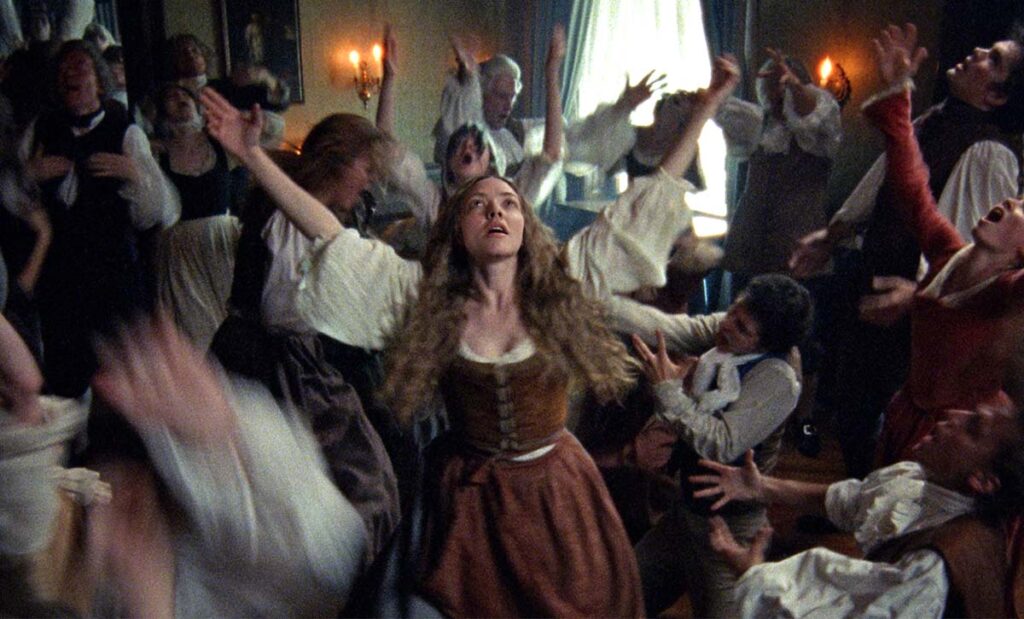
Working with choreographer Celia Rowlson-Hall and composer Daniel Blumberg, she makes the group’s vibrant celebrations of bodily contortion and prostration before their maker feel powerful and present. Each thump of their arms against their chest echoes first across the room, then seemingly toward the eternal.
This background might help contextualize why the Shakers are so receptive to the claims of Amanda Seyfried’s Ann Lee, an 18th-century Mancunian woman wrecked by four unsuccessful pregnancies. That crucible leaves her a hollow shell and empty vessel for an intense contact with Jesus after nearing death. She comes roaring back to her community with a set of new commandments: abstain from sexual relations, enter into divine rather than human marriage, and honor the Lord through labor.
The group heralds “Mother Ann” as a second, female coming of Christ. For them, she proves a fulfillment of scripture and a representation of God’s grace to understand humanity through the personification of both genders. However, when the established church in England brands Ann and the Shakers as heretics, they seek greener pastures abroad in the American colonies with their emphasis on freedom of religious expression.
It’s in this voyage to the New World where some semblance of an artistic mission starts to emerge for “The Testament of Ann Lee.” As in “Vox Lux” and “The Brutalist,” Fastvold and co-writer Brady Corbet use yet another esoteric cultural and historical thread to examine American values. This X-ray reveals the knotty contradictions of a country’s ideological framework. While cerebral concepts might be a lot to digest, the project benefits from their previously established corporeal dimension.
In many ways, the Shakers are a group primed to thrive on American soil. Ann’s emphasis on glorifying God and securing the blessings of heaven through finding one’s calling in work aligns neatly with the country’s capitalistic work ethic. Her emphasis on celibacy, too, feels of a piece with the founding puritanical sexual mores. Yet in other aspects, from the lack of gendered hierarchy in leadership to the destabilization of traditional marriage, Ann presents just as much of a threat to the powers that be.
“The Testament of Ann Lee” is not interested in adjudicating the veracity of the leader’s revelation. Fastvold never operates around the axis of discrediting her specific claim or the nature of religious epiphany overall. Her film instead fixates on the humanistic elements of religion and the fervency it inspires among adherents who so desperately seek a direct sign of providence to enter their lives. Even removing any notions of an eternal kingdom from the picture, the Shakers’ impacts on trying to transform the material reality of the world around them are something Fastvold views in a positive light. It’s utilitarian and utopian in nature.
With the lone exception of Abraham (Christopher Abbott), Ann’s husband, who cannot get on board with the forced chastity element, the Shakers uniformly embrace her vision. “The Testament of Ann Lee” is almost confoundingly free of internal conflict as the religious pilgrims toil to realize their egalitarian communal vision in upstate New York. That’s not to say Mother Ann’s adherents, chiefly brother William (Lewis Pullman) and devotee Mary (Thomasin McKenzie), are blind sheep or pitiful supplicants. They’re committed to struggling through the complexities of living out one’s faith, just as Ann herself is, and they embody it through their ecstatic movement performing the Shaker spirituals.
At times, “The Testament of Ann Lee” flirts with giving itself over to being an all-out movie musical. Especially in the back half, Blumberg’s compositions begin incorporating a rock kick in parallel with the Shakers’ arrival in America. The lines blur between songs that function as worship within their gatherings and those representing a heightened mode of dialogue.
The film might have benefited from some of the stricter guardrails espoused by its subject. Fastvold trusts the audience to figure out her storytelling conventions in lieu of establishing an implicit contract on what to expect. “The Testament of Ann Lee” often proves difficult to pin down, providing enthrallment in fits and starts rather than inducing a consistent state of rapture. It’s a bit slippery in the way that chasing the divine presence in art or life can be: present and tangible, then eluding one’s grasp like smoke.
The constant throughline of “The Testament of Ann Lee” is Amanda Seyfried, who lives and breathes the grace her character exudes to inspiring effect. She never gives herself over to playing Ann as a fully savior or saint. Instead, her poetic movement and soft warble bear the strain of deep, profound struggle to arrive at a place of inspiring joy. If the film around her functions more like a loosely defined parable, Seyfried always provides human grounding to root this baroque retelling in visceral vulnerability. [B]
Follow along with all our coverage of the 2025 Venice Film Festival.

New York-based freelance journalist whose writing appears regularly on Decider, Slant, Slashfilm, and The Playlist, covering film with a focus on cultural context.


