


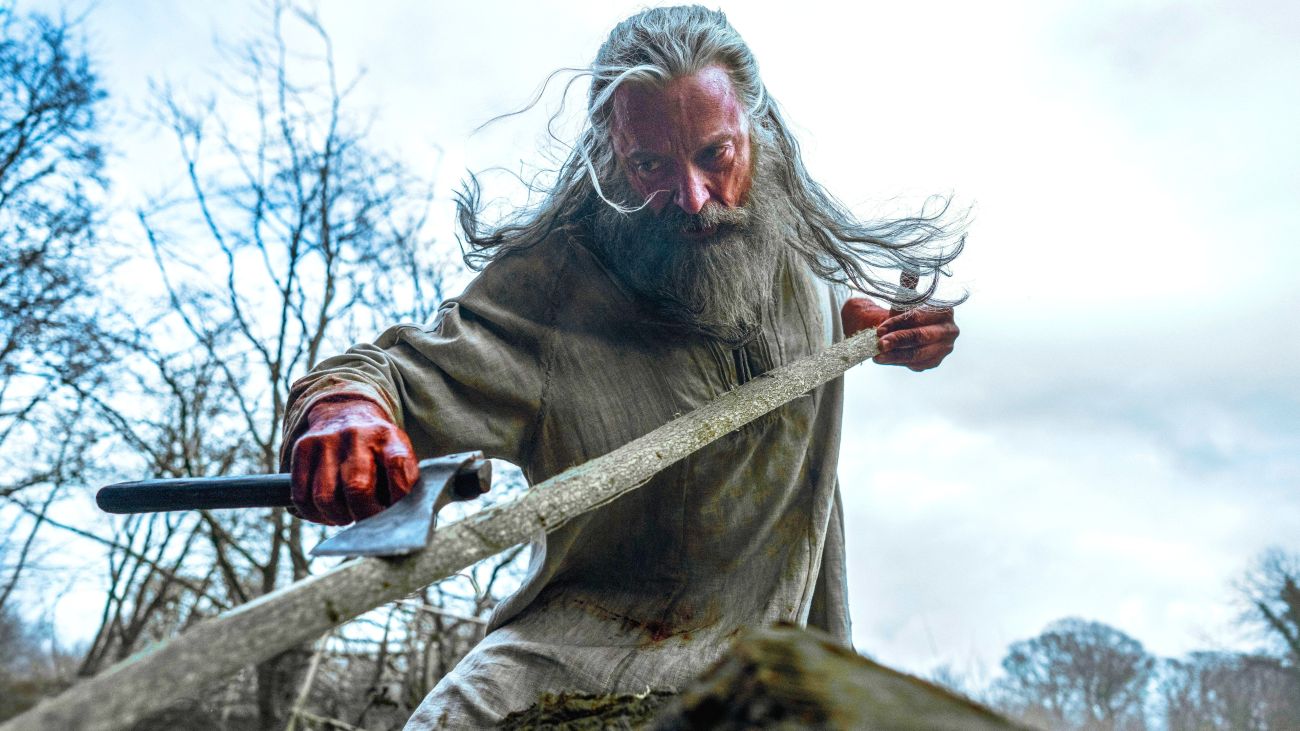
Robin Hood has been a lot of things over the centuries: noble thief, romantic outlaw, swashbuckling folk hero, animated fox, Kevin Costner with an accent that wanders wherever it pleases. But in Michael Sarnoski’s hands, the myth becomes something darker, sadder, and more spiritually eviscerated. His new film, “The Death of Robin Hood,” is less interested in the legend as a heroic brand than in the man who might be trapped beneath its curse.
Written and directed by Sarnoski, “The Death of Robin Hood” stars Hugh Jackman as an aging, haunted Robin Hood, a man grappling with a life of violence after a battle leaves him gravely injured. In the care of a mysterious Prioress played by Jodie Comer, he’s offered something that might look like salvation, if he can survive long enough to accept it. The film also stars Bill Skarsgård, Murray Bartlett, and Noah Jupe, and arrives in theaters June 19 via A24.
Sarnoski joined The Playlist’s The Discourse podcast to talk about stripping away centuries of heroic varnish, finding the emotional soul of Robin Hood, reuniting with cinematographer Pat Scola, and writing the upcoming “Death Stranding” movie. And early in the conversation, he acknowledged a thread that has become increasingly clear across his work, from “Pig” to “A Quiet Place: Day One” to “The Death of Robin Hood”: these are stories about people who, in some way, already feel dead before the movie begins.
“There’s definitely this recurring theme of people living their lives in a way that they already kind of feel like they’re dead,” Sarnoski said. “They’ve isolated themselves either literally or spiritually from the world. They’re sort of like, ‘Okay, this was my lot in life. This is what I’ve done.’ And they sort of feel like they have no more growth or living to do.”
For Sarnoski, that darkness isn’t the destination. It’s the place his characters have to move through before they can reconnect with themselves or someone else.
“I think we all feel that way in big and little ways in our lives,” he explained. “Sometimes you go into a deep depression where you fully isolate yourself from the world. But sometimes, even just in little ways, there are little parts of our personality that we become settled on. We’re like, ‘Okay, this is just who I am and what I have to deal with.’ And we cut ourselves off from the opportunity for growth.”
The film presents Jackman’s Robin as angry, damaged, violent, and morally compromised, a figure who may have been transformed by time and storytelling into someone far more noble than he ever was. For Sarnoski, that approach was both a revision and a return to origins.
“Everyone has their own version of Robin Hood that lives inside of them,” he said. “It’s weird because 80 percent of it is the same. When we say Robin Hood, we all kind of have the same image in our heads. But then there’s a chunk of it that’s only yours.”
Rather than deliberately trying to shock audiences with a subversive take, Sarnoski said he was trying to understand the character as a human being, especially as someone who might have lived through the violence that later became sanitized into legend.
“A lot of the things that people see as subversion and revisionism were more just, ‘Okay, what would it have been like to live as a medieval outlaw back then?’” He said. “What would that life have felt like, especially if you outlived it and you were haunted by these things?”
He also pointed out that many of the more familiar Robin Hood elements came later.
“A lot of the early ballads were just these brutal misadventures,” Sarnoski said. “A lot of the later cultural stuff, the Crusades and Richard the Lionheart, those were added hundreds of years later. The early ones were these dark folkloric tales.”
That darkness extends into the way the film imagines Robin’s influence over the people around him. Sarnoski said Skarsgård had an especially sharp read on the story.
“Bill Skarsgård’s assessment, which I loved, was that in a weird way, this is a movie about two cult leaders,” he said. Robin, at one point, was kind of a cult leader who led a band of child soldiers whom he would recruit through his storytelling. And then Robin gets to this priory, and in a weird way, the prioress, she’s running a commune.”
That connection becomes central to the film’s view of storytelling itself. Robin has used stories as a weapon. Comer’s prioress suggests they can also be used to heal.
“Robin sees the same sorts of techniques that he used, storytelling to manipulate people,” Sarnoski said. “So in some ways, he doesn’t trust her initially. But then it’s this slow realization of, ‘Oh, stories don’t only have to be used as a weapon and for violence. You can actually use them to help and heal people.’”
Still, making audiences accept Robin as a genuinely brutal figure proved trickier than Sarnoski expected, precisely because the myth is so deeply embedded.
“If we ever pulled back on some of that early violence, people weren’t willing to believe that Robin was a bad guy,” he said. “It was crazy how much we had to do just to convince people, ‘No, no, no, we’re not kidding. He was a brutal dude.’”
Part of what makes that work, Sarnoski said, is Jackman’s ability to carry both the physical violence and the spiritual exhaustion of the character.
“This incredible performance from Hugh just anchors us in it,” he said. “To be able to go from the intense violence at the beginning to the serenity and thoughtfulness of the end, it required an actor who could really make you believe in this character’s soul.”
Jackman has played wounded warriors before, most famously in “Logan,” a comparison that has already followed “The Death of Robin Hood.” But Sarnoski said this role asked the actor to access a different, quieter register.
“He gets to a sort of transcendently introspective space in this that is just hard to play,” Sarnoski said. “I can’t direct you to be like, ‘I really want to see you thinking back on the last 60 years of your life and really contemplating your relationship to God and violence.’ You can’t direct that. Either that actor has that space, or they don’t.”
That depth, he said, comes from Jackman himself.
“Hugh Jackman is really an intelligent person who wants to understand the people around him and understand himself,” Sarnoski said. “The amount of introspection and calm that he was willing to access, even through the violence and sadness of the movie, really came through.”
The film also marks Sarnoski’s first time shooting on film, after wanting to do so on “Pig” but lacking the budget, and then moving into a more VFX-heavy world with “A Quiet Place: Day One.” For “The Death of Robin Hood,” he and Scola wanted something that felt outside of time.
“Because this is a movie that deals with folklore and legend, we wanted it to have a timeless, outside-of-time feeling,” he said. “We didn’t lean heavily on VFX. We shot in all these real locations. It feels like it could have been made in the ’70s.”
That approach also shaped the atmosphere on set, especially on a film shot in only 30 days.
“There’s something so precious about shooting on film,” Sarnoski said. “We really needed everyone to be very present. There’s something about when that film starts going that everyone just hushes and you’re like, ‘Oh, we’re doing the thing now.’”
Toward the end of the conversation, Sarnoski also offered an update on his upcoming adaptation of “Death Stranding,” based on the acclaimed video game from Hideo Kojima. Rather than trying to recreate the game directly, Sarnoski said he’s focused on preserving its emotional and thematic impact.
“The thing that got me about that game was this deep exploration of connection and isolation,” he said. “Spatial and temporal isolation. These are people that are so far apart from each other, but also their own histories, and the generations before them have this distance.”
For him, the movie is less about checking off recognizable details and more about translating the feeling of Kojima’s world into cinema.
“It’s about trying to capture those feelings through a new story and through new characters,” Sarnoski said. “I made sure to draw from the deep mythology of this world. There’s so much to draw from. But it’s definitely a new amalgamation of all these things.”
And while fans should recognize the spirit of the source material, Sarnoski emphasized that the film is designed to stand on its own.
“I really think we’ve captured something that fans of the game will be like, ‘Oh yeah, this is Death Stranding. I feel this,” he said. “But also, it’s not at all the same story. It’s its own thing completely. And people who have never played it, you don’t need to know about ‘Death Stranding’ to enjoy the movie.”
“The Death of Robin Hood” opens in theaters June 19 via A24.
You can hear the full interview with Michael Sarnoski on The Discourse, part of The Playlist Podcast Network or you can also watch the video interview below:
The Discourse is part of The Playlist Podcast Network, which includes Deep Focus, Bingeworthy, and more. We can be heard on Apple Podcasts, Spotify, Soundcloud, and most places where podcasts are found. You can stream the podcast via the embed within the article. Be sure to subscribe and drop us a comment or a rating, as we greatly appreciate it. Thank you for listening. Also, remember to subscribe to The Playlist Newsletter for more conversations, reviews, and film and TV coverage.


