





I did want to ask about “Hotel Reverie.” What two ideas did you bring together to make that happen?
So there was an idea I’d had for a long time. The idea was about somebody who basically gets thrown into the role of a James Bond-type figure. And it’s a bit like the Future Society sends something that they’re trying to avert a catastrophe. So they send the device back in time. It is somebody’s meant to pick it up and put it in their ear, and then there’s somebody talking them through a mission, and of course, the wrong person gets hold of it. It’s like “The Bourne Identity” starring a dork basically was the sort of notion. I was thinking about that for quite a long time. Then I thought, well, maybe there’s a way of making it literally a secret agent movie that’s being remade. And I was scratching away at that idea. And then simultaneously, I’d also had an idea that I wanted to do for a long time, which was to do with the notion of somebody restoring old black and white horror movie footage, like a 1930s, like a “Frankenstein” type thing for an unreleased horror movie. And they were going to be restoring it using some high-tech means, and then they discovered they could talk to people in the movie bit like a Zoom call. So, I had in my head the image of somebody having effectively a Zoom call with somebody in vintage film, and this thing about somebody is thrown into the lead role of a story. And at some point, I watched “Brief Encounter,” which is an old British water romance, and I’d never seen it before. And I just thought, “Oh, hang on a minute. Alright, I can take those two. It doesn’t have to be a big action spy thriller, it’s a romantic movie.” And so you sort of glue those things together, and then you’ve got something else. That’s the advantage of walking around with all these confetti-like fragrances all the time, as you suddenly realize kind of like Lego pieces, I suppose, “Oh, that one could go with that one.” And suddenly you’ve got it, you’ve made a little helicopter or a little sailboat out of Lego.
I did love that episode very much. And I know Emma Corrin can do almost anything, but how did you know she would be right for this role?
I mean, I think Emma is absolutely fantastic. I had seen “The Crown,” and their versatility was pretty amazing. And I think just very quickly we had a meeting, I think it was on Zoom, I think it was on Zoom. It was just immediately apparent how Emma embodies that role. When you see, when you’re watching Clara, it feels like you’re watching somebody who’s stepped out of a film of that era, because that was always something we felt was very important that the whole vintage film in that really felt like an authentic. artifact. So, just knowing what an incredible actor Emma is, that was the reassurance. And sure enough, those gut instincts were proved correct.
I’m assuming casting Issa was also a gut instinct.
I mean, because I’m British, and so I was sort of less familiar with Issa. It was interesting. Again, she took to it really quickly and came over here. She runs a whole empire, and she was so sort of down-to-earth and so just immediately comfortable with everybody. So again, it was just a fascinating shoot, and what a fun, it was partly your fantasy of what it’s like being at a movie studio while we were shooting “Hotel Reverie,” like I say, it slightly overlapped with “USS Callister.” So you had all these extras for “Hotel Reverie,” who were in 1940s clothing or sort of Egyptian clothing. You also had people dressed in spacesuits and made up of aliens and stuff walking around for “USS Callister.” And we were doing this at Shepherdson Studios, and at the same time, they were shooting some pickups or reshoots or something for “Gladiator II.” So there were pretty much burly men in sort of togas, kind of thing. And that’s the “Blazing Saddles” sort of fantasy of what it’s like at a movie studio. So that’s sort of exciting because again, often on “Black Mirror,” you’re not shooting that. You’re shooting somebody in fairly contemporary clothing, like crying over an iPhone.
Speaking about characters crying, I thought that “Eulogy” was one of the more emotional episodes I can remember in a long time. Was that a very personal episode for you at all?
Definitely, it is in that the episodes that are more intimate and more sort of emotionally exposed can’t help but be more personal, I think. And I’m now an older guy, so I’ve got more past to look out to than I probably have future to be. But also it was interesting because what made it was that Ella Road, the co-writer on that episode, is a playwright. And she was introduced to me, she’d written a play called “The Phlebotomist,” which was quite a black mirror type near future sci-fi sort of play. And so we met and we were just talking about what’s a cool idea, what’s interesting. And again, I think I was describing some scraps of ideas that I ha,d and she was describing some concepts she was interested in. And we hit on memory and exploring how memory can be, how you can run from memories, or you can hold onto a painful memory that you are reinterpreting. And also, we were interested in the evocative nature of old media in a way. Like old photographs, imperfect photographs that you might have for the pre-smartphone era. You might have five photographs in a shoebox somewhere, and that’s all you’ve got to remember a whole your childhood by say. But somehow these photographs become more and more evocative than if you had 400. And it’s partly those imperfections. So, you end up having quite personal conversations about relationships and memory and regrets, and so on and so forth. And then it felt right to settle on the story of this guy who has vandalized what he had, he vandalized the mementos he had, and that has impaired his [memory].
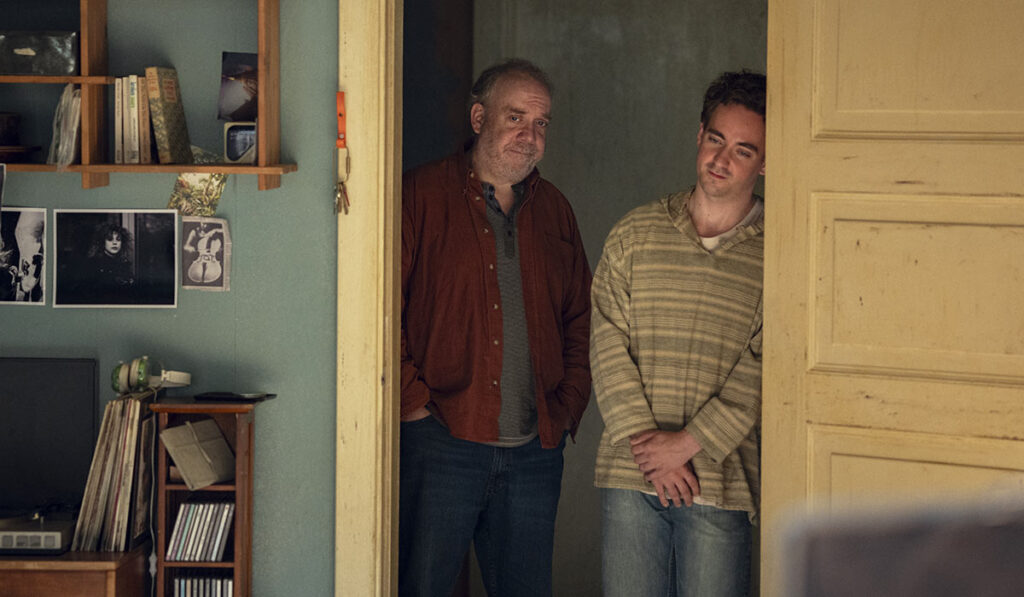
Paul [Giamatti] and Patsy [Ferran] absolutely knock it out of the park. I mean, I’ve been a fan of Paul’s since I think the first time I popped him on screen. “The Holdovers” was been my favorite films the last many years. But it is interesting because when we’re filming it, you can see Carol throughout, you can see her face in every scene, because all of those things are then done in post, that we’re sort of painting around and obscuring your face, scribbling over. When you watch the very first cut, the performances were there, and then I was like, “Can we just for the next rough cut, can we just mock up?” Even if we just put just a blob of something like temporary, it was amazing when you realize, “Oh my God,” this is when I get to the end, and we see she sees her for the first time in however many years, and what a powerful moment. And I think Chris [Barrett] and Luke [Taylor], the directors as well, have to hand it to them. They did an amazing job. We took a slight risk on them in a way. They hadn’t done narrative stuff like this before. They’ve done music videos, they’ve done commercials. We knew this was a sort of series of little set pieces in a way, this episode. But also, it had to be that in some ways it’s a quieter, more emotional story than we sometimes do. But again, it’s really high concept. What’s happening is really, it’s hard to describe on the page, and it’s really hard to realize. So there was a lot of sort of R and D that went into it, and they just did a phenomenal job. So I’m really, really proud of that episode
I will say, when I talked to Paul, he loved those directors. He raved about them.
He was so lovely as well. That was the other thing, he was not phased at all by the fact that we said, “Look, these guys, they’ve done music videos, they’ve done commercials, they haven’t done something like this before. We think you should meet them and talk to them.” And he did. And he was lovely. He was exactly what you would want Paul Giamatti to be like.
He’s always like the nicest, kindest guy. I just wanted to ask you one last quick question before I let you go: Will there be more ‘Black Mirror’?
I hope so. I don’t know yet. I don’t know. I’m certainly up for doing more, and I think the key is, so that’s slightly that would depend on the powers that be. But also I think my job on the show is to entertain myself indulgent and also sort of wrong-foot the viewer in some ways. It’s also a weird job. Again, you realize part of the remit is to surprise people, but also, people come with expectations. So it’s a really weird needle to thread. But I think we did, I think I was very pleased with the reaction generally, overall to this season, that I think from fans generally. Not that I do sit there refreshing social media in the dark obsessively looking, but from what I’ve heard, it seems to have gone down broadly, positively. And so yeah, no, I’ve certainly got loads more black mirror ideas up my brain’s sleeve. If a brain has sleeves, if I don’t believe it does.
“Black Mirror” is available on Netflix
Follow Gregory Ellwood on Bluesky
Follow Gregory Ellwood on Threads
Follow Gregory Ellwood on Instagram
Sign Up For The Breakdown Newsletter

Editor-at-Large Gregory Ellwood is one of the entertainment industry's most respected journalists and critics. Based in Los Angeles, he's the only current awards expert who previously worked on Oscar campaigns at a major movie studio. Over the years, he has written for the LA Times, Variety, The Hollywood Reporter, and Vox, among others. He also co-founded the entertainment news site HitFix, which spawned a legion of influential Emmy and WGA Award-winning alumni.


