




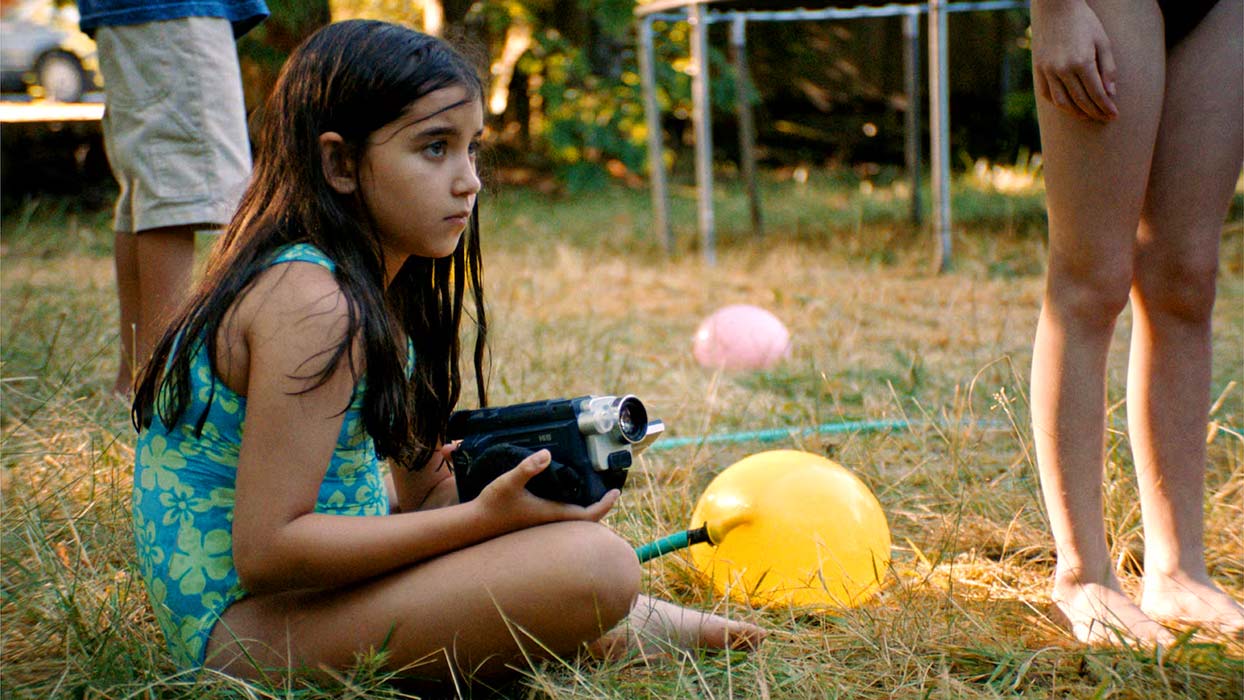
Movies about families often center on parents — they are, after all, the fitfully problematic wells from which each of us springs — but few dwell on the impacts of sibling relationships. Enter “Blue Heron,” Sophy Romvari’s staggering, autobiographical debut about a girl’s relationship to her dysfunctional half-brother, whose erratic behavior escalates after the family moves to Vancouver Island.
Set in the ’90s, “Blue Heron” follows eight-year-old Sasha (Eylul Guven), the only daughter in a family of three boys. The oldest is her mysterious half-brother, Jeremy (captivating newcomer Erik Beddoes), a teen loner who spends his free time drawing elaborate maps of the area and concocting increasingly alarming ways to test their parents’ authority. After a run-in with the police forces, Sasha’s mother (Iringó Réti, “Halo”) and father (Ádám Tompa, “On Falling”) to make an impossible choice, the film smartly fast-forwards to Sasha’s adulthood, where she (played as an adult by Amy Zimmer, of “Problemista” fame) reckons with the fallout of that decision.
The indie film world is glutted with subtle family dramas, so it’s commendable that Romvari has managed to find a novel way into her subject, as Heidi Ewing did with “I Carry You With Me,” and Charlotte Wells did with “Aftersun.” The first part of the film feels almost too hazy and lyrical for its subject matter — a few troubling things happen, but nothing really comes into focus, not even basic details like what Sasha’s parents do for work. When the film pivots to adult Sasha, who’s working to piece together what happened to Jeremy, everything falls into place. Given the startling clarity of most memoiric work, it can be easy to assume that people who have led complicated lives must remember every jagged detail — but such muddled recollections of childhood are actually common. Sasha’s gauzy, patchwork summer lends the film more realism.
“Blue Heron” finds strength in verisimilitude. The specificity of the time, place, and even the parents’ Hungarian background lend credence to the narrative, as does its stark lack of melodrama. Whether Jeremy is playing dead on the front stoop or actively bleeding, the camera — piloted expertly by cinematographer Maya Bankovic (“Ordinary Angels”) — regards him frankly. In the second half, Romvari casts real social workers to unpack her brother’s case and uses actual photos, videos, and audio from her childhood to illustrate the film. Jeremy’s maps even inspire the titles. Only modelesque bone structure interrupts the flow — if this film has one standout flaw, it’s that the actors are preternaturally beautiful.
Then, of course, there are the sibling dynamics that make “Blue Heron” so special. Jeremy is a complex character — enigmatic, frightening, and tender by turns — and Beddoes renders him with laudable restraint. Though Bankovic’s camera stays close, the film studies Jeremy with considerable emotional distance. Blonde, willowy, and adolescent, he seems less like a sibling to Sasha and her younger brothers and more like a wayward family friend. His motivations are never explained, his misbehavior never officially diagnosed. Like the titular bird who rules the wetlands around their home, he is almost another species. That’s not to say that the film lacks compassion, but rather that Sasha’s point of view so clearly dominates “Blue Heron,” and that sometimes family members can alienate themselves from you so successfully that they feel more like case studies than they do people.
The deceptive simplicity of “Blue Heron” might make it easy for some viewers to dismiss, but this is the sort of film that lingers long after the final credits. Romvari’s unique vision, coupled with Bankovic’s naturalistic visuals and the cast’s marvelous performances, culminates in a family drama that defies genre and expectation. It’s worth seeing — more than that, it’s worth digesting. I recommend a cinema screening, a quiet, wide-open day to follow, and — if it hits too close to home — a debrief with your therapist. [A]


