



.
“Capote” vs “Infamous”
Shared Theme: Head-to-head biopics of Truman Capote, especially as pertaining to his research and writing of “In Cold Blood”
Released within: 13 months of each other Sept 2005/Oct 2006
Different approaches: So well, wow. While other films on this list bear a passing resemblance but seem to do their best to differentiate in terms of tone, in this example they are frighteningly similar in terms of storyline, plot beats, and even subtext. Both movies detail Truman Capote’s increasingly fraught and complex relationship with convicted killers Dick Hickok and Perry Smith which fed into his pioneering “nonfiction novel” “In Cold Blood,” and with both ready at the same time it really was a case of playing chicken; “Infamous” blinked first. The relative quality of the films here is surprisingly difficult to judge as both tell the story very well, and both are marked not just by crisp and perfect embodiments of Capote in the central role (Philip Seymour Hoffman would win Best Actor for his, but perhaps Toby Jones’ portrayal is our slight favorite), but also by strong supporting casts, many playing real-life famous people. In fact in supporting terms, Douglas McGrath’s “Infamous” is maybe the starrier, as one of its differences from Bennett Miller’s “Capote” is in how it also gives a little attention to Capote’s New York milieu of fame and glitz, which arguably makes us understand his eventual breakdown and isolation better than the slightly narrower focus of “Capote.”
Which was more successful? If ever there was a case of first past the post taking the ribbon, this is it. “Capote” was a prestige pic hit, with its Oscar approval also bolstering it to a respectable $50m, off a low-budget base. “Infamous,” by contrast, made just over $2.6m the following year.
Which was better? Again, the first Truman Capote/”In Cold Blood” biopic you saw will probably be the best Truman Capote/”In Cold Blood” biopic you saw as the second time around, the story is just so strikingly similar that whichever you’re watching, you get a freaky sense of déjà vu. But while we’d never begrudge Hoffman his Oscar, we do feel a bit sorry for everyone involved with “Infamous” which is by no means an inferior film, especially for those supporting cast members who gave performances against type to good effect, like Sandra Bullock as Harper Lee (though again, Catherine Keener’s Lee in “Capote” is also terrific) and Daniel Craig as Perry Smith (Clifton Collins Jr in the rival film) — in the latter case especially interesting as “Infamous” makes the homoerotic nature of Capote’s fascination with Smith much more apparent than in “Capote.” Most of all, great British character actor Toby Jones deserved more from his pinpoint accurate portrayal than for it to end up the answer to a movie trivia question.
“Finding Nemo” vs. “Shark Tale”
Shared theme: Two computer-generated movies, made by rival studios, about aquatic life
Released within: 18 months — May 2003 and October 2004
Different approaches: If it looked slightly suspicious that two rival animation studios would have movies about insect life, released less than two months apart from each other (see above), then it seems like outright theft when a movie set underwater becomes the highest grossing animated film of all time and then an oddly similar feature comes out a little over a year later. If ever there was a case of “riding coattails,” this would be it. “Finding Nemo” concerns an overprotective father (Albert Brooks) who ends up losing his son and embarking on a pan-oceanic adventure to recover him. Meanwhile, “Shark’s Tale” is about a plucky little fish (Will Smith) who pretends to be a bad-ass “shark slayer” with the help of a mob-boss’ cowardly son (Jack Black), in a plot that somehow manages to nonsensically fuse “GoodFellas” with “Dragonheart.” While “Finding Nemo” chose to portray its aquatic stars as, um, fish, “Shark’s Tale” tried to make them look like people, frequently adopting the physical characteristics of the actor who is providing the character’s voice, which means that Smith’s character has little fins where his trademark big ears are, and Martin Scorsese, as a puffer fish, has giant eyebrows. Truly hilarious. Or something.
Which was more successful? “Finding Nemo,” with more than $380 million, was the highest grossing animated film of all time (at the time). “Shark Tale,” which followed “Finding Nemo” by more than a year, was not. “Shark Tale” netted $160 million, which is admittedly impressive, but still $200 million less than its predecessor.
Which was better? While “Shark Tale” has its fans, undoubtedly, somewhere, possibly hidden deep within the Afghanistan mountains, “Finding Nemo” is the clear victor. There’s a reason it was such a smash – it’s that fucking good. From Ellen DeGeneres‘ peerless performance as the forgetful fish Dory to Brooks’ equally nuanced job as the fretting father, to Willem Dafoe as the polar opposite — a father figure who pushes his faux son a little too far — the cast is uniformly excellent. “Shark Tale,” on the other hand, has a starry cast (including Angelina Jolie, Robert De Niro and Renee Zellweger) but not nearly as much compassion or depth. It’s the first DreamWorks movie in which the zippy pop culture references overtook the rest of the movie and simply became the movie. There was nothing deeper going on beyond how the next “Jaws” gag could be wedged into the story, which is typically not how great filmmaking works (and a team of three directors helmed this thing). Unlike “Finding Nemo,” which tugs on your heartstrings from the opening prologue and doesn’t let up until the credits roll, there isn’t a single moment of emotional resonance in “Shark Tale,” unless you count the relief that washes over you once it’s over.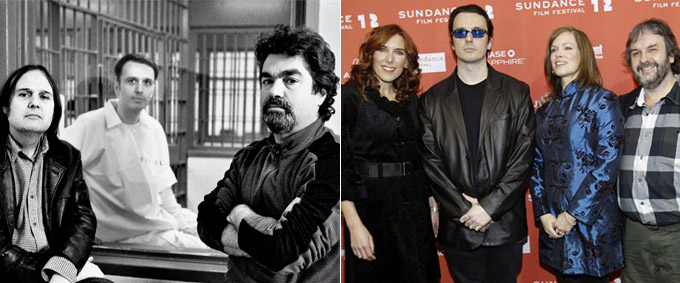
“Paradise Lost 3” vs “West of Memphis”
Shared Theme: Documentaries detailing the struggle for justice of the wrongly imprisoned West Memphis Three
Released within: 14 months of each other, though ‘West’ premiered at Sundance just 4 months after “Paradise Lost 3” bowed in Toronto.
Different approaches: Strange to be talking about dueling documentaries, but with the case of the West Memphis Three becoming one of the most high-profile instances of wrongful imprisonment in U.S. history perhaps not as surprising as it seems at first glance. And in fact, the films are different — “Paradise Lost 3: Purgatory” (review here) is after all the conclusion to Joe Berlinger’s epic trilogy of HBO docs, the first of which was certainly hugely instrumental in getting people’s attention drawn to the case in the first place. This fact is acknowledged in Amy Berg’s “West of Memphis” (review here) which is told maybe more in terms of the campaign to free the men than what happened subsequently (arguably the central figure in ‘West,’ Lorrie Davis who met and eventually married the imprisoned so-called “ringleader” Damian Echolls while he was on Death Row, mentions that she was moved to start writing to him after hearing about the case through the first Berlinger film). ‘West’ is also, however, critical of the second HBO doc, which cast suspicion on Mark Byers as a possible alternate suspect, while Byers emerges as something of an unlikely hero in Berg’s film, in publicly showing his change of heart regarding the Three’s guilty verdict. But the achievement of “Paradise Lost” cannot be underestimated, and as three successive contemporary snapshots of the ins and outs of the trial, subsequent investigation and eventual release of the men (‘Lost 3’ initially started filming under the impression it would end with the men still incarcerated), it has a different quality, and perhaps a different historical value, from ‘West of Memphis.’ Mainly though, with the events ‘Lost 3’ details, like the new DNA and witness evidence that points fairly damningly to a different perpetrator, coming about largely from the continued fundraising efforts of the campaign detailed in ‘West’ perhaps really the four films together make a compelling portrait of how, in telling a story, a documentary can become an integral part of the story too.
Which was more successful? It’s hard to gauge in traditional terms, with both films playing festivals and then released only in limited theaters, but ‘Paradise Lost 3’ did snag a Documentary Oscar nomination, at least partly, we have to believe, in recognition of the vital role the trilogy and its filmmakers played in righting a dreadful wrong.
Which was better? Both documentaries are expertly told narratives of a grotesque and at times enraging miscarriage of justice, and Berlinger’s sprawling film certainly has earned the right to be considered definitive. But for newcomers to the story, “West of Memphis” maybe provides the more coherent overview from the murders to the initial trial and then through the long, revelation-strewn path to eventual freedom for the convicted three, and is also notable for the appearances by the campaign’s famous champions like Eddie Vedder, Patti Smith, Johnny Depp, Henry Rollins and the film’s producer, Peter Jackson. But whichever you watch, prepare for the incendiary story to leave your blood boiling.

