


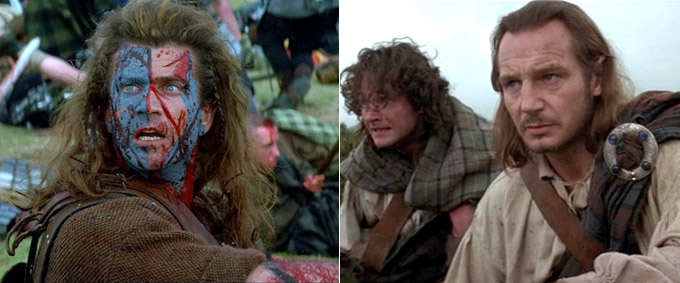
“Rob Roy” vs “Braveheart”
Shared Theme: Historical Scotsmen driven to noisy rebellion against the ruling elite due to injustices and outrages visited on their wives
Released within: 6 weeks of each other — April/May 1995
Different approaches: The thematic and geographical similarities between these stories more than cancel out the fact that the are set in time periods separated by 5 centuries or so — to even the less casual moviegoer, two movies with stars in kilts bellowing over the highlands is probably one too many. And Michael Caton-Jones’ “Rob Roy” does do essentially the same thing as Mel Gibson’s “Braveheart” albeit with less blue face paint, in exploding a Scottish legend into the dramatic tale of the struggle of the oppressed masses against the toffs/Englishmen who keep them down. Liam Neeson and Gibson are on a par in many ways as the frontmen of each, but as we recall there’s a little humor in “Braveheart” that communicates William Wallace’s charm and charisma to us, something we never quite got from Neeson’s Rob Roy. However “Rob Roy” wins in the villain stakes with Tim Roth really quite stealing the show by managing to be menacing in one of those daft 18th century wigs.
Which was more successful? ”Braveheart.” First to screens by a slim margin, the film took about treble its production budget and won 5 Oscars, while “Rob Roy” barely made it into the black and even at the time was critically regarded as the lesser film.
Which was better? “Braveheart.” It’s become fashionable to diss the Gibson movie (the worst film ever to win best picture, Empire? Really?) but it’s still a very fine piece of epic rousing filmmaking, that paints in wide strokes across a broad canvas, yes, but still manages to engage, in a shamefully enjoyable, emotive way. Oh and it provided the valuable service of giving groups of drunken men something to bellow at each other on the way home from the pub (“You’ll never take… our FREEDOM”) in the days before “300” (“This. Is. SPARTA.”)
“Antz” vs. “A Bug’s Life”
Shared theme: It’s very hard to be an individual when you’re a single tiny ant in a colony full of countless drones.
Released within: Two months of each other — October and November, 1998
Different approaches: There are few dueling movies with a background as contentious as “A Bug’s Life” and “Antz.” To explain: Jeffrey Katzenberg was an executive at Disney when “Toy Story” was being developed and eventually the discussion turned to what the Pixar team’s next movie would be (it was then called, simply, “Bugs,” which is also very similar to “Antz”). Katzenberg then left the company to help with DreamWorks SKG, overseeing the animation division. DreamWorks Animation would combat both Disney (with its traditional hand-drawn animation facility, made up of poached ex-Disney employees) and Pixar (as they’d be utilizing work from Pixar competitor Pacific Data Images, or PDI). When Pixar bigwig (and “Bug’s Life” director) John Lasseter found out about “Antz,” he was furious and called for a meeting with Katzenberg. Katzenberg’s terms were simple: move “A Bug’s Life” away from the Thanksgiving release slot, where it would go up against DreamWorks’ hugely expensive traditionally animated feature “Prince of Egypt,” to a slot sometime in the new year, and Katzenberg wouldn’t just remove “Antz” from the schedule (it was to open in October) but he would cancel the movie altogether. Lasseter told him to go fuck himself (in so many words), and Katzenberg rallied the troops at PDI and got the movie done ahead of the November debut of “A Bugs Life.” That said, for a project that was very clearly stolen from a preexisting one, “Antz” doesn’t look or feel all that much like “A Bug’s Life.” It was PDI’s first feature-length movie and the animation is cruder than in “A Bug’s Life” (Pixar’s second film) with a harsher, more satirical script about conformity and political unrest and the first strands of DreamWorks’ obsession with timely pop culture references (here it’s things like “Starship Troopers“). Even the bugs look different — in “Antz” the characters are a more lifelike brown, while in “A Bug’s Life” they’re blue, to avoid what Pixar called “the ick factor.”
Which Was More Successful? “Antz” got to the box office first and made a little over $90 million, which is impressive but no match for the domestic haul of more than $162 million for “A Bug’s Life.” Even if they come second, Pixar beats them all.
Which Was Better? There are some really wonderful things about “Antz” — it’s got a smart script and Woody Allen is wonderful as the neurotic main ant, named Z. But the general lousiness of the animation and the somewhat dour aspects of the screenplay ultimately undermine what should have been a more jovial, buoyant experience. “A Bug’s Life,” on the other hand, is just that: it’s a sunny confection that effortlessly combines Aesop’s Fables and Akira Kurosawa into one grand design. And while “A Bug’s Life” is often regarded as one of the “lesser” Pixar movies, is still charming and hilarious and gorgeous to look at, with the animators pushing the computers to convey nature in a looser, more organic way (compare this to the blocky nature of the PDI animation). It might not be as heartfelt (or as grandly experimental) as some of the other Pixar movies, but it is a solid, warm-hearted follow-up to “Toy Story,” which isn’t exactly an easy thing to do, with or without corporate subterfuge.
“Armageddon” vs “Deep Impact”
Shared Theme: Asteroid impact threatens the planet with extinction
Released within: 2 months of each other — summer 1998
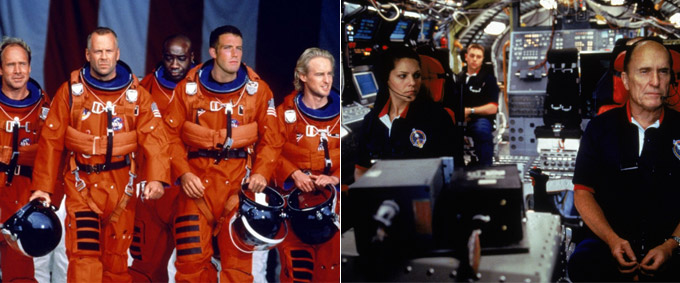
Different Approaches: While the premises are the same for these two films, right down to teams of astronauts being sent up (perchance to self-sacrifice) in desperate attempts to divert the seemingly inevitable, Mimi Leder’s “Deep Impact” plays out in a much more minor key than the gung-ho Aerosmith fueled testostrionics of Michael Bay’s “Armageddon.” In fact you could almost hazard that they diverge in terms of genre, with ‘Impact’ unraveling as more of a disaster movie while “Armageddon” goes for straight-up, one-man-saves-the-world type heroics. Bay’s film is broader by miles of course, while Leder’s, despite having the storyline to support some pretty massive scenes of planetary destruction, is more interested in the human reaction to this potential apocalypse, something it deals with with surprising heart (Maximillian Schell and Tea Leoni’s embrace on the beach as the tsunami hits is memorable and moving). But perhaps the reason that “Armageddon” is so brash and staccato in its rhythm is that there was no time to make it? The rumor goes that, hearing about the well-progressed script for “Deep Impact” at lunch, a Disney exec took notes and rapidly greenlit “Armageddon” as a counter move, which left Bay with only 16 weeks from a standing start to get the film in the can.
Which was more successful? “Armageddon” was the number two movie of 1998 (to “Saving Private Ryan“), making a hefty $553m of a $140m budget. But maybe contrary to the narrative at the time, the more downbeat nature of ‘Impact’ didn’t actually put people off in their droves; the film pulled in a very respectable $349m off a much smaller, $80m budget. It also opened bigger, though that could simply be down to being first in theaters.
Which was better? If the day will ever come that we reassess Bay’s “Armageddon” as anything but a noisy, graceless, frenetic and yet strangely boring headache of a film, today is not that day. “Deep Impact” takes our prize, not because it’s at all a flawless movie — it gets a little slack at times with all the heavy-duty emoting — still it has more actual meat on its bones in any one of its scenes than was contained in the whole bloated 151 minutes of “Armageddon.”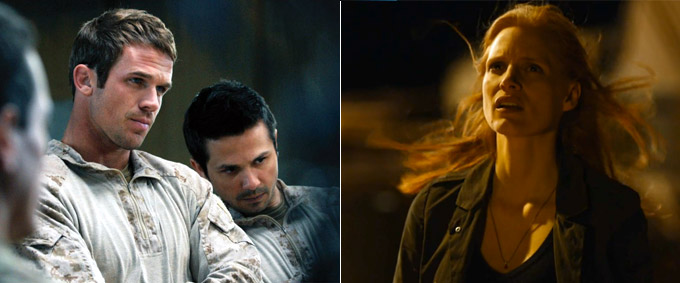
“Zero Dark Thirty” vs. “SEAL Team Six: The Raid On Osama Bin Laden”
Shared theme: The hunt for Osama Bin Laden was, like, super hard, but thankfully there were a bunch of rough and tumble bad-asses who were up for the challenge.
Released within: Two months of each other (“SEAL Team Six” aired in November 2012, “Zero Dark Thirty” was out at the end of December)
Different approaches: “Zero Dark Thirty” takes an almost journalistic approach to the material, covering the ten-year hunt for Osama bin Laden in sometimes painstaking detail, beginning with the terror attacks of 9/11 (heard but not seen, over a chilling black backdrop). It focuses on a single CIA operative named Maya (Jessica Chastain) who doggedly led the pursuit. On the other hand, “SEAL Team Six” goes for an almost faux-documentary approach, with a number of characters looking into the camera to address the audience as if they’re being interviewed and sequences meant to appropriate the look of several kinds of non-cinematic cameras (helmet cameras, complete with timestamps, etc). Sometimes this approach works, but other times, like when they utilize news footage of President Obama with his cabinet and they have someone dub in the voice of the cabinet member saying lines of dialogue from the movie, come across hilariously bad. The fact that the Weinstein Company-produced “SEAL Team Six” initially aired on the National Geographic Channel does, at least, explain why the budget and production values appear to be roughly the same as that of most original Shark Week programming.
Which Was More Successful? “SEAL Team Six” was actually incredibly successful for a TV movie, especially a cheapo knock-off like this one — it pulled down 2.7 million viewers, which was enough to make it National Geographic’s highest rated broadcast of 2012 and the network’s sixth-highest rated broadcast ever. But it doesn’t quite compare to the $95.7 million ‘ZDT’ grossed in the United States (another $13 million overseas), universal critical adoration and 5 Academy Award nominations. Sorry, Weinstein Company and National Geographic Channel.
Which was better? Let’s think about this one… Um, “Zero Dark Thirty” is a true masterpiece, a kind of “All the President’s Men” or “Zodiac” but in the desert and with one of the most amazing female leads in recent memory, a woman who has devoted ten years of her life to one man, a man she is desperate to kill. “SEAL Team Six” isn’t necessarily bad, well, it is, but it’s not that bad. It’s just that the real-life conceit that director John Stockwell, who besides being a fairly big-time filmmaker now, was the nerdy kid’s jock friend in John Carpenter‘s “Christine,” strives for is constantly being undermined, largely by his distracting casting decisions. The last thing you want to ask yourself, while getting involved in the planning and execution of a plot to bring down an infamous, genocidal terrorist, is “Hey is that T-Bag from ‘Prison Break?'” And yes, it is T-Bag from “Prison Break.” Thanks for asking. (And here’s our full breakdown on the differences between each movie)

