


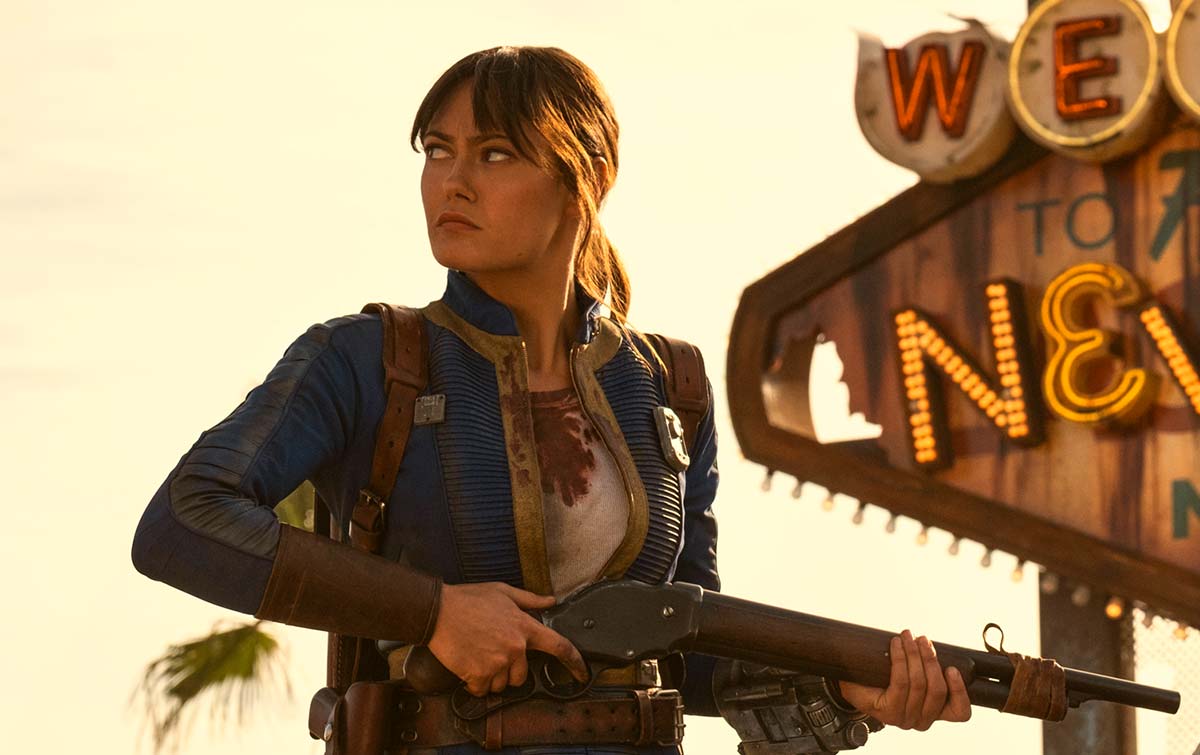
One season in, and the consensus on “Fallout” remains clear: this is a video game adaptation done right. “Fallout” began life a console mainstay, with the first entry hitting shelves in October of 1997, and though seven years have elapsed since the most recent release, last year saw “Fallout” make its way to Amazon Prime by way of an eight-episode season which told the story of life following a nuclear war, one that took place in the latter half of the 2000s and, with two hundred years having passed since the event, humanity has essentially been occupying a network of fallout shelters (“Vaults”). Much like the games upon which they were based, “Fallout” adopts a retro-futuristic tone, with the aptly named Vault Dwellers overwhelming with ’50s-esque earnestness and rampant inbreeding, though when one such dweller, Lucy (Ella Purnell), witnesses the capture of her father Hank (Kyle MacLachlan) at the hands of a tribe of raiders upon their successful breaking into Lucy’s home Vault, her next move sees the highly positive young woman venture out to the surface for the first time in pursuit, leaving behind her younger brother Norm (Moisés Arias) as he begins his own quest investigating other Vaults.
Meanwhile, a side plot, which soon meets up with Lucy’s journey, involves former actor Cooper Howard (Walton Goggins), badly mutated during the initial nuclear strike and who’s spent the past two centuries as a so-named Ghoul, with a deformed face and thirst for vengeance as he attempts to find his family. Periodic flashbacks shed further light on Howard’s previous life, and when Cooper and Lucy finally intersect, do their travels reveal additional decaying remnants of society? Is there even room for a third storyline? You’d better believe so, it revolves around Maximus (Aaron Moten), a war orphan who now works for the Brotherhood of Steel, a post-military organization focused on retrieving pre-war technology. He, too, will soon join our dynamic duo, as will Hank. However, Lucy’s relief soon turns to horror when it’s revealed that the past acts her father committed, and his subsequent fleeing, shift Lucy and Cooper into road trip mode. Cue Season Two!
READ MORE: 8 December Show To Watch: ‘Stranger Things,’ ‘Fallout,’ Emily In Paris’ & More
The importance of Vault-Tec should be noted, it having played a role in Season One and continuing to figure heavily in this second jaunt; a massive corporation responsible for the construction of the Vaults, a Vault-Tec executive, Bud Askins (Michael Esper) now exists as a Rollerbrain, or “Brain-On-A-Roomba” (yes, it’s exactly what it sounds like), overseeing a team of Vault-Tec executives locked in cryosleep for an indeterminate amount of time. We last left Norm after making this discovery, now locked within this chamber and given the choice between entering a cryogenic tube of his own or meeting his demise. His solution? Take out Bud, awaken them all, and deal with the fallout, pardon the pun!
Meanwhile, Lucy and Cooper continue across the wasteland toward the former Las Vegas, now infamously renamed New Vegas, in a noteworthy nod to the signature place first seen in 2010’s “Fallout: New Vegas,” where Hank has now taken refuge, as seen at the tail end of Season One. As if to stitch together further gaming references with little in the way of transition, Season Two’s premiere introduces Robert House (Justin Theroux), a noteworthy villain from the games now making his televised debut and oozing with a mix of classic debonair and an overall Howard Hughes look & feel. He’s here to show off a nape-inserted device, one that promises compliance, but if the dial turns up too high, it could result in the wearer’s head…no longer existing. He’ll materialize again, and in the continued spirit of flashbacks, Episode Two sees Cooper in attendance at a VFW where he’s present to honor a fellow Marine as the latter receives an award; it’s a series of scenes where Cooper’s past-life selflessness sits on full display as his former comrade regales the assembled crowd of how his friend performed in the act of duty years prior. However, further peeks into Cooper’s covert operations as he investigates Vault-Tec lend weight to the theory as the action shifts back to the present, where an apparent disconnect between Lucy and Cooper has begun to form. It’s not long to see this take center stage, as the two find themselves in the midst of a hail of bullets and the discovery of a tribe Cooper sees fit to disregard but Lucy can’t help but offer assistance; when given the choice between assisting a wounded Cooper or one such tribeswoman, Cooper gets the cold shoulder, with Lucy angrily proclaiming her wish never to allow herself to turn out like everyone’s favorite Ghoul.
Even in this separation, time must be reserved to check in on Maximus, now having to deal with the arrival of a prefect (Kumail Nanjiani) from another branch of the Brotherhood, one in whom he may have found a kinship, as short-lived as that may be, especially when it’s acknowledged how soon enough the battlefield will see both men on rival sides. This, however, is not what will end their time together. As the narrative heads back over to Lucy, now in captivity after encountering further militias, each with their own unique acronyms and goals, could Cooper now be the one with the opportunity to do the saving? Bear in mind, by this point, we’re scarcely halfway through the season.
As much as there may be happening onscreen, with every sinister-sounding line of dialogue punctuated by the occasional burst of action, Season Two of “Fallout” maintains a slow-burning pace throughout, fortunately unhampered by the actors’ ironclad commitment to the compelling characters they inhabit. It doesn’t remain easy to cite any one standout, as each understands the mission and radiates copious amounts of both chemistry and charisma in the process. The crystal-clear photography somehow balances the retro with the post-apocalyptic, resulting in something that never once feels bleak, possibly even cheery, as guns are drawn and Cooper growls his way from scene to scene. To compare this, both this season and its predecessor, to anything of even remotely similar caliber ultimately becomes useless; this is as unique as it gets, whether based on a long-running video game franchise or otherwise.
There’s no denying the depth; with countless titles within the world of “Fallout” from which to scrape material, it’s a complex story to tell, yet Season Two showrunners Graham Wagner and Geneva Robertson-Dwonet have succeeded in taking the reins from Season One’s Jonathan Nolan and continued to move “Fallout” right along seamlessly. Could one surmise the endgame? Possibly. Until then, it’s a joy to find out what that might be. [A-]


