

Quentin Dupieux’s return to France after his 2014 Los Angeles-set film “Reality” was more than a homecoming. Ever since 2018’s “Keep an Eye Out,” his first film shot in his homeland, the electronic musician and filmmaker has brought a breath of fresh air to French cinema with a series of low-budget, high-concept films unlike anything else being made in the country. Deceptively simple, sometimes profound, and always offbeat, films like “Deerskin” (2019) and “Daaaaaalí!” (2023) have given French actors, otherwise busy with small-scale realist dramas or Americanized cop thrillers, a unique playpen in which to do something different.
READ MORE: 27 Most Anticipated Films From The 2026 Cannes Film Festival
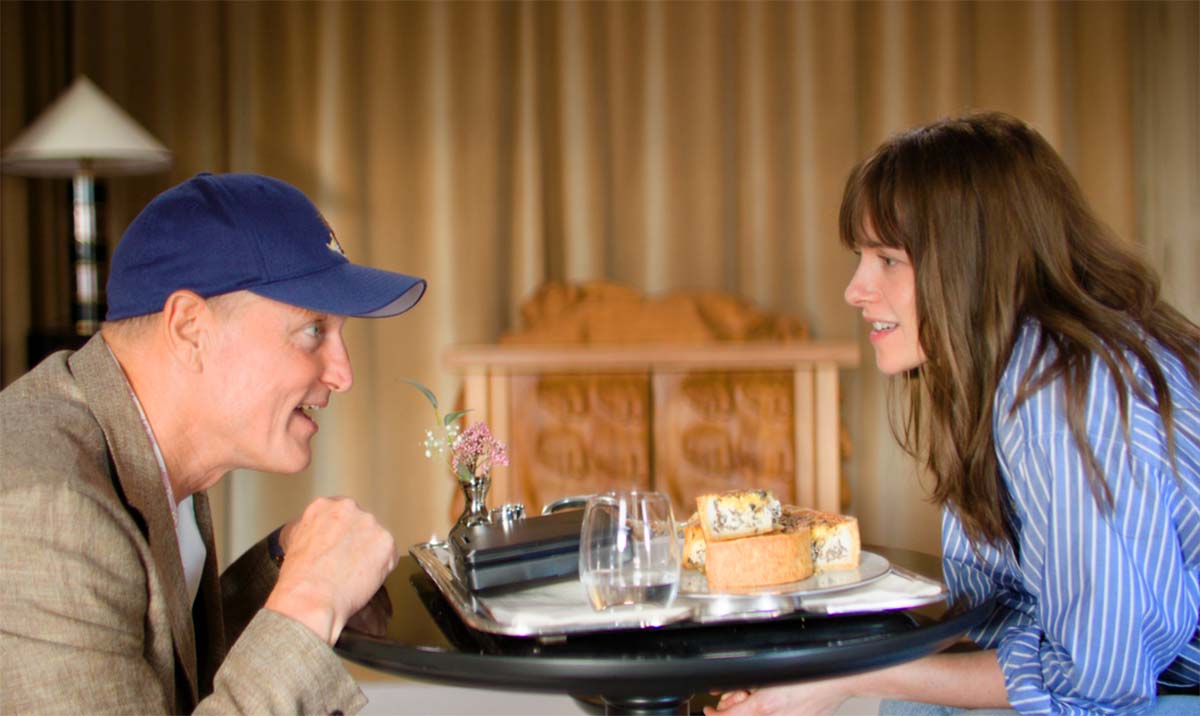
Premiering in the Midnight Screenings section of the 2026 Cannes Film Festival, “Full Phil.” seems like an attempt to reproduce that experiment in the U.S. Woody Harrelson plays the titular Philip Doom, on holiday in Paris with his bratty daughter Madeleine (Kristen Stewart, unfortunately at her most am-dram). Although it is often said that comedy does not travel well, Dupieux’s brand of absurdism could be expected to work anywhere, in any language. In fact, on paper, a lengthy and pointless conversation about a clogged toilet should be even funnier coming out of the mouths of two Hollywood stars.
Dupieux worked in a somewhat similar register in the wonderful “Incredible But True” (2022), giving French acting royalty Léa Drucker and Benoît Magimel stunningly banal situations and dialogue to work with. The result then was a hilarious breakdown of language and convention, teasing out from behind trite banalities an all-too-human desperation to please and to alleviate the boredom of existence.
The conceit in “Full Phil.” is similar, but its effect is more blunt and abstract. Unfolding in a less realistic register than “Incredible But True,” the scenes between Phil and Madeleine gesture toward some allegory: while this father berates his daughter for using his en-suite bathroom, she stuffs her face with inhuman amounts of rich food and watches a crappy black and white creature feature on a small monitor. We watch, cringing in discomfort, for clues about what the point of all this might be. When it finally comes, through the characters’ dully didactic dialogue, it turns out to be more disheartening than the frustrating mystery.
To every single one of Phil’s pleas for kindness and connection, his daughter replies with contempt and some kind of accusation painting him as a creep. She isn’t sincere, but when the hotel staff gets involved and decides to “protect” her, Madeleine does not object. Dupieux paints a depressingly reactionary portrait of a world where political correctness has gone mad: a female hotel employee (Charlotte Le Bon) stays to watch over Madeleine because Phil raises his voice slightly and, I quote, “there have been a lot of sordid things going on in hotels lately.”
Meanwhile, Paris is shaken up by riots just outside the Dooms’ hotel window, and the implication is clear. While these young women conspiratorially speculate about potential violence, they ignore the actual police brutality taking place in the streets below.
Scenes from the low-budget horror film Madeleine watches offer welcome interruptions from the unfunny, disconcertingly alarmist father-daughter drama. Featuring American comic duo Tim Heidecker and Eric Wareheim as a pair of mad scientists, the film-within-a-film turns up the awkward clunkiness and fascistic tendencies of the genre to mildly amusing effect: the eager scientist-explorers brutally murder a monster—reminiscent of the iconic “Creature from the Black Lagoon” (1954)—and deploy implausible machines to study its insides, for example. These sequences are most enjoyable for their voluptuous black and white cinematography, miles away from the uniformly bright digital image of the rest of the film, and the work done on costumes, practical effects, and lighting.
Perhaps unsurprisingly, however, this parallel story likewise goes nowhere and never rejoins the other in any meaningful way. To argue that Madeleine’s aggressive behavior might in some way be caused by the violent horror film she is giggling at feels like a stretch. Still, there does seem to be at least an effective parallel between the movie’s heightened violence and her cynical hyper-vigilance.
As “Full Phil.” alternates between these two levels of reality with a randomness that feels vacuous rather than edgy, a ticking-clock mechanism within the film thankfully lets us know that we are approaching its conclusion: the more Madeleine eats, the bigger Phil’s stomach gets, and it’s not hard to guess how this will end. At that fateful, final moment, Dupieux cuts to a flashback to Madeleine’s childhood that feels like a feeble and confused attempt to insert some heart into this bleak picture. It seems the film is trying to say something about the trauma, violence, and beauty of parents’ relationship to their children, but this last-ditch attempt at some meaning—let alone profundity—feels like a cynical, calculated move, even as it is narratively incomprehensible. Dupieux has excelled in the past at such ambitious maneuvers, notably in “Yannick” (2023) and “Deerskin.” Despite the chaos of “Full Phil,” there is still hope that he could do it again. [D]
Elena Lazic is a French film critic, curator, and writer based in London, UK. She is the founder and editor of online publication Animus Magazine, and a Production Manager at Radiance Films.

