





“Faces say so much, but only after you’ve looked at them for some time,” muses Laurence Rupp’s Philip Weiss as he hovers his camera over his wife, Léa Seydoux’s Lucy. It’s a statement that writer/director Marie Kreutzer spends nearly two hours proving in her latest film, “Gentle Monster.” There are few more revelatory sights in today’s cinematic landscape than sticking a camera in the proximity of Seydoux’s visage and simply resting it there to take in the subtle conveyance of her character’s expressions and emotions.
READ MORE: 27 Most Anticipated Films From The 2026 Cannes Film Festival
Lucy’s journey through doubt and disbelief proves that sometimes the most impactful acting is simply reacting honestly. Kreutzer’s aesthetic is a largely unobtrusive one throughout “Gentle Monster,” as cinematographer Judith Kaufmann tends to place the camera at a distance that allows viewers to take in both the characters and their settings. This makes it all the more impactful when the lens gets right up in Seydoux’s face and lets the toll of the turmoil roiling her family reveal itself.
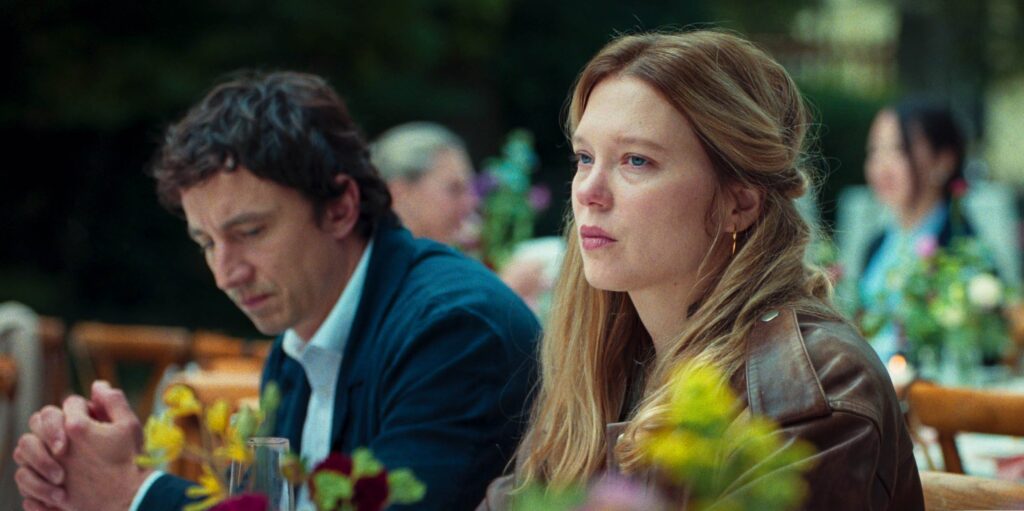
An extended prologue shows Lucy, Philip, and their young son Johnny (Malo Blanchet) settling into their new lives in an idyllic rural home in the German countryside … yet still feeling ever so slightly unsettled. That lingering suspicion immediately calcifies into real drama once the title card of “Gentle Monster” hits, accompanied by the cop Elsa Kühn (Jella Haase) and the loud hip-hop music she blasts on her way to the Weiss home. It’s not until Lucy heads to the station and reads the descriptions on the elevator buttons that Kreutzer makes clear why they apprehended her husband: child pornography and sexualized violence against children.
Lucy finds herself unwittingly cast in an archetype she chafes against: the “wife of a monster,” akin to the “mother of a monster” trope for parents of mass murderers in America. While the authorities have enough suspicion from Philip’s chat activity to execute a search warrant and confiscate his computers, they do not perceive an imminent enough threat of violence to have his case jump the queue of investigations. Thus, the Weiss household must carry on in an indefinite purgatory where Lucy frets about the secrecy of her husband, the safety of her son, and the sanctity of their family’s reputation in the community.
As a gifted pianist and musical performer, Lucy’s work revolves around taking love songs written by men and interpolating the emotions they cannot put into words. But when it comes to divining the truth from the man she thinks she knows better than anyone, those critical faculties crumble. Kreutzer’s cast of characters and locations—Lucy is a French woman married to an Austrian living in a German-speaking locale where it’s often easiest to talk in English—lend a fluid approach to language that mirrors the character’s own struggles with articulacy. Perversely enough, the person she feels most comfortable being honest with is Kühn.
The film’s title derives from Philip’s chatroom handle, a paradoxical pen name that speaks to the duality Lucy endeavors to reconcile. Further complicating any evaluation of the present is Philip’s sordid past as a low-level drug dealer who swears he’s turned the page on that chapter in his life. There’s “no off button” to stop loving someone overnight, as Lucy tells her stern mother, Eloise (a perfectly cast Catherine Deneuve). But the lingering investigation results hang like a Sword of Damocles over her marriage, and its presence sure does make the electricity flicker.

It should go without saying that at no point in “Gentle Monster” is Kreutzer trying to excuse or explain away the exploitation of children’s innocence. But it offers some understanding that feels in line with the revelations stemming from the steady drip of information from the Epstein files, which revealed the coziness of the elite with some of the most heinous sexual abuses. For those like Philip who feel insecure about whether or not they have power, deriving it from those without the wherewithal to resist can prove illicitly alluring.
Kreutzer’s conclusion is all the more potent because she conveys it not through some grand monologue of enlightenment but as the conclusion of Lucy’s deep soul-searching. The performance, as multifaceted as it is multilingual, is yet another feather in Léa Seydoux’s cap, continuing her peerless streak of working with some of global cinema’s most exciting directors. The psychologically piercing glimpses into the character’s shifting calculus, both moral and practical, shift the axis of intrigue from Philip’s guilt or innocence. The real driving force of “Gentle Monster” is how Lucy will process the latest development.
Seydoux is so brilliant that she outshines other elements of the film, especially the script. Kreutzer tries to expand the story’s scope by setting up Kühn’s home life as a narrative counterweight to Lucy’s. But scenes where the officer tends to her ailing father (Sylvester Groth), whose dementia brings out sexually harassing behavior toward female home aides, add little to “Gentle Monster” and its lamentation of men who do not understand how to express themselves.
Kreutzer is no stranger to writing tightly cloistered psychodramas about women unraveling, as shown by her international breakout “The Ground Beneath My Feet.” She might have served “Gentle Monster” better by narrowing her focus to a pure character study. But one hardly has to squint to find those elements in the film. They’re present every time Kreutzer trains the camera on Seydoux and lets her demonstrate why she’s among cinema’s finest working actresses. [B]


Marshall Shaffer is a freelance film critic and journalist based in New York. In addition to The Playlist, his byline can be found at sites including Slant Magazine, Decider, Crooked Marquee, and Men's Health. He is a member of the Critics Choice Association and New York Film Critics Online.

