


The promise of finality implied by the title of Michael Sarnoski’s “The Death of Robin Hood” looms large over the proceedings. It’s to the point of fault. The film is so obsessed with endings that it never really begins.
No one needs a PhD in cultural studies to divine why the story of Robin Hood, an outlaw in English folklore famed for redistributing his loot from the rich to the needy, proves so sticky in a time of pronounced income inequality. Much like more recent adaptations of the lore with Russell Crowe and Taron Egerton as the mythical figure, Sarnoski’s film resists the obvious urge to historicize the contemporary. But while those films turn the character into a war hero as an excuse to stage a medieval action film, “The Death of Robin Hood” has something else in mind for the protagonist.
READ MORE: 53 Must-See Films To Watch Summer 2026
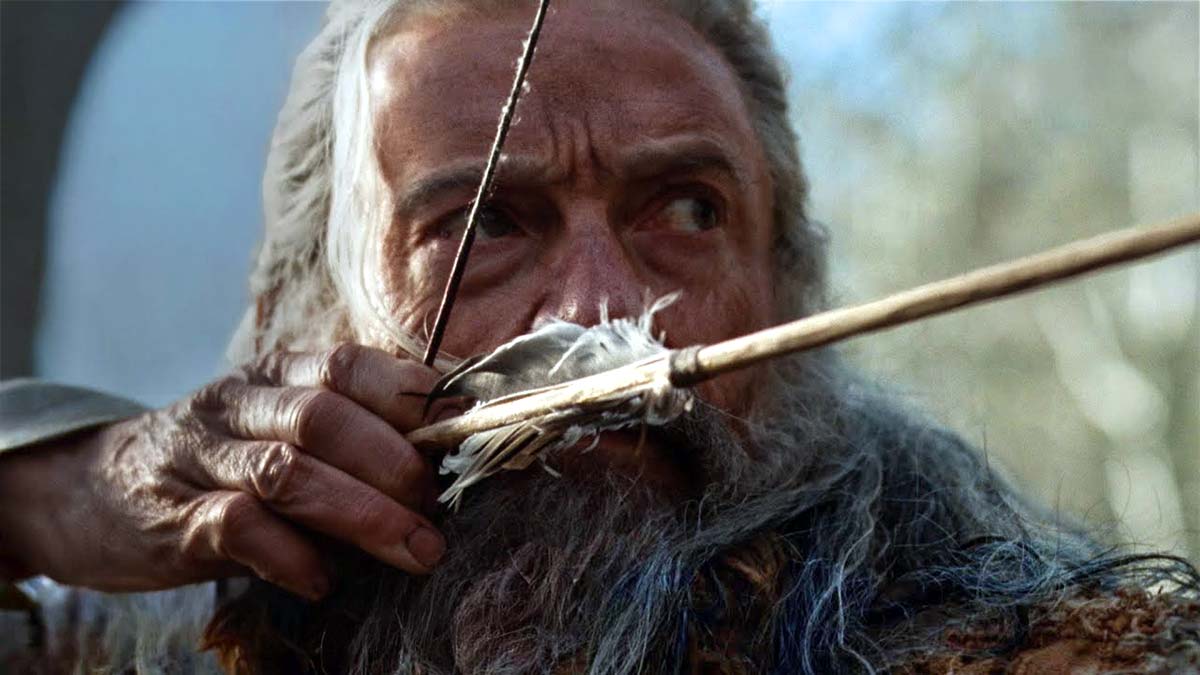
From the first sight of Hugh Jackman’s Robin Hood, it’s clear this beleaguered bandit is far from his glory days. With a weathered visage resembling that of his Wolverine in “Logan” and a thick rat’s nest of matted white hair resembling Santa Claus, his legend feels entirely past tense by the time Sarnoski’s film catches up with him. There’s still a battle left to fight, however, and it unfolds in a genuinely gruesome and gnarly fashion. (Never doubt that a weapon so simple as a bow and arrow can inflict stomach-churning carnage.)
Following the serious wounds he sustains, Robin Hood – known only by the name “Randolph” – must recuperate at a priory where his reputation does not precede him. Stripped of the pressure to perform his persona like a character, Robin has the space to contemplate who he is and what life means. Under the tutelage of Jodie Comer’s benevolent Sister Brigid, his extended convalescence becomes an opportunity to contemplate guilt, forgiveness, and salvation.
But redemption for what, exactly, remains frustratingly unclear in Sarnoski’s film. “The Death of Robin Hood” spends two hours floating in a murky middle ground between the mythical and the mundane. Details, or even intimations, about what haunts Robin from his past are fuzzy at best. It’s like watching a vibes-heavy edit of the project that overcorrects on removing plot points or character backstory. Any intention of strategic ambiguity comes across as vagueness.
If the intention is for audiences to fill in the gaps in their cultural knowledge of Robin Hood, that shared repository is just not deep enough to connect the dots in a feature-film context. Jackman has done a version of this story before in “Logan,” which worked in large part because viewers brought 17 years of lore and love to see the character confronting his mortality. (There’s also plenty of his arc as Jean Valjean in the screen adaptation of the “Les Misérables” musical, for that matter.) “The Death of Robin Hood,” to the film’s detriment, gives the actor no such scaffolding.
The sumptuous cinematography, lent by Pat Scola, gives the film a poetic quality that keeps the eyes engaged as the mind wanders. But those visuals are not strong enough on their own to create the atmosphere of a Malick-style tone poem that prioritizes essence over actuality. Sarnoski waffles between operating in the symbolic and humanistic realms, thereby robbing the images of greater expressive power.
“The Death of Robin Hood” ambles along instead as a series of vignettes of varying quality, tied together by a sulking, somber Robin in his feelings. The effectiveness of each scene primarily depends on how well the character he plays opposite is developed. It’s no surprise that the film’s most moving exchange comes with Noah Jupe’s Godwin, a young man blinded by battle and seeking vengeance. (Contrast that with Murray Bartlett’s leper, who mostly dispenses empty platitudes.) But the film comes alive just as much in the brief appearance of sidekick Little John, who Bill Skarsgård embodies with an irresistibly impish sense of macabre humor that begs for a spinoff.
The experience of watching the film becomes akin to tuning in for the super-sized series finale of a television program as one’s first point of exposure. It’s easy enough to admire the evident technical merits, yes, but difficult to find any element that invites a viewer into the specific, soulful experience of the characters. As “The Death of Robin Hood” circles the obvious ending, the main point of reflection it invites is the missed opportunity to flesh out this world with a level of detail on par with its ambitions. [C]
“The Death of Robin Hood” will release in theaters on Friday, June 19.

Marshall Shaffer is a freelance film critic and journalist based in New York. In addition to The Playlist, his byline can be found at sites including Slant Magazine, Decider, Crooked Marquee, and Men's Health. He is a member of the Critics Choice Association and New York Film Critics Online.

