


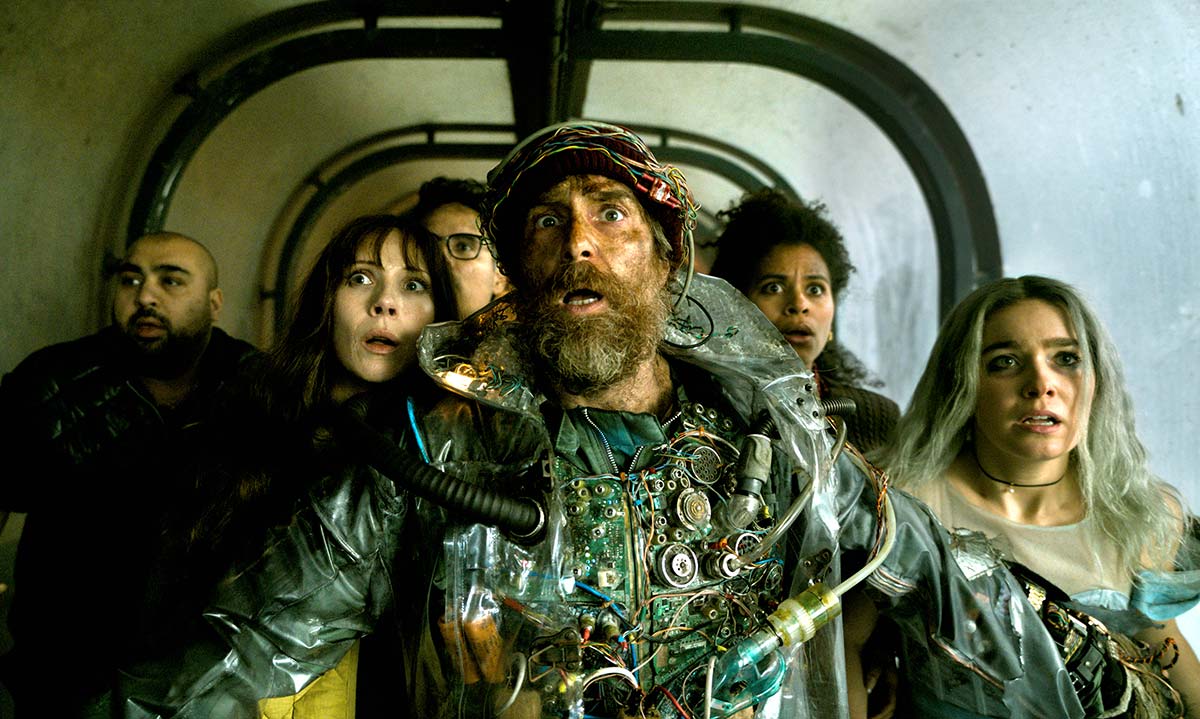
During any given commercial break of 2026’s Super Bowl, viewers likely got some message from an established tech giant or a fresh-faced startup that the AI era had arrived—and its continued progress was inevitable. Clearly, that memo did not reach director Gore Verbinski’s desk. The filmmaker’s first feature in a decade, “Good Luck, Have Fun, Don’t Die,” arrives in American theaters at just the right moment, with its defiant refusal to blindly follow humanity into a new era of surrender to technology.
“AI? Isn’t that a thing already?” asks Zazie Beetz’s Janet after Sam Rockwell’s raving, wire-laden Man known only as “Man from the Future” confronts her with its danger. She could just as well be speaking for the audience watching the film. From “2001: A Space Odyssey” through to “The Terminator,” the threats posed by artificial intelligence have bordered on apocalyptic. Both years in those films’ dystopian worlds have come and gone with no humanoid robots lording over people. Instead, the film argues, humankind has created the conditions for willingly handing over reality to digital overlords.
READ MORE: 14 Must-See February Films: ‘Wuthering Heights,’ ‘Pillion,’ ‘Crime 101’ & More
As the gradual encroachment of AI into everyday life nears an event horizon moment, it’s notable that the Man from the Future’s goal in time travel is to place appropriate safety guardrails around the technology to protect people. Screenwriter Matthew Robinson’s chief starting point for “Good Luck, Have Fun, Don’t Die” could easily have been Jonathan Haidt’s much-pored-over book “The Anxious Generation,” which approaches the current smartphone crisis through the lens of harm reduction for youth.
The Man from the Future, whom Rockwell brings to life with a gonzo bravado, reflects the exhaustion of a population that feels as if their relationship to technology is one battle after another. When the film picks up with his character crashing into a bustling Los Angeles diner, he’s got his elevator pitch down about the need to rescue humanity from impending technological doom due to a “Groundhog Day”-level of eternal recurrence. He knows exactly which unsuspecting patrons he needs to pluck as partners in his mission. But he restarts his 117th go-round in the time loop because the inner sanctum of the rogue AI still eludes him.
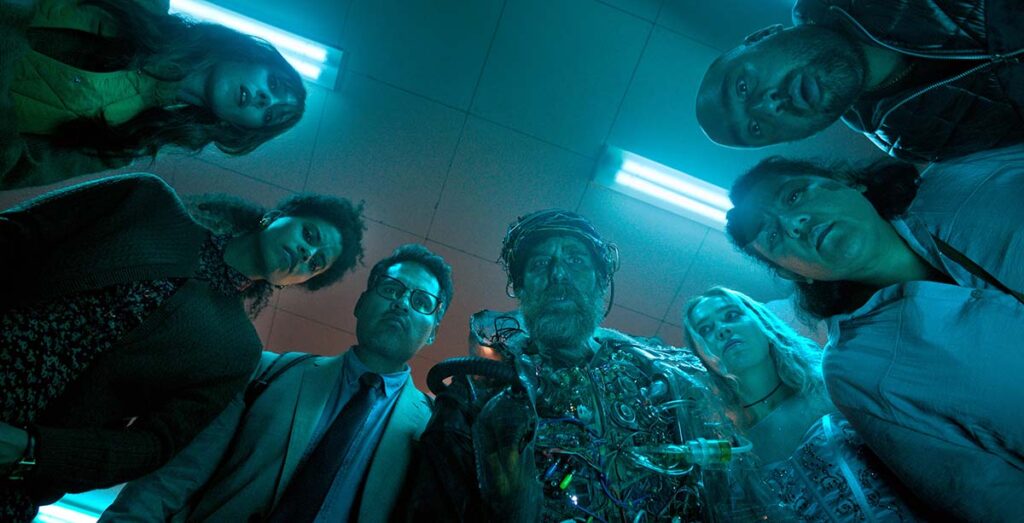
Robinson’s amusingly sui generis script feels like the ultimate argument against the very forces of homogeneity that the rabble-rousing protagonist rallies these unwitting combatants to fight. His chatty, monologue-prone dialogue and fragmented storytelling at first give off the vibes of a late-’90s Tarantino rip-off. Save for one instantly dated Labubu crack, it’s a mercifully more iterative screenplay than an imitative or reference-packed one.
Each of the main characters receives an episode that explains how they ended up at the diner that fateful evening. These backstories all possess a “Black Mirror”-esque quality, with chilling funhouse-mirror versions of contemporary society. Some offer fun but familiar variations on well-worn tropes: the screen-addicted teenagers enthralled by generative AI slop, the woman so sick of technology that she literally develops an allergic reaction to the Internet.
But Robinson’s most inspired ideas come from leaning even further into the daring black comedy at the heart of his conceptual gambit. This shows up most prominently in a segment that touches a third rail in American society: school shootings. His take on the alarming placidity of grieving parents imagines a cottage industry of cloning the teenage victims – complete with an ad-supported tier for those who want to save a little on their replacement children. The segment’s unblinking satire makes the film worth the price of admission on its own.
The sheer number of sidekicks to cycle through – including Beetz, Michael Peña, Haley Lu Richardson, Juno Temple, and Asim Chaudhry – does make “Good Luck, Have Fun, Don’t Die” feel as overstuffed as its lengthy title. Verbinski’s energetic, assured direction helps smooth out much of the motion sickness caused by Robinson’s herky-jerky script. The film serves as a reminder that the Man knows how to direct a rip-roaring action-adventure romp. Verbinski proves adept at adapting to the pace of Internet-era spectacle, reflecting a Daniels-like sense of absurdity and animated action in its zippy, quippy storytelling.
There’s some dust gathered on his director’s chair following a prolonged absence, however. Like many of the formulaic blockbusters that might as well have been written by a large-language model, “Good Luck, Have Fun, Don’t Die” struggles to stick the landing once the Man from the Future and Richardson’s Ingrid reach their desired destination. The climactic set piece devours the storytelling in the third act as it renders AI into just another unremarkable and personified villain. It’s at once too heady and not heady enough – plus, just like the rest of the film, bogged down by dragging on.
Yet, perversely, this conclusion does only strengthen the bona fides of “Good Luck, Have Fun, Don’t Die” as a true movie of its moment. Everyone can align on the peril ahead as AI increasingly embeds itself in everyday life. How to meet this challenge with a new response remains tantalizingly just out of reach. Verbinski and Robinson’s cinematic equivalent of screaming “FIRE” in a crowded room might help the next person tackling this pressing topic find the exit. [B]
“Good Luck, Have Fun, Don’t Die” opens in theaters on Friday, February 13.

New York-based freelance journalist whose writing appears regularly on Decider, Slant, Slashfilm, and The Playlist, covering film with a focus on cultural context.


