



Life feels increasingly like the absurd, arcane trappings of a Yorgos Lanthimos film with each passing year. Or, perhaps, the intensifying unraveling of social order across the globe has revealed that the world has always been this way, and the Greek director’s observations have just been ahead of the curve. These tantalizing possibilities intersect in Lanthimos’ latest project, “Bugonia,” a film that perfectly meets a cultural moment of conspiracy and cynicism.
READ MORE: 2025 Venice Film Festival Preview: 23 Must-See Films To Watch
It’s not a particularly high bar to call this Lanthimos’ most openly political work since his films always feel like they’re unfolding in a funhouse mirror’s reflection of the real world. Will Tracy’s script might draw its origins from the 2003 South Korean film “Save the Green Planet,” but it never feels dated in the slightest. Kidnapping a suspected extra-terrestrial – in this case, Teddy (Jesse Plemons) and cousin Don (Aidan Delbis) abducting big pharma CEO Michelle Fuller (Emma Stone) – hardly feels like a high-concept plot hook anymore.

It’s a damning indictment of a broken society that “Bugonia” does not even have to try particularly hard to hit targets in contemporary life. The film need not nod directly toward topics like Make America Healthy Again, fertility anxiety, girlboss capitalism, the manosphere, performative activism, and online radicalization. Their insidious, invisible influence informs perspectives on both sides of the screen.
But Lanthimos and Tracy are not interested in pitting sanity against irrationality in a simplistic dichotomy. From the earliest introductions of the characters, editor Yorgos Mavropsaridis finds parallels between Michelle and the men rather than points of divergence. In their own way, each places personal wellness on a pedestal. They undergo strenuous regimens of bodily optimization, with both incorporating yoga poses into their routine.
Where the comparison falls apart is how they triangulate this health obsession in relation to systems of power and authority. Michelle can impose her vision through a dominant regime of drug manufacturing that Teddy (and, through some easy convincing, Don) views as an instrument of oppression. Given her company Auxolith’s sanitized corporate jargon that skirts responsibility for any outcomes of the cures they peddle, Michelle is a prime target to embody the nebulous “they” whom Teddy can turn into a scapegoat for all his woes.
By the time “Bugonia” picks up with Teddy’s spiral down the rabbit hole of extremization, he’s already surmised that the same colony collapse disorder plaguing his beloved bees is repeating itself in his own species. If Michelle’s activity is so nefarious that it represents an existential threat to humanity, it’s not too far of a leap for him to conclude that she must be an alien. In the land of Lanthimos, it feels like following the real-world political trend of labeling any perceived foe as a “pedophile” toward its logical conclusion.
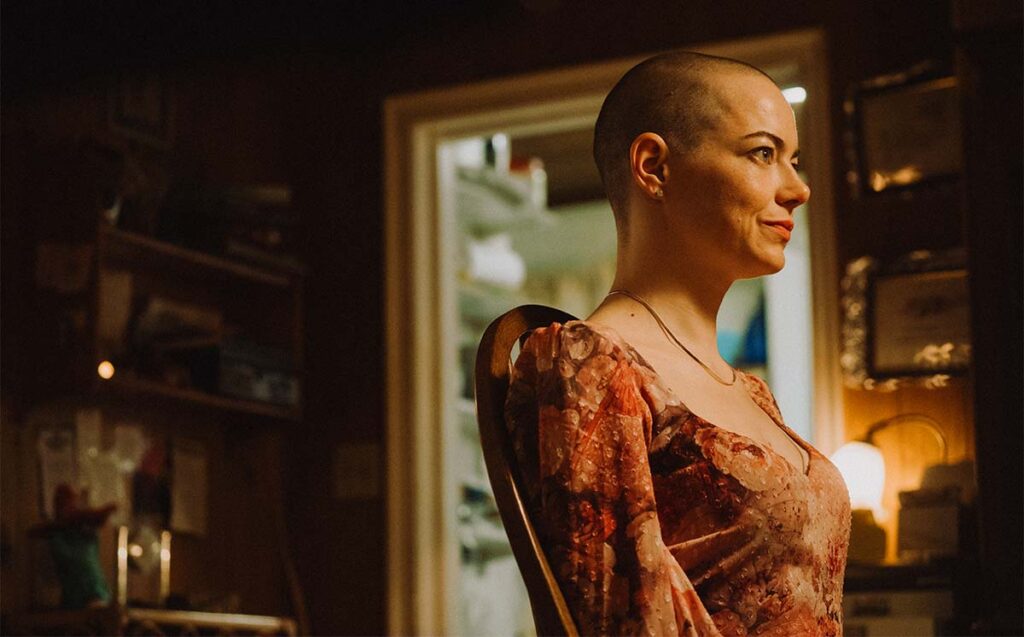
Establishing these twisted stakes in “Bugonia” is at times more intriguing than the events themselves, which unfold on a plot level much like any hostage saga would. Teddy and Don capture their target, who then attempts a full battery of tactics from negotiating to cooperating in an attempt to secure her release. But just as few look at a Dalí painting to admire the brushstrokes, so too do the storytelling mechanics of Lanthimos and Tracy matter less to the film’s success. It’s not the what; it’s the how.
The New Korean Cinema era that birthed “Save the Green Planet” (along with venerable auteurs like Bong Joon-ho and Park Chan-wook) was known for its wild tonal swings. Lanthimos, a modern master of moods, pays tribute to the period in “Bugonia” – but not by aping their style. Instead, he stacks tones on top of each other to show their vibrant, complementary interplay. In a world where people can share the same space but inhabit different realities, it’s only fitting that a scene can simultaneously play as both an absurdist comedy and a terrifying thriller.
“Bugonia” opens up again in its third act as the scenario goes past the initial captivity into even stranger directions. Any moment the film begins to feel mired in chamber drama, Lanthimos and Tracy ratchet up the stakes once again. The cast expands alongside the scope, introducing wild-card characters like Teddy’s ailing mother (Alicia Silverstone) and a loquacious local sheriff (Stavros Halkias of podcast fame).

But the film remains rooted in its central conflict between two intractable ideologues entrenched in their own sense of self-righteousness. The physically committed performances of Plemons and Stone mirror the fervency of their beliefs. Lanthimos pushes each to the edge of their corporeal capacity, and they match the narrative’s escalations with furious intensity each time.
“Bugonia” might be as blissfully bonkers as the era of its release, yet don’t let that distract from what a masterclass in directorial control the film represents for Yorgos Lanthimos. The distortions of the fisheye lenses employed by cinematographer Robbie Ryan might disguise it, but he’s a connoisseur of compositional rigor in the one-point perspective style favored by Stanley Kubrick. These visuals are not the only thing “Bugonia” shares with the legendary director, either.
Fanboy speculation over the putative heir to Kubrick’s throne tends to fixate on his perfectionism (à la David Fincher), epic scopes (akin to Christopher Nolan), or dark humor (like the Coens). There but for bigger budgets goes Lanthimos. “Bugonia” goes even further to harness an underappreciated Kubrickian characteristic: his deep affection for humanity amidst their folly. Lanthimos closes his film on an ironic musical montage that recalls the ending of “Dr. Strangelove” with its prognosis for the species.
“Humans can’t help themselves,” Michelle pointedly observes in the film. Lanthimos offers little evidence to refute her case … but ample evidence to love and care for their well-being even still. [A-]
Follow along with all our coverage of the 2025 Venice Film Festival.

Marshall Shaffer is a freelance film critic and journalist based in New York. In addition to The Playlist, his byline can be found at sites including Slant Magazine, Decider, Crooked Marquee, and Men's Health. He is a member of the Critics Choice Association and New York Film Critics Online.

