


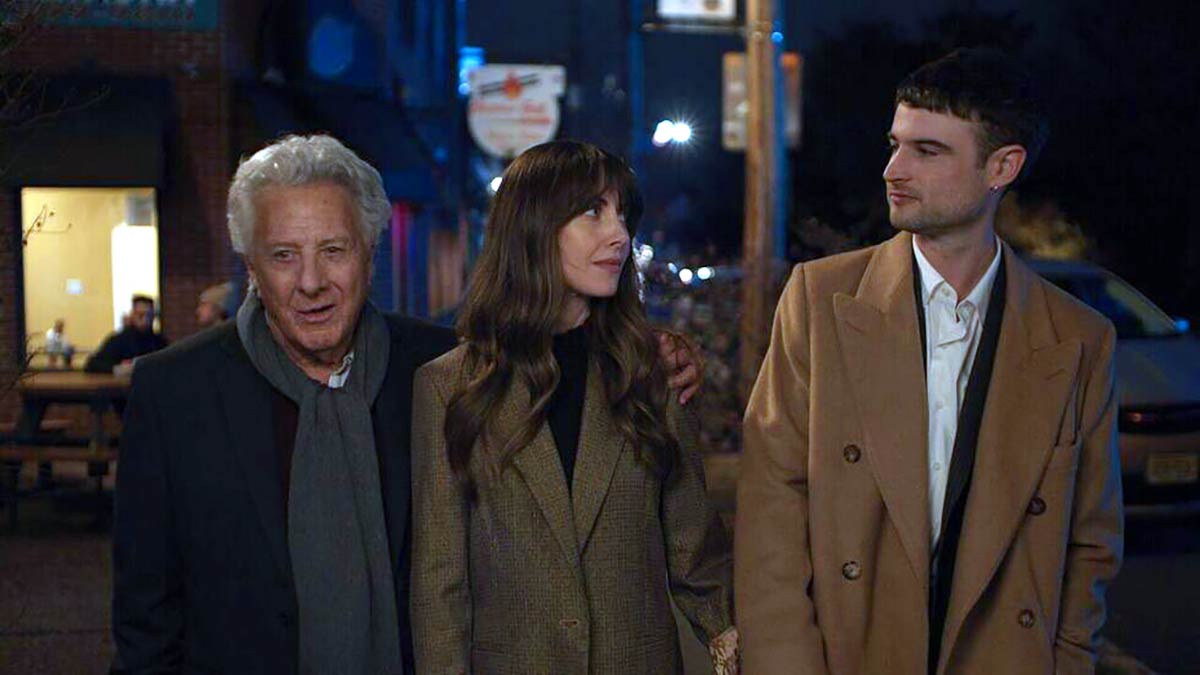
On paper, Alison Brie’s Elise functions as the protagonist of “The Revisionist.” This frustrated novelist, wife, and mother runs low on inspiration for her next story, so she looks inward to find drama in her own life. As it turns out, this coincides with the dramatic re-emergence of an old flame (André Holland’s John) – who also happens to be something of a rival to her husband (Tom Sturridge’s Jacob).
She also identifies the perfect wedge between the two men: Jacob’s aging father (Dustin Hoffman’s David), a successful writer whose stories could move some serious inventory as a book. But in the ultimate act of paternal tough love, David deems his son unworthy to be the custodian of his life story and refuses to let him serve as the official estate biographer. The more charismatic John, on the other hand, faces no such obstacles. Elise positions this congenial outsider to gain the trust of the cantankerous literary giant, and she succeeds.
Reading the basic setup of Alex Vlack’s film might give the impression that Elise is some secret genius puppet-master playing everyone like a fiddle. But despite her centrality to the mechanics of the story, Alison Brie is functionally a non-entity in “The Revisionist.” She’s largely relegated to the sidelines of the action.
Instead, she mostly appears in the film’s clunky framing device. In cutaway glimpses interspersed amid a key dialogue exchange, Vlack shows that Elise is refashioning some version of what actually happened into fiction. Teasing out where exactly the lines get blurred might be an interesting task, provided there was any reason to believe this mousy woman could act as such a master manipulator.
This meta element in “The Revisionist” only leads Vlack into a cul-de-sac he can never escape. Having the ability to call BS on his own scene by simply cutting back to Elise playing God over her keyboard robs the movie of any sense of stakes or shared reality. “They know you can do anything,” David Fincher once observed of shepherding an audience through a story, “so the question is what don’t you do.” There’s no such discretion exercised here. And when anything goes, nothing matters.
Further, this cop-out allows Vlack to recycle tired storytelling tropes and vague dialogue. He essentially passes over the responsibility for quality control to an unreliable character, one whom he never takes the time to develop or explain. The so-called main character offers something of a cautionary tale, then, about the maxim “write what you know.” None of these characters turn out to be anything other than exactly who they appear to be at first glance.
Even with a brisk 90-minute runtime, the time spent with these characters and in this shifting scenario still feels monotonous and interminable. The actors, especially André Holland, give their best trying to make “The Revisionist” work. But there’s only so much they can do when their characters have no internal consistency due to the film’s structural conceit. It’s the equivalent of listening to an annoying friend telling a story and undercutting every development with an arch “…or did they?”
If there’s any saving grace in “The Revisionist,” it’s getting to see Dustin Hoffman still doing good work at 88 years old. There are only so many of these performances left from such a master of his craft, and it’s too bad that one of them is just a reheat of what Hoffman did to much more profound effect in Noah Baumbach’s “The Meyerowitz Stories (New and Selected).” Vlack’s film offers a great reminder of why he’s a legendary actor. Granted, that’s mostly because he can outshine the stilted dialogue with a soulful spin on art and mortality. [D]
“The Revisionist” premiered at the 2026 Tribeca Festival.

Marshall Shaffer is a freelance film critic and journalist based in New York. In addition to The Playlist, his byline can be found at sites including Slant Magazine, Decider, Crooked Marquee, and Men's Health. He is a member of the Critics Choice Association and New York Film Critics Online.

