


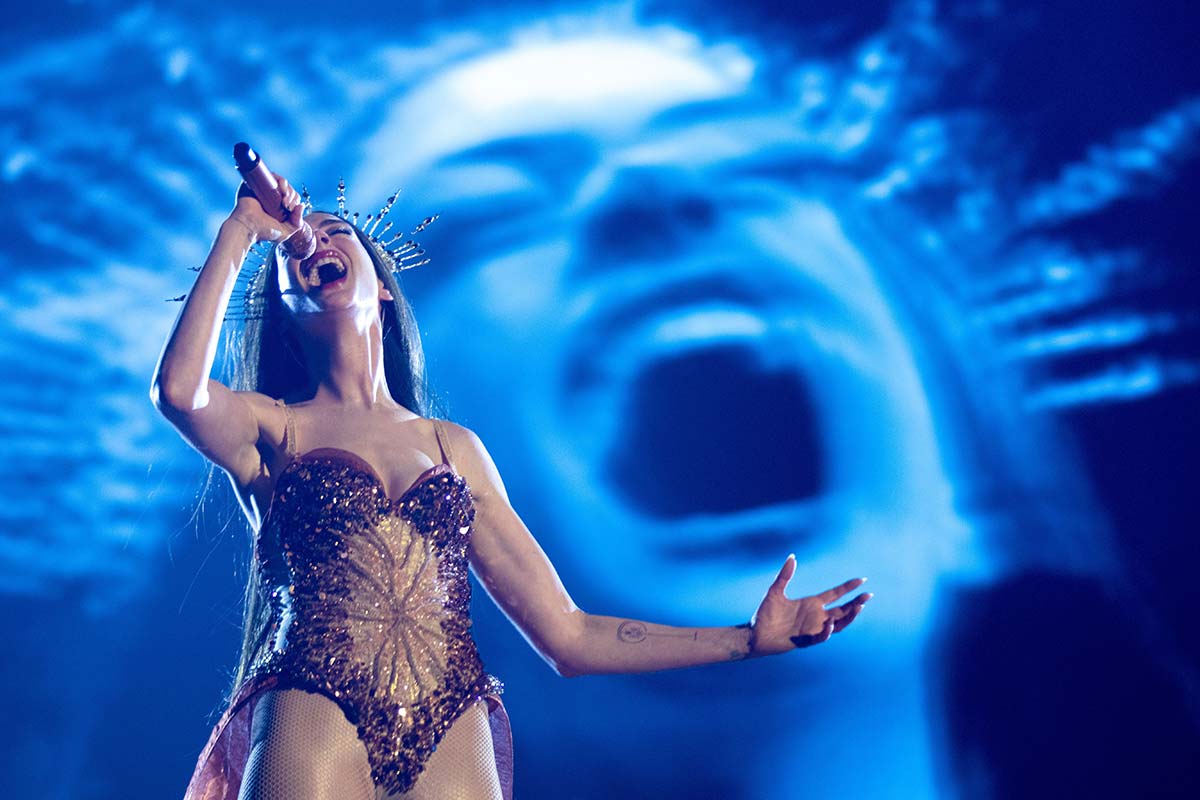
The challenge for a critic reviewing a film like David Lowery’s ethereal pop star psychodrama “Mother Mary” boils down to a single question: which film to review? The script houses at least four different stories and genre stylings under its auspices, each as lightly sketched as the early intimations of a dress designed by Michaela Coel’s fashion designer character, Sam Anselm. None of the various components cohere as neatly as the piece commissioned by the fading musician, Anne Hathaway’s titular Mother Mary.
READ MORE: The 150 Most Anticipated Films Of 2026
The film begins as a talky two-hander between Sam and Mary, former collaborators reunited after spending a decade apart in enmity. The former fangirl once had a dream gig creating for her icon, but eventually grew disillusioned with designing for her demanding patron. But when Mary shows up at Sam’s studio in a moment of desperation, clamoring for an outfit that feels like her again, the spurned creator agrees to hear her appeals.
With two actors like Hathaway and Coel, each able to channel something uniquely unvarnished and human, there’s a high floor on simply letting them cook. Hathaway, in particular, proves riveting in her prostrate vulnerability before her former collaborator. She operates in a register of rawness not seen since her Oscar-winning turn in “Les Misérables,” and it helps establish the existential desperation that motivates her unexpected request.
“Mother Mary” aims for something akin to Ingmar Bergman’s melodramatic mood pieces, but it lands in a place of turgid boredom. Its opening section spends far too long mired in expository throat-clearing as the duo traipses about Sam’s studio, whispering emotionless platitudes past each other. Lowery’s writing lacks any sense of the specificity of their relationship, leaving his leading ladies to do what amounts to an acting exercise with placeholder dialogue.
Some bigger picture themes do eventually emerge from all their hushed chatter, thankfully. Buried deep inside the film lies a parable for the parasocial era of fandom, a warning for devotees like Sam not to invest too much of themselves in a larger-than-life cultural creation like Mother Mary. Getting the chance to build the mythology herself only enhances her disappointment in the hollowness of the fame apparatus.
The challenge with pulling this thread in “Mother Mary” is that Lowery shows little knowledge or interest in the pop landscape beyond sourcing Jack Antonoff and Charli XCX to write the music. His film does not need to glom onto a real-life figure for Mother Mary’s figure to resonate, although she most closely approximates the baroque stylings of Lady Gaga. Yet because he renders this atmosphere with such abstraction, the setting seems frustratingly disconnected from reality. Its indistinct representation of the cultural context is enough to make one yearn for the concreteness of Brady Corbet’s “Vox Lux,” arch and austere as it may be.
As the pretenses and illusions between Mary and Sam fade, a dimension of religious folk horror opens when they begin to share dark dreams and visions. This turn will not surprise anyone who’s ever taken a communion class once Lowery throws out a big buzzword like “transubstantiation” early in the film. He suffuses “Mother Mary” with religious iconography: haloes, crosses, saints, madonnas, and more dominate the aesthetics. But, again, the ethereal connection between a musician styled as a Joan of Arc-like savior and a willing supplicant never gets full development. Lowery stultifies by intimating at big ideas without consummating them.
As the pretenses and illusions between Mary and Sam fade, a dimension of religious folk horror opens when they begin to share dark dreams and visions. This turn will not surprise anyone who’s ever taken a communion class once Lowery throws out a big buzzword like “transubstantiation” early in the film. He suffuses “Mother Mary” with religious iconography: haloes, crosses, saints, madonnas, and more dominate the aesthetics. But, again, the ethereal connection between a musician styled as a Joan of Arc-like savior and a willing supplicant never gets full development. Lowery stultifies by intimating at big ideas without consummating them.
Most disappointing, however, is how these spiritual undercurrents curdle into imagistic “metaphorror” regarding a kind of mutual exorcism between Mary and Sam. Working through the demons they need to expel to find peace – if not closure – in their relationship provides a natural extension of their parallel trajectories. Words could not possibly describe this inextricable, inexplicable connection of the soul. Thankfully, Lowery barely attempts to try, relegating this linkage to the realm of symbolic imagism.
“Mother Mary” ends on a high note as Lowery can dwell on the strength of this neo-giallo aesthetic to conjure arresting visuals. Much like he managed in “The Green Knight,” the director can harness a powerful, pulsating energy that transcends traditional ways of meaning-making through montage and mise-en-scène alike. But without more of a narrative to glom onto, motifs like the flowing red dress adorning the film’s poster offer little more than empty signifiers. It’s the most Nicolas Winding Refn film that the Danish provocateur never made.
Few filmmakers have a range like David Lowery; the particular three-film run of “Ain’t Them Bodies Saints,” “Pete’s Dragon,” and “A Ghost Story” demonstrated a versatility most directors can only dream of harnessing. But the scattershot “Mother Mary” can never effectively find the connective tissue between different modes of storytelling. To put it in musical terms, this is less a mixtape and more of a playlist on a chaotic shuffle. [C+]
“Mother Mary” releases in theaters on Friday, April 17.

New York-based freelance journalist whose writing appears regularly on Decider, Slant, Slashfilm, and The Playlist, covering film with a focus on cultural context.


