




The primal fight-or-flight response that makes us not be able to look away from a car crash also fuels a desire to escape a situation we feel can’t do us any good. Julian Schnabel’s “In the Hand of Dante” triggers the latter, a film akin to entrapment for those unlucky enough to have to sit through its painfully stretched 151 minutes.
READ MORE: 2025 Venice Film Festival Preview: 23 Must-See Films To Watch
Adapted from the eponymous book by Nick Tosches, Schnabel’s bloated affair inexplicably stars the always great Oscar Isaac as the fictional Nick, a New York author roped into a violent scheme to steal and authenticate the original manuscript for Dante Alighieri’s epic poem “The Divine Comedy.” Joining him on the blood-covered trek to Palermo is Gerard Butler’s Louie, a brass hitman with a penchant for punctuating every sentence with a fully pronounced slur and fashioned with a synthetic-looking toupée that makes him look like Megan Rapinoe.
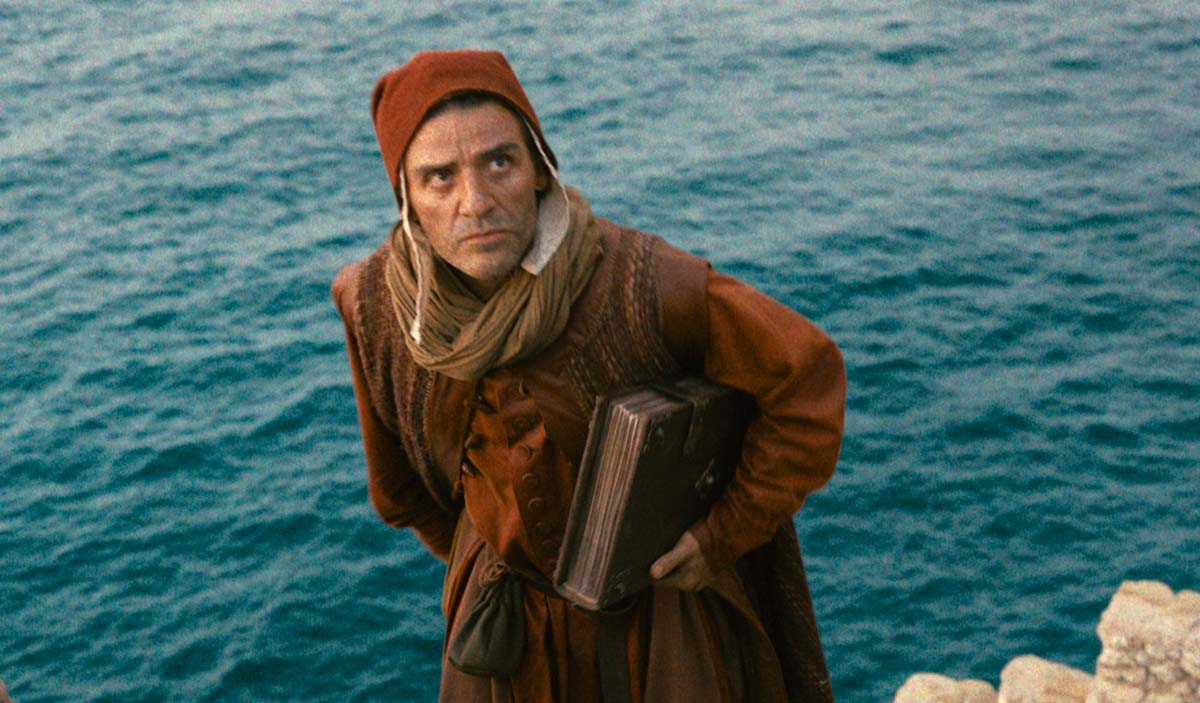
“In the Hand of Dante” seesaws between this modern-day heist and 14th-century Italy, where it finds Isaac as the lauded poet in the months preceding his writing of the classic masterpiece. Through this back and forth, Schnabel desperately grabs at a mishmash of genres, trying his hand at period romance, historical drama, crime thriller, and heist movie to the point of whiplash. The result is a janky patchwork of themes languidly tackled by an equally mismatched cast, led by Isaac in a rare misfire despite an earnest attempt to find any sliver of momentousness in the stupefying script. It makes sense that his Nick was originally meant for Johnny Depp, the kind of grimy sleaziness the role requires, standing in direct opposition to the “Dune” star’s sensibilities.

If Isaac leans into sterness, Butler roots his caricature of the New York gangster firmly in the pantomime. The Scot spits his words with the cadence of an actor unable to let go from the page, his eyes a clear window to the inner spinning of nuts and bolts that power this attempt at the villainous that lands as comic at its best. But Butler is the luckiest man in Schnabel’s epic, for his performance earns a blanket of brilliance when juxtaposed to that of two of his superhero castmates: Gal Gadot in a double role as Isaac’s love interest Gemma/Giulietta, and Jason Momoa as the heir to the mafia’s kingdom of Palermo.
The “Aquaman” star enters every scene like Carmen Sandiego, his large body permanently outfitted in a tight white suit and his tiny man bun popping out of a flamboyant hat that somehow seems to get bigger every time we see it. As for Gadot, it would be more credible for Isaac to share the romantic interludes with Momoa’s large hat than the “Wonder Woman” actress, who delivers every single line as if making up the words as she goes, uncomfortably trying to understand where to place the emphasis. When the two finally interact in the film’s great climax, it is genuinely one of the funniest scenes of any film this year, a riveting battle between two actors who will make you question whether they have ever interacted with another human being.
And therein lies the only slight reward for the survivors of such gruelling shared torment: a generous chest of one-liners written in earnest but delivered with the kind of goofiness that lends itself to endless quoting. “I’ve been a widow for 700 years until I met you again,” moans Gadot’s Giulietta in a rushed casino sequence, while “The White Lotus” breakout Sabrina Impacciatore plays an Italian librarian who runs after the stolen manuscript, shouting, “My thesis! The people of Italy!” For cinephiles, there is also the consoling pleasure of a handful of scenes starring Martin Scorsese as Dante’s guiding oracle. The filmmaker, also an executive producer here, is covered head to toe in grey hair, a Gandalf-like figure first recognizable by his voice, and who comes to offer a few moments of respite from the world’s who-can-act-the-most championships.

Put forward as a musing on the burden of searching for artistic perfection, “In the Hand of Dante” ends up confirming its thesis by contrast. That it comes from the same director of “At Eternity’s Gate” and “Basquiat” makes it an even more maddening, irredeemable experience. [D-]
Follow along with all our coverage of the 2025 Venice Film Festival.

Rafa Sales Ross is a Brazilian film journalist, critic and programmer currently living in Scotland. She contributes to Variety, BBC Culture, Sight & Sound among others, and can often be seen writing about Latin American Cinema and explorations of death and desire.


