





A significant part of Luca Guadagnino’s “After the Hunt” is told through hands. When guests begin to fill the long corridors of Alma’s (Julia Roberts) apartment, her hands are at first frenzied, long fingers cutting through the air as she gesticulates carefully argued points. As conversations lull into the soothing rhythms of inebriation, her hands rest gently atop Hank’s (Andrew Garfield) long legs, stretched across the chic upholstery of her two-seater.
READ MORE: 2025 Venice Film Festival Preview: 23 Must-See Films To Watch
When Maggie (Ayo Edebiri) awaits Alma outside her door the next day, the young woman’s hands are anxiously attached to her curved body, wrists curved to turn her arms into a flimsy shield. When the two sit by a dark staircase to talk, Alma’s hands are at first stretched in a clear sign of camaraderie, and as Maggie tells the story, they begin to retract, slowly, then all at once.
“After the Hunt,” arguably, is also about the washing of one’s hands — washing yourself away from responsibility, guilt, from a conversation entirely. Written by Nora Garrett in her screenwriting debut, the story begins as a large group of academics gathers at Alma’s lavish Connecticut apartment for a soirée. The Yale philosophy professor and her psychiatrist husband, Frederick (Michael Stuhlbarg), are comfortable hosts, and their guests familiar with the small mundanities of their house.
Only a select few, however, get access to the couple’s selective inner circle, and two of them orbit around Alma as polar satellites. Hank is Alma’s boisterous confidante and her fellow racer in the marathon towards coveted tenure; Maggie, her quiet shadow, a PhD student with a seemingly harmless crush on her glamorous mentor. On the night of the party, the two stumble out of the apartment together. Hank will make sure Maggie gets home safely. Alma closes the door and watches the two harmlessly spar towards the lift. All seems perfectly fine.
When Maggie shows up at Alma’s door for the second night in a row, her trembling voice relays a pained confession. Instead of just dropping her off, Hank went upstairs. The two shared a drink. He kissed her, and then went further. She said no. He kept going. When Alma sternly asks her student, “What are you saying he did?” She promptly answers in frustration: “Isn’t it obvious?”

But nothing in Guadagnino’s thorny drama is obvious. From that late-night confession, the Italian director steps back into the tennis court of “Challengers” to craft a treacherous match. The rules of the game, though, have changed. White cis men are no longer in their home turf when it comes to matters of he-said-she-said. At Yale, academics tiptoe around inflammatory statements. They talk about “the climate,” “politics today,” the qualms and manias of the new generation. Alas, the meaning is clear: the hunt is on, and the witches are now men.
The titular hunt refers to that perceived sense of persecution, but also the limits of the ravaging ambition, and Alma understands the adrenaline of competition as well as the frustrations that come with a disparate set of rules. When she first joined academia, it was a boy’s club and, although things seem to have changed, her battle scars still throb. Why not on her turn? Roberts roots her best performance in over a decade in this very encompassing of a politically incorrect bitterness, the unravelling of her Alma like a nagging crease on a perfectly pleated set of white chinos.
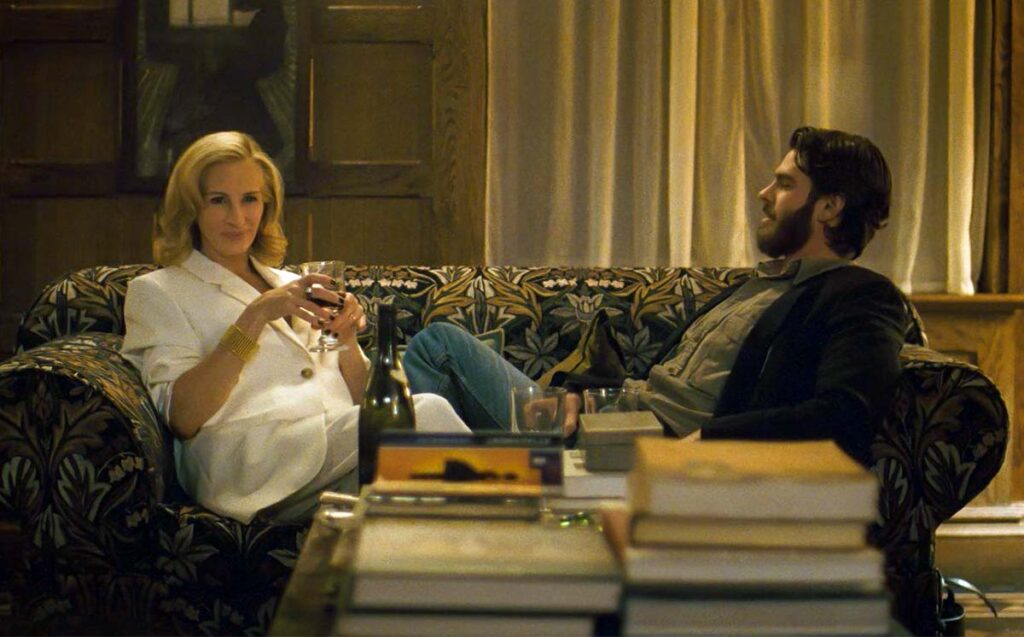
To lens this dizzying downwards spiral, Guadagnino plucks legendary cinematographer and frequent Spike Lee collaborator Malik Hassan Sayeed out of a 25-year hiatus. The two mimic the inconsistent rhythms of malleable truths through camerawork, wavering between steady and frenzied as heads are cut out of the frame, minds writhing, but the body trodding on, stubbornly functioning in its mechanical miracles.
Still, a bothersome, ever-present sense of constraint permeates this twisted drama on the complexities of Gen Z morality. The Italian auteur, renowned for gnawing at the knotty edges of controversy with the unrestrained hunger of the unbothered, seems somewhat hesitant to fully dig into the messiness of the piping hot issue at hand. Garrett’s script is eager to hand out inflammatory tidbits on the perception of this new generation as entitled and unwilling, as well as the convenience of rigid structures for those already comfortably nested within its limits, but it is challenging to find any sliver of real substance in this exercise in polished regurgitation.
Garfield, cast as a clever reversal of his good boy image, is too young to grant truth to the direct competition between a man and woman in academia, sitting 15 years younger than Roberts. Alongside him, Edebiri struggles to settle into her most challenging film role yet, an unbudging clunkiness standing between her and a much more assured Roberts. It is Stuhlbarg who once again comes from the fringes of a Guadagnino narrative to gobble the entire show to himself, tapping on the sensitive notes of his “Call Me By Your Name” patriarch to imbue the role of the dutiful yet painfully self-aware husband with masterful class.

It is the words of Tom Jobim’s “Ligia” that usher “After the Hunt” into its stubborn conclusion, the bossa nova anthem melancholically recalling the emotional distress of an impossible love. It is a choice that clearly reflects the film’s preoccupations, which lie not as much with existential questions of morality but with more primitive matters of yearning. As a study of the former, Guadagnino’s drama feels lacking, but if seen as a musing on the latter, it opens up as an imperfect but still fascinating read. [C+]
Follow along with all our coverage of the 2025 Venice Film Festival.

Rafa Sales Ross is a Brazilian film journalist, critic and programmer currently living in Scotland. She contributes to Variety, BBC Culture, Sight & Sound among others, and can often be seen writing about Latin American Cinema and explorations of death and desire.


