


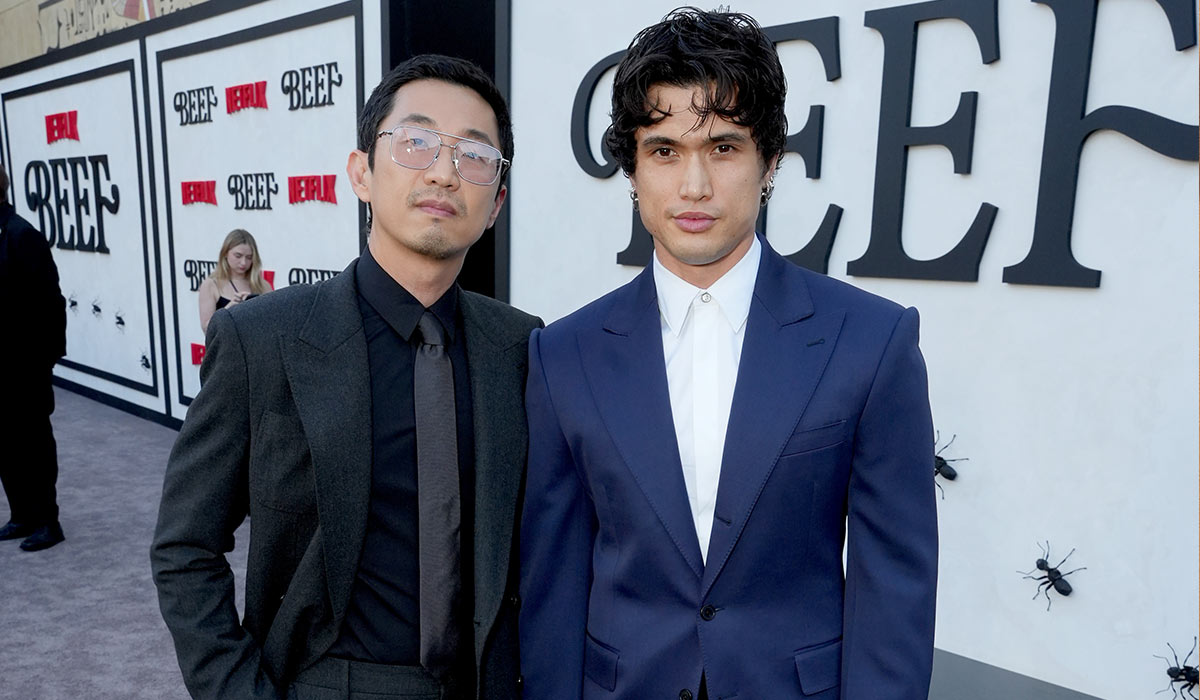
If it wasn’t clear already, expect more directing credits from Lee Sung Jin. During an interview earlier this month, the “Beef” series creator, known as Sonny to his friends and colleagues, absolutely lit up when asked if that was his creative preference. He replied, “Resoundingly, yes. Yeah. The process of writing is so agonizing, the most painful process.” But as a writer, Jin has demonstrated an auteur sensibility that rarely resonates in episodic television. And that’s one reason season two of “Beef” is almost as critically acclaimed as the first.
Unlike season one, which primarily focused on two Los Angelinos (Ali Wong, Steven Yeun) whose road rage incident spiraled into something life-changing, the second go-around is a significantly different animal. Set somewhere in the rich enclaves of Santa Barbara, season two finds Joshua Martin (Oscar Isaac) and his wife Lindsay (Carey Mulligan) attempting to survive and thrive as the manager and interior designer of a posh country club. When young twentysomething employees Ashley (Cailee Spaeney) and Austin (Charle Melton) record them fighting, a game of manipulative chess unfolds. And chatting with Jin about how he conceived this scenario and its inherent generational conflict was a blast.
We should also note the lengths Sonny went to pitch Melton the project were super gutsy and, yes, as the headline indicates, he really wants you to know he hates pickleball. Like, he really hates it.
Despite Lee’s sometimes long answers, this interview has actually been edited for length and clarity.
____
The Playlist: The first season of “Beef” was one of the seminal shows of this decade. How much pressure did you feel with the idea of turning this into an anthology series and creating something in the same universe?
Lee Sung Jin: Well, I’d be lying if I said I didn’t think about that, but for me it’s less about chasing expectations and more about trying to drown all that out is the hard thing. Because I think for us, my collaborators on the show, I think it’s easy to fall into the trap because we’re in a business that ultimately is for commerce, where you start to think about how will the audience receive it? How well will it do, et cetera, et cetera. Will it replicate things? And ultimately, when we check back on our intentions, I’m like, “Oh, well, our intention for ‘Beef’ is never that. It’s actually we’re trying to do Carl Jung and shadow work through the show.” And so it became more about, “All right, well, what haven’t we got to express in season one that we want to in season two that feels very pressing to express? And then also how can we visually show that story without repeating ourselves?” Because for me, when I was in my teens and twenties, when a band that I liked just copy-and-pasted their first album for their second, I’d be like, “All right, I’m moving on to the next thing.” Whereas my favorite band, Radiohead, I remember when “Kid A” came out, I was just like, “What?” I was confused, and I sort of missed “OK Computer,” but then I’m like, “I don’t know why, but this is making me rethink a lot of things.” And here I am in my 40s, and “Kid A” is for sure the most-listened-to Radio album for me. And so that is our North Star. Obviously we’re not Radiohead, but I think that is an aim of ours through “Beef” is treating these albums over the test of time, when we look back, are we going to feel like we were pushing ourselves artistically and narratively and honestly spiritually as well?
Was it then easy to just decide, “O.K., Ali and Steven’s characters are done. I don’t even want them to cameo. It needs to be a whole different thing?
In a way, yes, because season one was always designed to be a limited. That’s why it has the ending that it does. It felt pretty final. And the debate was always, “O.K., is it going to be a limited or an anthology?” And it wasn’t for lack of trying, where I certainly was during the awards run pitching all sorts of ideas. And Jinny Howe at Netflix wisely pulled me aside and said, “I can tell you’re just pitching to get a season two. That’s not why we want to do ‘Beef.’ We can leave it a limited. We’ll do another show with you happily, but you should only do ‘Beef’ if you find something that you’re really passionate about.” And that’s a harsh callout from essentially my boss. And so it took me a minute to do a lot of self-reflecting, and then it wasn’t until a real-life incident again, where I overheard a spat in my neighborhood, that that’s when I was like, “Oh, that’s actually what I want to write about.” I was telling that story to friends, and all my younger friends, like Gen Z, they were so worried about my neighborhood couple like, “Oh, are they okay? Did you call 911?” And all my friends who are my age and older, they just shrugged and were like, “Who amongst us hasn’t shouted those words in that order on the way home?” So that’s when I was like, “Light bulb moment. I want to talk about relationships over the course of time.” And so in answer to your question, the Amy/Danny story was always over. We briefly entertained the idea of seeing Ali Wong and Stephen Yeun playing pickleball in the background of one of the country club scenes, but I think ultimately it was the schedule that didn’t allow. And also I think maybe that would’ve been too cute. And also I love tennis. I do think that pickleball is ruining the sport. So, I wanted to keep it true to tennis and feel free to run that as a headline: “Lee Hung Jin hates pickleball.”
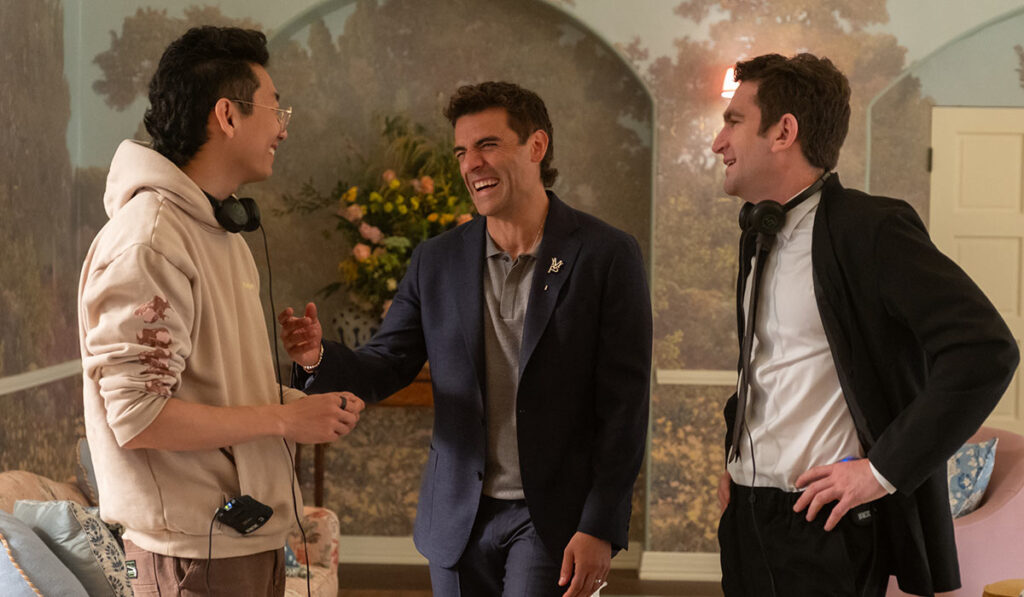
I feel like the pickleball fad is fading a little bit.
Oh man, I hope so because I play tennis at these courts near my house weekly. I played tennis in high school, and it’s just more and more that they’re building more pickleball courts, and they’re like tennis courts to make more room for pickleball. And it’s just sad to see. There’s nothing funnier to me than hearing people get animated and fighting over a sport where you’re in a miniature little tennis thing and you’re swinging at the saddest-sounding ball. And we actually talked about in the room, “Oh, should we be satirizing this because it is really funny?” But when we were imagining that, tonally, I think it got a little too broad. There’s something about wanting this country club setting this season to feel very painterly and almost like “Barry Lyndon,” I think is an obvious huge reference for us. And imagining James Laxton’s beautiful cinematography over a pickleball scene, I was just like, “Oh, that’s too broad and silly.” So, we kept it to tennis.
Do you remember when you had the spark or the inspiration for this particular story outside of the argument you heard? Or was that just it?
Yeah, I called Jinny afterwards, and I was like, “Hey, this has happened to me this week. I think there’s a show here.” And she has great instincts. She was just like, “Yep, that’s the one. That’s the one. I could tell that you’re passionate about this.” It’s interesting. I haven’t seen it. Usually marriage is explored through one couple. Oscar literally did that on “Scenes from a Marriage,” and really the only one I can think of that was a big reference point for us was “Who’s Afraid of Virginia Wolf?” being a more generational juxtaposition of couples. And so yeah, from there we ran with it. There were elements that I had known prior to that moment. I had the fortune of shooting a music video for RM, one of the members of BTS, between seasons of “Beef.” And it was my first time back in Korea in probably 30 years. I went to elementary school there, I was born there, and first time working with a Korean crew, and I just caught the bug. I was like, “Oh, I definitely want to shoot here for something.” I didn’t know what at the time. And also while I was there, I was kind of being wined and dined by Korean conglomerate culture. There’s this word called “Chaebol” in Korean, which means the six families that own everything because all the corporations are passed down from these six families. And that was a slice of the Korean experience I hadn’t really seen dramatized in the West. There are Korean movies about that culture, but certainly I haven’t seen anything in the West about it. So, I knew that that was something that I wanted to explore. I didn’t know at the moment how. And as this couple’s idea came to me, that’s when I thought, “O.K., one of the couples needs to have someone who’s half Korean, and he or she will have an identity struggle, and then one end will be this Korean conglomerate.” And it just so happened that I had seen “May December” and I was blown away by Charles’ performance like everybody else. And I went hard at courting him. Gold House was doing a celebratory dinner for Charles and “May December,” and I emailed the head of Gold House, and I said, “Can you please seat me next to Charles Melton at this point? I’m going to pitch him all of season two.” And Bing Chen, who’s the head of Gold House, was like, “Dude, you’re asking me day of. I kind of have a seating chart with Charles next to Chloe Zhao. I don’t think I can move Chloe.” And I showed up, and then there was an empty seat next to Charles. So I sat, and I notoriously used PowerPoint to pitch, and I create these little Photoshops where I take actors’ faces, and I photoshop them into environments, and I pitched him all of season two with his face in these little mini storyboards, and he was…
Wait, time out. You did this at the dinner.
Yeah, I was definitely hogging Charles’s attention during the dinner, but he was so engaged, and by the third appetizer he had said “yes.” And it was so cool too. I think Charles, as a half-Korean, hadn’t gotten to really explore a lot of that side of himself through any of his works up until that point. And I have a half-Korean daughter now, and a lot of the writers are half Asian, so it’s felt like really ripe fertile ground. That was definitely a piece I had known for some time.
What would you say the biggest challenges were for you tackling season two? Was it the writing? Was it the directing?
I think the challenging part, which affected both the writing and my directing, was just the number of perspective characters. Season one, super simple. Every scene is either Danny’s scene or Amy’s scene. And so when you’re writing it, we tend to write with someone’s perspective in mind. It’s always somebody’s scene, which then helps the directing because then camera-wise, you just know that the camera should be closer to your perspective character mostly. And in season two, we not only doubled it, but we exponentially increased it in that sometimes it’s the older couple scene, sometimes it’s the younger couple, sometimes it’s Chairman Park scene, sometimes it’s Chairman Park and some Dr. Kim scene. You even have Troy and Ava as a fourth couple that rears their heads sometimes. And so writing-wise, it just became a much more complex math problem. And then, as a result, directing-wise, a lot of it was about how do you shift perspective in a scene in an elegant way? So, an example of that is the hospital episode where the doctor comes over to tell Cailee’s character, Ashley, that, “Oh, she’s fine. She can go home.” And that’s when Cailee thought the pain scale was based on Letterboxd. It was like two and a half stars is average. So she thought she was five was average. And so our shot coverage for that scene, the way I planned it, is it’s technically Ashley’s scene. So, you start the scene kind of closer to Ashley, and you’re over Ashley’s shoulder when you’re looking at Charles. And then when the doctor arrives, we cut to the two-shot of their reaction, and as you start to feel that, “Oh my God, Ashley is not smart and maybe she is crying wolf.” That two-shot then becomes Charles’ single. That is how we’re passing the baton from this was Ashley’s scene, and now it’s Charles’s scene. So, having to think about perspective was the hardest thing when you have six-plus perspective characters.
I could tell when you were directing this season as opposed to when Jake Schreier was. You definitely have your own POV and your own cinematic eye. Are you enjoying directing more than writing now? Should we expect a film or a series next time that you want to direct every episode?
Resoundingly, yes. Yeah. The process of writing is so agonizing, the most painful process.
That sounds like a director right there.
I don’t enjoy it, but it is very rewarding because you’re like, it’s therapy, it’s cathartic. The process of directing for me is a blast. I love being on set. I love collaborating with my HODs [heads of departments]. I love just the spirit of problem-solving live together. And then I had the fortune of having a great collaborator in Jake in season one, where I learned a lot of his rubric. He self-describes it as a rigid rubric for the way he balances coverage. It’s been really fun for me in season two to take that foundation and then, as you’re saying, add my own sauce to it. And a lot of that is discovering things in the moment, and I think I’m sort of addicted to that feeling. Another example is Charles in the hospital episode, right after that scene when he realizes that maybe Ashley’s crying wolf, he calls Eunice. And normally on our show, definitely season one, what we probably would’ve done, what Jake probably would’ve done, is either Steady or Dolly leading and following, where you’re really pretty close to the character because you want to get all the wonderful expressions that Charles is giving. But on the day, and this is a credit to my collaboration with James Laxton, we were like, “We always do that. This is starting to feel like the point in the episode where something surreal and ominous is going to start. This is when everything starts to take a turn, so can we switch it up?” And so we went longer lens. We stayed wide at the end of the hallway. So you see Charles just on the phone, so far away, feeling and walking to the camera, and it wasn’t until he landed that we did just a small pull to reveal the vending machine. And so it felt almost horror-like, where you’re like, “Oh God, what does this mean, the vending machine?” And so there is this kind of ominous surrealism that we got to introduce through our shot selection. Maybe it’s because it’s new to me and writing I’ve been doing for a long time, but I’m definitely enjoying it, and I can’t wait to do more. I am writing a film right now that I will direct, and also, as part of my overall deal that I’ve just re-upped, I am working on three shows right now that I am excited about. It remains to be seen if I direct them or not, but certainly, at least one of them, I want to direct fully myself.
So is the film also part of your Netflix deal, or could it be with somebody else?
That I’m not sure yet. It’s so early, I have to write it and then show people, and then we’ll see. Yeah.
One of the things that I so appreciate about what you guys did with this season is just the generational contrast between the late millennials and this Gen Z. Several shows and movies that have hit this zeitgeist at this point. Have you paid attention to how different viewers of different ages have reacted to the show, and has anything surprised you about that?
Not surprising. It’s all very intentional. And Netflix now does a thing, which I think I’m allowed to share: for a lot of their shows before you launch, they do what was old school consumer testing. They call it consumer insights, and they preview some episodes to 2000 Netflix members, and then you get all the survey answers back, and it was really reassuring, I think, both to me and to the network to be like, “Oh, the younger crowd is resonating with Ashley and Austin at first. And for elder millennials and older, they truly cannot stand the way Ashley and Austin speak, and they love Josh and Lindsay. And that was all by design. And I think we as writers love to set something up one way and then play with expectations and twist it through the season. And it’s been nice seeing people who despise Josh and Lindsay to begin with, and by the time they kiss at the end, be rooting for them, and people who rooted for Ashley and Austin at the beginning just thinking that they’re absolutely diabolical by the end.
I mean, a lot of it is by design, and it’s been very fun to see how people react. And also there’s oftentimes surprises too. I’ve had so many people come up to me at screenings, younger people who are actually like, “Chairman Park and Dr. Kim are my favorite.” Interesting. And then I’ve had elder millennials tell me that the way Charles is in the show, “I have a best friend that’s exactly like that.” But that’s the joy of what we do is we’re in our little cocoons, and we try to write something true, and then you express it, and then everyone reacts depending on where they’re at. And my hope is that this show can remain timeless enough, if we’re fortunate, that people can revisit the show 10, 20 years from now and feel something different. Because I certainly do with all my favorite things. When I rewatch “Mad Men” or “The Sopranos,” or “There Will Be Blood” or “No Country For Old Men,” all my favorite things from my twenties, when I watch it now, I’m like, “Wait, this hits completely different.” And I think that’s what great art does. That’s why the Mona Lisa is still the Mona Lisa. Every time you look at the Mona Lisa, you’re like, “That smile is different. I don’t know why.” And I’m feeling something strange, and it’s very different than when I last time I saw it. And so that’s definitely a goal of ours. I’m hoping, with time, that comes to fruition.
“Beef” season two is available on Netflix
Follow Gregory Ellwood on Bluesky
Follow Gregory Ellwood on Threads
Follow Gregory Ellwood on Instagram
Follow Gregory Ellwood on TikTok
Sign Up For The Breakdown Newsletter

Editor-at-Large Gregory Ellwood is one of the entertainment industry's most respected journalists and critics. Based in Los Angeles, he's the only current awards expert who previously worked on Oscar campaigns at a major movie studio. Over the years, he has written for the LA Times, Variety, The Hollywood Reporter, and Vox, among others. He also co-founded the entertainment news site HitFix, which spawned a legion of influential Emmy and WGA Award-winning alumni.


