


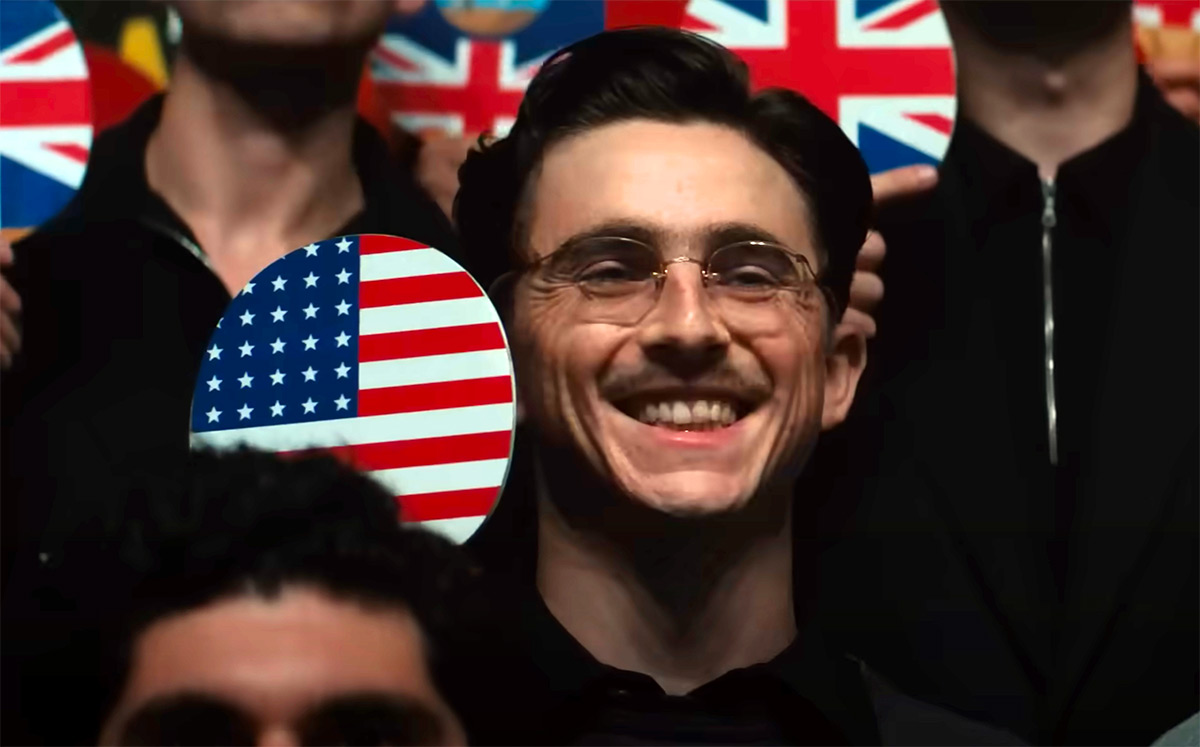
Timothée Chalamet might currently be annoying the terminally online with his cocky bravado—the brash chutzpah, the not-so-subtle suggestion he’s destined for greatness and an Oscar looms in his near future—but his immodesty is not unearned. In fact, Chalamet may just be suffering from Marty Mauser hangover—the audacious, self-assured young punk street hustler he plays in “Marty Supreme,” the masterful new drama from filmmaker Josh Safdie. Boastful pretentiousness may be irritating, even gauche, especially when awards-season theater turns every interview into a campaign stop, but to Chalamet’s credit, it’s the performance of the year, in one of the year’s best movies; a blisteringly riotous and entertaining time at the movies.
READ MORE: PART TWO: The 150 Most Anticipated Films Of 2026
Arguably the Gen-Z, amphetamine-driven version of Scorsese’s “The Color Of Money,” if Benny Safdie took a left turn and swerved into a low-key register for his first feature-length effort, “The Smashing Machine,” with Dwayne Johnson, then Josh Safdie doubles down on the anxiety symphony of “Uncut Gems,” employing a similar high-velocity grammar and tilting it toward something more euphoric.

Set in 1950s New York, Chalamet plays the aforementioned cocksure Marty, a shoe clerk kid working in his uncle’s shop with a woozy head full of moxie, dreams and ambition. Sleeping with his neighbor’s young wife (a terrific and breakout Odessa A’zion), ladies’ shoes is merely a pitstop on the journey to greatness, which, for Marty, sits atop an Everest that is a ping-pong immensity. With the help of his friend Dion (Luke Manley), Marty tries to convince his pal’s successful father to subsidize his dreams by creating a non-regulation orange ping pong ball—a unique ball for a unique guy.
Plotting scam after scam, when he finagles himself into a U.K. trip for a tennis table tournament, Marty’s life changes when he meets Kay Stone (Gwyneth Paltrow), a socialite and semi-retired actress, and her wealthy businessman husband, Milton Rockwell (“Shark Tank” TV personality Kevin O’Leary). This fateful meeting alters the trajectory of Marty’s life and theirs, but if it wasn’t them, his magnetic dynamo would have surely suckered others into his chaotic vortex.
The Fall & Winter Film 2025 Preview: 61 Movies To Watch
From there, “Marty Supreme” wildly pinballs between ping pong competitions and the cons Marty runs, often with his friend Wally (rapper Tyler, the Creator), in order to fund his flights overseas for these big tournaments. Snowballing lies, escalating swindles, cheating gambits, and collapsing ploys send the picture into a rollicking series of white-knuckle adventures and near-disasters. And it’s a sweaty speedball of frenzied mania and an exhilarating thrill ride from start to finish.
While some might call it a sports movie, ping-pong is simply the arena, and the subject is appetite—ambition as a fever, desire as a survival tactic, confidence as a kind of currency you can spend before you actually have it. Marty begins in the kind of cramped, grimy existence that makes “dream big” sound like a laugh: a shoestore grind, living in a shoddy railroad apartment, staring at the ceiling and seeing a future no one else can. But Marty doesn’t merely want out—he wants up, fast, and with witnesses.
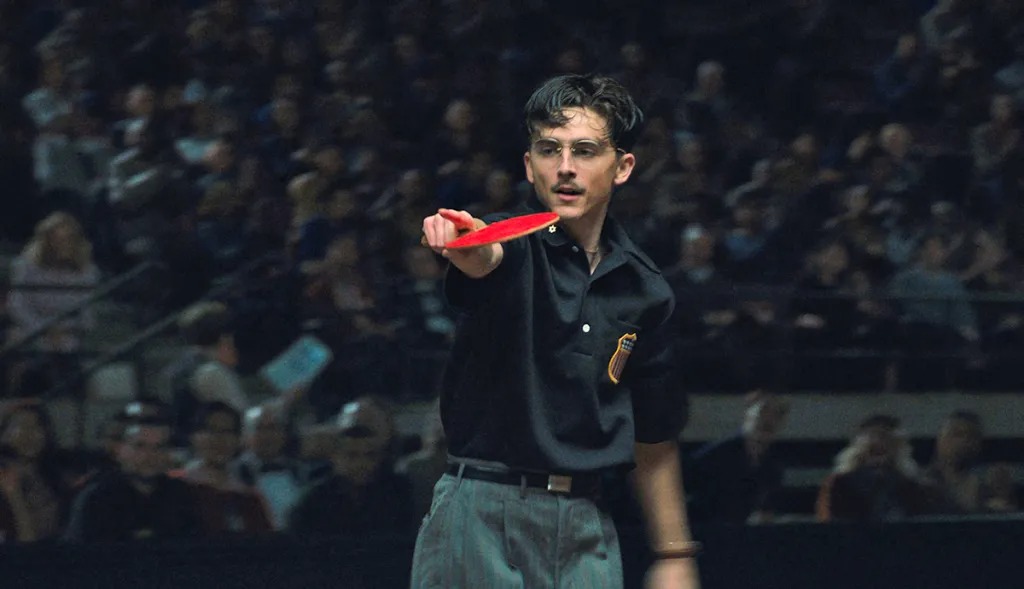
Chalamet plays Marty like a cocksure human flare: all combustible nerve, bright-eyed arrogance, and predatory charm, a grifter-athlete who treats reality like something negotiable. The oddball coterie of a cast is exceptional, if unusual; A’zion as a breakthrough one-to-watch; take-no-shit Bronx-born filmmaker Abel Ferrara as a perfectly slimeball criminal that Marty unfortunately double crosses; Fran Drescher playing down her vanity as Marty’s unappreciated mother, with fun appearances by Emory Cohen, Isaac Mizrahi, Géza Röhrig, Penn Jillette, Sandra Bernhard, and more (Not for nothing, a host of right-wingers in small roles too; David Mamet, NY radio talk show host John Catsimatidis, and O’Leary, but for benefit of the doubt, the film is simply littered with weird characters and personalities in bit parts).
Paltrow effortlessly reclaims her power and elegance, reminding us why she was one of the greats, and O’Leary’s oily entitlement suits this odious character like a tailored suit. He proves perfectly repellent as Marty’s main antagonist, the bankroller who eventually mocks the dream with controlling wealth and power—Marty’s kryptonite.
O’Leary’s Rockwell doesn’t hustle; he acquires. Which makes his fascination with Marty feel both patronizing and hungry, like he’s watching an animal he wants to either cage or bet on. One line lands like a sneer and a prophecy all at once, Marty crowing: “It’s only a matter of time before I’m staring at you from the cover of a Wheaties box.” Rockwell meets the kid’s brazen self-mythologizing with a mix of disbelief and disdain, but there’s admiration in it too—because Marty’s unearned chutzpah is so outsized it forces everyone to take a position. Laugh him out of the room, or start investing in the legend-to-be.

The film’s New York street folklore evokes Martin Scorsese; there’s faint cousin-energy to “The Color of Money” in the way Safdie understands the seduction of the con.
Formally, the movie’s craft maintains a sense of engineered frenzy rather than shapeless chaos. Darius Khondji shoots the film with purposeful grime, refusing any glossy period-postcard sheen in favor of sweat, harsh light, and lived-in texture. And Daniel Lopatin (aka Oneohtrix Point Never) crafts a score that doesn’t just underline tension—it supercharges the whole thing, pushing the movie toward something anthemic and strange, as if the sound itself is getting high on Marty’s self-belief. Anachronistically—and akin to Steven Soderbergh’s inspired choice on “The Knick”—the soundtrack is peppered with seemingly malapropos 1980s synth-pop and post-punk (Peter Gabriel, New Order, Tears for Fears, Public Image Ltd., Alphaville), giving the film an unexpectedly dreamy edge that, in the friction of that juxtaposition, is positively thrilling. Something about that misty hopefulness only furthers the idea that Marty Mauser, a supreme force of sonic youth, is just unstoppable—charging ahead on pure vibe and velocity, convinced the world will bend because he refuses to imagine it won’t. The result is a film that feels both filthy and luminous at once: the world is ugly, but the dream is glowing.
And yes, the ping-pong sequences are a genuine jolt. Even if sports isn’t the point, Safdie uses the game’s speed and topspin as pure cinema—furiously clammy set pieces that play like action choreography, all snap reactions and aggressive rhythm, and they’re riveting to watch.
Safdie knows precisely how to orchestrate the anxious thrill of suspense and tension, building scenes until they’re practically vibrating and then punctuating them with some outrageous left turn that lands with shock, awe, and hilarious disbelief. It whips ass; a deliriously wild film.
“Marty Supreme” isn’t a moral fable about discipline and sportsmanship; it’s a portrait of ambition as a living, breathing necessity—something Marty must manifest into existence, from his lips to God’s ears. Throughout the madness, Safdie finds an unexpectedly human pulse within the chaos, transforming it into an ecstatic, white-knuckle rollercoaster ride. Chalamet rides that velocity with a star-making performance that dares you to deny it—if he’s been acting inevitable lately, well, this is the aftereffect, bet. [A+]

