


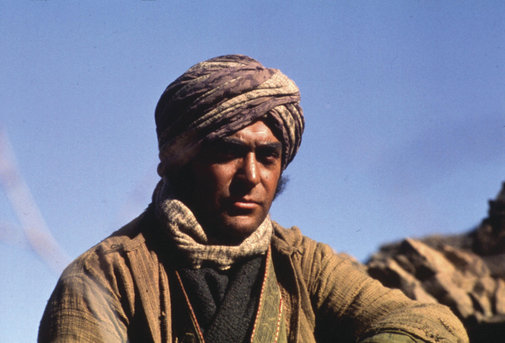
 “The Man Who Would Be King” (1975)
Directed and co-written by John Huston, this film (based on the Rudyard Kipling short story) went through multiple rounds of potential actors over the years (Clark Gable and Humphrey Bogart, Burt Lancaster and Kirk Douglas, Richard Burton and Peter O’Toole, Robert Redford and Paul Newman). It was during the last round that Newman suggested Sean Connery and Michael Caine, and Huston went on to cast them in the two lead roles. As Danny Dravot and Peachy Carnehan respectively, Connery and Caine play two British soldiers who leave the army and become imperial-era Alexander the Greats in Kafiristan (modern-day Afghanistan). To give you a taste without ruining the adventure and plot, Danny tells a group of native recruits that, “A soldier does not think. He only obeys. Do you really think that if a soldier thought twice he’d give his life for queen and country? Not bloody likely. “ It’s a rip-roaring, old-fashioned adventure, but one that Huston gives a sort of post-colonial subtext, perhaps not intended by Kipling (it’s hard not to see a sense of ‘end of empire’ in the characters’ eventual fates). Caine and Connery have such great, immediately iconic chemistry that it’s a shame they never teamed up again. Biographical detail fans should note that Caine met his wife, Shakira Baksh Caine, while she was playing Sean Connery’s character’s local bride.
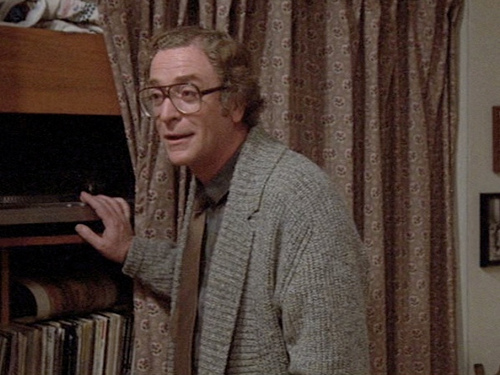 “Hannah And Her Sisters” (1986)
Back before Woody Allen’s Grand European Tour, when he still made films in New York, “Hannah and Her Sisters” was one of his finest, telling the story of three tightly knit sisters and their extended family in Manhattan. Caine and Allen might not seem like an obvious combination, but his storming turn as Elliot, husband to Mia Farrow’s Hannah, won him his first Oscar. A bespectacled middle-aged accountant, Elliot pursues his wife’s vivacious younger sister Lee (Barbara Hershey). As the affair commences, Elliot is not only a philanderer, but also caddishly blames his wife’s self-sufficiency and emotional strength for his wandering eye. Playing another character we should hate, Michael Caine makes us believe in Elliot and the earnestness of his torn feelings between Hannah and her sister. Elliot lacks the panache of Alfie and the dignity of Caine’s later roles, but we are forced to feel for Elliot as he searches for what he thinks is the answer (“For all my education, accomplishments and so-called wisdom, I can’t fathom my own heart”) rather than viewing him merely as a middle-aged lech (“She looks so sexy in that sweater. I just want to be alone with her and hold her and kiss her…”). Almost thirty years later, Elliot still resonates with audiences, as Peter Bradshaw wrote in his Guardian review, “Caine’s performance, so fervent, so agonisingly dedicated, actually gains in force and touching sincerity with the years.”
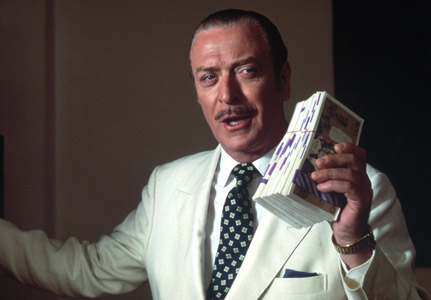 “Dirty Rotten Scoundrels” (1988)
An unofficial remake of “Bedtime Story” starring David Niven and Marlon Brando, “Dirty Rotten Scoundrels” follows two very different conmen on the French Riviera as they are wined and dined by rich female tourists. Unlike others on this list, “Dirty Rotten Scoundrels” is strictly a comedy (and one that makes you wonder why he doesn’t go broad more often), but like in the other films, Caine plays a real cad. Lawrence Jamieson (Caine) is a suave and sophisticated con artist who seduces gullible but not wholly innocent women and relieves them of their wealth. Lawrence’s modus operandi involves convincing these women of a certain age that he is an exiled prince who needs funds to rally his troops and reclaim his birthright. In Caine’s portrayal, Lawrence is catnip for these bored, too-rich-for-their-own-good women with his dashing looks and classic charisma – stealing their hearts and their wallets. Lawrence’s financial future is threatened by the appearance of Freddy Benson (Steve Martin), a small-time crook who has taken an interest in the very same women Lawrence is after – “A poacher who shoots at rabbits may scare big game away.” Whether battling over an American soap queen or teaming up to get rid of a mark, Caine and Martin are a laugh riot. In the end, it turns out that Lawrence’s heart is as golden as his bank account, and we have fallen in love with Michael Caine all over again, even as a thief, liar, and con man. Martin might get the most uproariously funny scenes (particularly in his moments as Prince Ruprecht), but Caine’s the perfect, ultra-suave foil for him, and gets almost as many laughs.
