


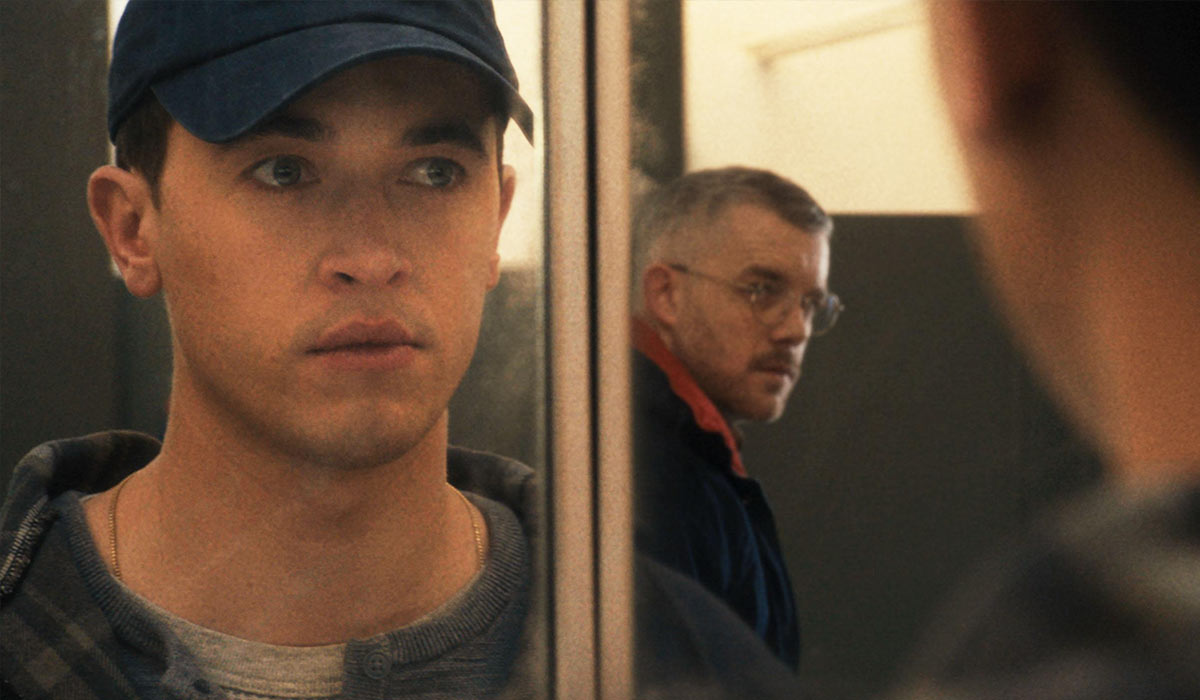
PARK CITY – At its core, “Plainclothes” is a coming-out movie and at this point in cinematic history, coming-out stories are almost a genre in and of itself. Truthfully, many now “classic” gay coming-out films had already hit theaters by 1997, the year “Plainclothes” takes place. Written and directed by Carmen Emmi, this 2025 Sundance Film Festival world premiere reminds us that self-acceptance can be a mountain to overcome for many, and somewhere today, even in a big liberal city or “blue” state, someone is struggling with this secret.
The object of Emmi’s cinematic affection is Lucas (Tom Blyth), a twentysomething police officer trying to make it through a suburban existence in upstate New York. Syracuse, NY, specifically. His current assignment? Hanging out at the local indoor mall, assigned to a solicitation sting ring with a brazen and overly macho colleague Ron(Christin Cooke). Lucas is closeted and battles anxiety and guilt over ensnaring men who believe the attraction he’s instructed to tease is mutual.
When he makes eyes with Andrew (Russell Tovey) in the shopping center, he feels a connection to a potential arrest victim he hasn’t felt before. After a short encounter in the restroom, he breaks it off and walks out signaling to Ron nothing happened. He’s never felt something like this before and is completely unprepared to handle it. Andrew still passes along his phone number and, eventually, Lucas finds the courage to call it.
To be frank, beyond serving as a narrative mechanism for Lucas to confront his feelings and meet Andrew, the sting storyline is the least interesting aspect of “Plainclothes.” What sparks is the incredible chemistry between the lead actors and how Lucas’ increasing stress over his family and, more importantly, his mother Maria (Maria Dizzla) finding out is portrayed on screen. Lucas is convinced he will break his mother’s heart if he tells her the truth about his sexuality. He even had a live-in girlfriend (Amy Forsyth), hoping to provide her with the grandchildren she so desperately wants. Notably, this is where “Plainclothes” adds its imprint on the coming-out genre.
Throughout the picture, Emmi, cinematographer Ethan Palmer, and editor Erik Vogt-Nilsen have mixed contemporary digital camerawork with footage shot on a Hi8 video camera. At first, it feels a bit too much like a gimmick, but as the story unfolds Vogt-Nilsen impressively cuts to just the right shot – rarely lingering on it – to either make you sympathize with Lucas’ internal struggle or remind you just how long ago these events took place.
Period movies of this era are often hard to pull off. The clothes are either too out there like they were pulled from a music video or filmmakers fixate on the loud aspects of the era (newsflash: cars were boring and for most of the decade most people shopped at The Gap or Banana Republic). Emmi and his wardrobe team thankfully don’t overdo it with Lucas or Andrew’s apparel, but the forgotten use of pagers is spot-on.
Emmi’s screenplay also inspires by including a twist of identity that unfolds in a frantic and captivating sequence on New Year’s Eve. The conflict between Lucas’ homophobic Uncle Paul (Gabe Fazio) and his mother, may seem gratuitous at first, but Emmi makes sure it pays off when it counts. This entire portion of the movie wracks up the tension bit by bit. So much so, that you’re not entirely sure where it’s going. Considering the familiar family quarrel setup, it’s one of the most welcome surprises in the movie (and Tovey’s character is nowhere to be found).

What truly elevates “Plainclothes” in this genre are the contributions from Tovey and Blyth. Both Brits do fine American accents (upstate New York is essentially a generic newscaster voice) but their chemistry on screen is palpable. And, sure they make an argument oh why gay actors (in this case, Tovey) can bring an inherent experience to intimate scenes more than publicly non-queer actors seem to, but even their straight scenes take you off guard. During one pivotal scene, Tovey is perhaps the most unfiltered and raw we ever remember seeing him on screen. It’s a quick moment, but it’s a “wow” one.
For Emmi’s ambitions to genuinely succeed, however, Blyth, who is best known for his role in “The Hunger Games: The Ballad of Songbirds and Snakes” and “Billy the Kid,” has to convince you that Lucas’ fears are genuine. That the anxiety he suffers over keeping this secret is real and, just as important, channel that newfound teenage energy most queer people experience when they first fall in love. By the time “Plainclothes” reaches its unexpected climatic moment, he’s utterly nailed it. And as the credits roll, all you can think is, “Show us more, Mr. Blyth. Show us more.” [B]


