




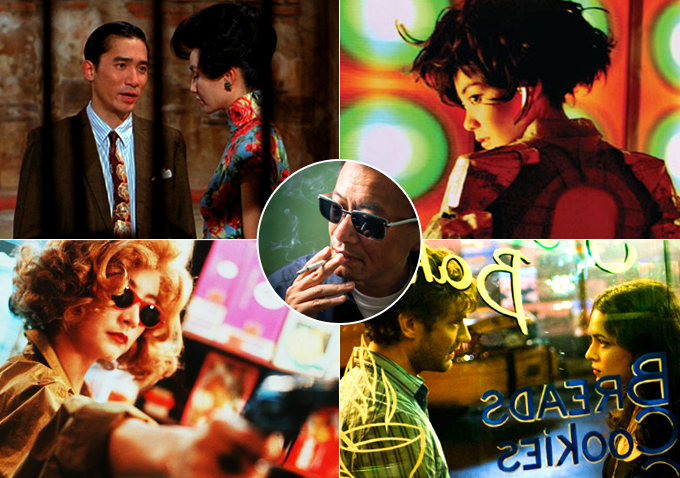
 “2046” (2004)
Narrative concerns seem miles away from “2046,” Wong Kar-wai’s strangest and most adventurous picture yet. Four years in the making, the film robbed us of one of the world’s most vital filmmakers for an extended period, shrouded itself in mystery and ultimately ended up vexing those who sought easy answers. After all, Wong is a director whose trademarks are ambiguous motivations and ambivalent characters all portrayed with deceptive figurative lucidity—and in “2046” he gives full, expansive rein to all those instincts. The story picks up after “In The Mood For Love,” following that film’s protagonist, Chow (Tony Leung) as he recovers from the fallout of his relationship with Su Li-Zhen (Maggie Cheung) by sequestering himself in his hotel room. The science fiction stories he starts to write there are portrayed as a microcosm of his ongoing life, adding Su Li-Zhen to his tapestry of past lovers in an act of catharsis. And so the film becomes a multi-character study that follows the emotional entanglements of several women, including Zhang Zi Yi as a showgirl with a double life, as well as Chinese cinema all-stars Gong Li and Faye Wong. Not everyone was appreciative of Mr. Wong’s sluggish working style, including DP Christopher Doyle (one of two cinematographers credited here, the other being Kwan Pung-Leung), who told the Guardian, “I feel that ‘2046’ is unnecessary, in retrospect… I think probably Wong Kar-wai realized that somewhere, and that’s why it took so long. You do realize that you have basically said what you needed to say, so why say more? I think you have to move on.” But, respectfully, “2046” nonetheless feels alive with the lyricism of a reinvigorated filmmaker, one not afraid of forming bonds that don’t always connect, and one who is aiming so high that even a failure to achieve those heights leaves a film that at times towers above most others. “2046” is messy and sometimes disjointed, but then so is love interrupted, life on hold, and so are the broken ties to a past you can neither forget nor escape. [A-]
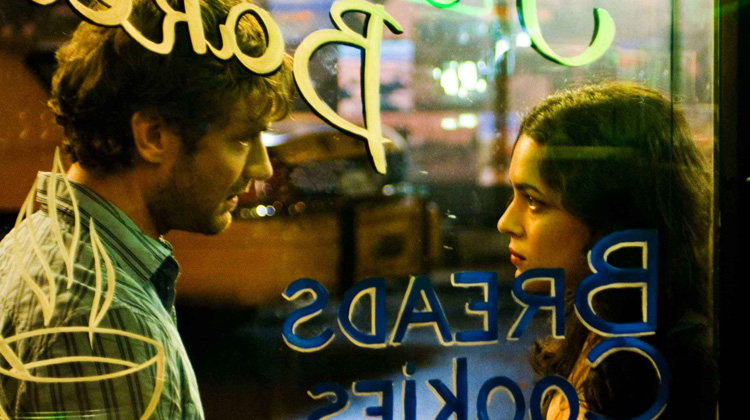 “My Blueberry Nights” (2007)
Known in some circles as Wong Kar-wai’s most egregious misfire, the Asian director’s maligned English-language debut, “My Blueberry Nights” isn’t quite as bad as its legend suggests, but it does have its share of problems. Fetishist that he is, one of the road trip-cum-romance’s most glaring issues is how WKW uses visual shots of various sumptuous pastries and confections to express desire and longing, that come across as a kind of unintentionally hilarious dessert pornography. And Darius Khondji, while one of the great living DPs, in lensing his director’s wishes, shoots a movie so overblown and oversaturated in luminous neon-soaked lighting, that it takes on the quality of a cinematographer shooting a parody of a Wong Kar-wai film. Then there’s the thin narrative and a lead, musician Norah Jones, who hadn’t acted before and it shows. While Jones, a terrific singer who knows a thing or two about heartache, isn’t terrible, she’s not the most dynamic force on screen either. Which leaves this hopelessly romantic picture—about a heartbroken woman, Elizabeth (Jones), who travels the U.S. to get away from her pain—to rely on its supporting characters, most of whom work, but that’s also far from a certainty. An alcoholic cop (David Strathairn) and his estranged wife (Rachel Weisz) in Memphis, Tennessee give the movie some engaging southern flair and genuine emotional depth, plus a chance for Elizabeth to focus on something other than her own sadness. But the miscast Natalie Portman never convinces as a sassy, free-spirited (and crucial third-act) gambler in Nevada who helps Elizabeth find her way spiritually. There are more surprising highlights, too. Cat Power, nee Chan Marshall (who provides some key cuts in the movie’s romantic soundtrack) has a completely electric cameo as the ex-girlfriend of Jude Law and their brief time on screen crackles with regret, anguish and a genuine-article wistfulness that you couldn’t bottle if you tried. And musically, Ry Cooder provides an exceptional dusty twang score with emotionally resonant melancholy notes around the edges. But even the sum of these first-rate elements can’t add up to anything resembling a first-class film. Notoriously taking several years to direct and edit a movie (“2046” took up five years, “The Grandmaster” was shot over a three-year period, minus the editing), “My Blueberry Nights” was shot in a scant seven weeks, indicating that as frustrating as those long waits can be, perhaps they’re justified. That said, a “rushed” production is hardly the worst of its problems, and “My Blueberry Nights” remains the black sheep of WKW’s back catalogue. [C-]
Short Films
Wong Kar-Wai also has seven short films to his credit—though some are more accurately described as commercials, or “branded entertainment.” Perhaps his most well-known is 2001’s “The Follow,” the fourth installment of BMW films “The Hire” series written by Andrew Kevin Walker. Notable for being a Wong collaboration with famed cinematographer Harris Savides instead of usual DP Christopher Doyle, the short does boast a blue-ish gray palette of more restrained hues than we’re used to from the director. But it’s a very slick and wonderfully shot piece nonetheless, and the mood brought to the simple story of a man (Clive Owen) hired by an agent (Forest Whitaker) to follow a beautiful woman (Adriana Lima) whom her husband (Mickey Rourke) suspects of infidelity is all Wong Kar-wai: elegant and enigmatic, with an undertow of melancholy.
Wong’s first brush with the world of commercials, though, was back in 1996 with the copy-and-paste-mandatory “wkw/tk/1996@7’55”hk.net.”Decoding the title explains a lot: it’s a collaboration between “wkw” and “tk,” which stands for Takeo Kikuchi, a fashion designer, the film is 7mins 55 seconds long without credits, and was shot in “hk” (Hong Kong). It’s a pretty gonzo few minutes of jittery editing that have a hip, kinetic energy following a loose story about a young couple repeatedly playing a game where they hunt and shoot each other. Some of the shots are again extraordinary (the scene with the noodles and the gunsmoke especially), and the good-looking central pair (Japanese actor Tadanobu Asano and Hong Kong actress Karen Mok) look appropriately cool, dishevelled and kooky throughout. In its entirety the film is now apparently only available on the Japanese laserdisc of “Fallen Angels,” though you can watch a pretty low quality rip of it below.
Most recently, commercial-wise, Wong directed a short piece for Chivas Regal which premiered in Cannes 2013. Lacking Christopher Doyle the film feels a little flat and it is far more a traditional commercial than, say, his BMW short—complete with copious pouring shots, glory images of the bottle and a plot that appears to revolve, Milk Tray-man style, around a beautiful woman’s (Du Juan) demand that a handsome man (Wong regular Chen Chang) buy her a 100-year-old bottle of Scotch and make it snow in India. It’s hokum and Wong’s touch feels very muted here, so really, all we get is some very glossy and rather anonymous ads for scotch, which you can watch below.
A much more successful commercial venture was in 2007 for Philips Aurea LCD technology. Entitled “There is Only One Sun,” this 10-minute short is very much in the vein of the sci-fi-neon futurism of “2046,” detailing a beautiful agent (Amelie Daure) who falls for the man she has been assigned to entrap. Many Wong staples are here, a narrative about regret and impossible love, a pre-emptive killing and some spectacular sets, costuming and shotmaking. And the commercial aspect of it would be easy to overlook — a subtle mention at the beginning and a screen that appears in the film are the only real nods to the brand, so mostly we’re free to simply enjoy a little sampler of Wong at his glossy, neony best.
Wong Kar-wai’s one and only music video so far is 2002’s DJ Shadow track “Six Days.” Apparently coming about after the musician contacted Wong as a fan and discovered the admiration was mutual, the song could have been written for Wong, with its looping lyrics and refrain “Tomorrow never comes until it’s too late.” It’s actually a pretty great slice of the Wong/Doyle aesthetic, with the underwater sequences especially blissed out and ethereal, and the story, opaquely told, hits all the familiar WKW high notes. A young guy (Wong regular Chang Chen) tries but can’t forget his true love (Malaysian model Danielle Graham), despite her faithlessness, and remembers their affair complete with mysterious tattooing, swimming and frequent references to the number 246 (“2046” was due out soon). Wong even gets to work in a short fight scene and ends the video, as he does “The Grandmaster,” with a Bruce Lee quote.
Away from the commercial/music video end of the spectrum, there is 2004’s “The Hand,” a type of companion piece to “In The Mood For Love,” that could have easily been one of the “Summer in Beijing” triptych of stories that WKW had conceived for his 2000 romantic masterpiece (in the end, all three stories were said to be folded into “In The Mood For Love”). It has the same endless shots of a well-dressed, slicked-back Chang Chen smoking countless cigarettes and cosmetics-lacquered ladies in wonderful beehives. An erotic short in the “Eros” series (which also contained shorts by Steven Soderbergh and Michelangelo Antonioni), it teeters on that razor thin line between the sexiest and the most unintentionally funny short about a handjob ever.
In 2007, Wong participated in another portmanteau film, albeit with a much shorter entry, as one of the 33 directors featured in “To Each His Own Cinema“. His 3-minute segment “I Travelled 9000 km To Give It To You” literalizes the film’s theme of “love for cinema” by portraying a fumbling but passionate encounter in a movie theater while a French film plays. Of course, this being a Wong joint, it’s ambiguous as to whether the encounter is real, imagined or remembered. It’s pretty slight and feels a little disposable by contrast with some of his other shorts, but you can judge for yourself below.
And finally there’s 2000’s “Hua Yang De Nian Hua,” which is a 2½-minute-long collection of clips from old black-and-white Chinese movies, set to one of the classic tracks used in “In the Mood for Love.” On the surface, it should be the most anomalous and possibly anonymous of these short films, as it contains no footage shot by Wong himself. And yet, especially if you view it as a kind of reference board for the same year’s “In the Mood for Love” (and it’s included on the Criterion edition of the film), it’s a fascinating and beautiful artifact in itself, focusing especially on women, their clothing (the structured cheongsam dresses that his female stars often wear are in much in evidence), makeup and hairstyles, but also on their expressions and movements. To a Western eye, it’s also a rare glimpse of a vintage Chinese cinema that’s fully as glamorous as any Golden Age of Hollywood compilation. Gorgeous.
— Jessica Kiang, Rodrigo Perez, Erik McClanahan, Mark Zhuravsky