


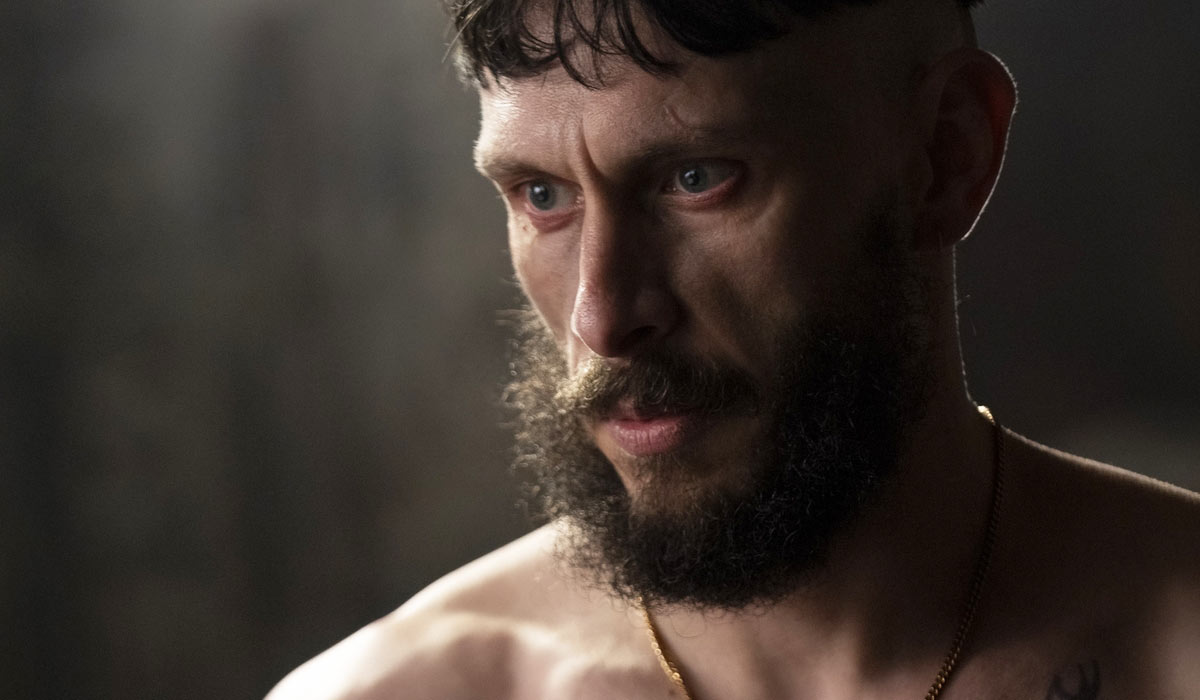
When you conceived it, did you always see yourself starring as Reuben?
No, no, I didn’t want to. Ruben never came into my mind because it was so out of my comfort zone. It was so far away from me. If you look at Donny Dunn and you look at Ruben Pallister, you don’t go out, and we have to cast this person over there. And “Baby Reindeer” was a huge undertaking. And one of the biggest pressures is this kind of jewel focus that you have when you’re in front of the camera and behind. You’re almost acting in a scene, but you’re also trying to figure out how it looks on camera. And you almost have a hyperfocus across two areas all the time, and that can be quite hard, and it can be quite difficult to gain those perspectives. I’ll do a scene now, whether I’m in it or not. I’ll watch it back in the mornings, really just try and assess where it’s going right, where it’s going wrong, and it just adds a lot of pressure. And so I’m always having to basically go around with a lot of analytical minds all at once. And so I thought, “Well, I’ll take that off my plate as well. I’ll just be behind the camera on this one, and I’ll just fulfill my duties off camera and just have a singular focus kind of thing.” But I think thanks to the success of “Baby Reindeer,” the channels were really pushing for me to be in it in a way that was meaningful. And then Jamie was also pushing me to be in a way that was meaningful as well. And so I felt this kind of chorus around me of people who I really respected and admired, basically saying that it would be to the benefit of the show if I was in it. And so I had to think about what to do. And really at this point, Ruben was the only really meaningful sort of male character left.
Wait, to clarify, Jamie was attached before you were ever committed to actually starring it.
Oh yeah, for sure.
I think most assumed that you were attached and then you guys went out to him. So, when you pitched Jamie, had “Baby” come out yet?
I think it had just come out, and I think it had just come out. And so I think he’d maybe watched a few episodes and enjoyed it. I think he was taken by the idea of doing something like this, which was a bit rough and dark, and a bit twisted and a bit going back to the U.K. I think he just really fancied it above everything else. I think he gets the play character that we haven’t really seen in Jamie before too often. And I think he just was really up for it, but he responded very quickly. I always remember that. I always thought, oh, we’re just going to send it out and then not hear anything for ages. But he got back really quickly, and I flew out to meet him, and he suggested it, I think, first before anyone else, me being in it as Ruben. And I was quite taken aback that he’d said it. I don’t know what he saw in me that made him think, “Oh, you’d do Ruben.” Because I thought, “Well, he’s been watching ‘Baby Reindeer’ at home. So, what made him think, Donny Dunn?” I mean, quite a lot of characters were attached before me, most of them.
Were you more apprehensive about taking on this role than doing anything with “Baby Reindeer”? Was this tougher for you than playing that role?
Oh yeah. I mean, “Baby Reindeer” was pressure because I’d written on TV shows before, but I was suddenly showrunning a whole show and then being on camera in every single scene, and it was very deep-end stuff. So, the pressure was enormous. But Donny Dunn was not me, but it was based on a person I was years ago. So, lots to draw on immediately in a way and get stuck into. And there was a lot there to access. But with Ruben, it was so far away. And the biggest pressure was trying to shake off the worry that people wouldn’t…The first barrier, I think, to overcome, at least for me, was, “Oh my God, this is so far away from me. I don’t really see myself as an intimidating person.” I have to get people to buy that, and what if I make a fool of myself?” And that was the first barrier to overcome. And once you get through that, it was nerve-wracking, and I had to almost put it to one side, almost the nerves and the expectation, and be like, “Well, I’m never ever going to get into character enough if all I listened to were the…” You have to risk failure so much. But because it was so far away from me, it was a whole different kind of pressure, but it was a big one. They were different kinds of tough, because Donnie, I had to reenact some pretty awful things.

Did you enjoy the physical transformation? Having to do all the lifting, do all the meal prep, all that stuff? I mean, it was worth it for the role, but was it tougher than you thought?
I enjoyed it in so far as it helped me get into character, and it helped me feel the character in my body, and it helped me get into a certain mindset of being a bigger person. What was interesting is just the way life changes around you when you’re a bit intimidating. And of course, I had to carry that awful beard and haircut around in my life. I looked quite mad. So, you got to feel what it’s like to have that power. And that’s very helpful from an acting point of view to feel like you’re the most intimidating person in a room in a way. And I was doing so many jobs. I was doing the writing and the showrunning, and then I would always work out late at night so it didn’t interrupt the flow of the day, but then you get back, and you’d be quite adrenalized from working out, and you’d have a rough sleep, and then you’d get up in the morning and your body’s sore and you’re having to type.
It was a huge battle with exhaustion in a lot of ways.
Have you kept any of that regimen?
Oh, it’s funny. I’ve told myself I’m going to the gym today, but I remember at my best, but that was such serious dieting, and it took me to fasting, and I was doing a lot of cardio as well towards filming, even though I wasn’t eating as much, trying to strip out some of the fat. And to be honest, with Ruben’s body, that took so much effort and so much discipline, and I realized it would’ve almost been impossible to keep up. But I did say to myself, “I’m never going to let this go when I was at my best.” And then the last scene finishes, and I’m like, “Oh, I’ll have a cheat day. Oh, I’ll have another cheat day. No, I won’t go to the gym this day. I’ll have a packet of gummy bears this day. Oh, I’ll put it off.” [Laughs.] And then you’re back down. And then so I’ve actually been trying to lean myself out a bit as well. I’ve still got a bit of excess Ruben fat because a lot of it was putting a lot of fat on, and so I’m still trying to burn a bit of that off and get a bit slimmer and a bit move around life with a bit more pace.
I believe you’ll be able to do that. I know I’ve read that you said that this is not based on anything that happened in your life, but was there one spark of inspiration for the story that you remember?
I remember being on a tube, and I remember starting to write the first scene on the tube, and the notes on my phone, the barn scene, and it pretty much remained very close to what it was in my notes on the phone. And I honestly can’t remember the kind of light bulb moment, but I think back in 2019, which was when I wrote this kind of spec script, there was a lot of conversation around male violence, male repression, and all this stuff. And I think I thought, “Oh, well, maybe you could contextualize that struggle or that battle that they have in our current times by flashing back to their childhood and showing the kind of unaccepting environments in which they grew up.” And then I thought, “O.K., so then you’ve got a wedding.” And I just remember just feeling that kind of spark of creativity and just writing on my phone. And then I remember getting off the tube, I was still going, and then I sat in Soho Square and delayed my meeting slightly so I could finish it. And I love it when that happens. You get a kind of creative, I don’t know, like spark, and it feels quite exciting. And I just remember that. That was where I wrote the first scene in Soho Square and notes on my phone.
You have the pilot script, the BBC and HBO both come on board. What was the most difficult part of breaking out the rest of the show?
Oh, there’s loads of tough ones. I mean, the time was really tough, the time pressures because the whole show was kind of done in two years. So, “Baby Raindeer” came out on April 11th, 2024, and by October I was in pre-production on “Half Man,” and we were filming less than eight months later. The turnaround was so quick. There were so many factors that came into that, such as Jamie’s availability, scheduling, all kinds of stuff. But that was the real-time pressure, and I felt like I was doing it all the time, rightfully so. I loved it. I don’t regret it, but I remember there was a real sense of urgency to the whole thing, and that was a real pressure. And then the structural stuff, I liked the idea of joining them at these different turning points in their lives. Each episode was a different year, but that’s quite a tough writing job because there’s a lot of contextualization to do and exposition to explain where they’ve been in the meantime. And exposition is hard to write because it could be so boring, so you always have to find interesting ways of doing exposition. It was almost like having to recontextualize the series every time you came to an episode. So, there were loads of creative and scheduling pressures and all kinds of things. But I guess in those situations, I just know I need to just roll up the sleeves and just keep powering through, I guess.
In the context of this, as the writer, as a showrunner, over the entire series, is there one scene, it may not even have you in it, that you’re most proud of? That you think of when you think about the show?
Well, there’s loads of scenes I’m very fond of. I think it’s got to be the crying one, the second scene from the end in episode six where they finally have this conversation they should have had their entire lives. I’m quite proud of that scene. I think the whole series builds to that point, and I just hope it pays off their journey well. I like the twist at the end of the scene, but I think it’s certainly my favorite scene in it. People always talk about the hospital scene, and I think that was very proud of that because we shot that in less than a day. That was a crazy race against time, and we shot it out of sequence as well due to lighting and everything. I was just so pleased that it came off in the way that it did. I love the court scene at the end of episode three and the kind of weed scene in two. But if I had to pick one, it would be the final conversation they have in the prison.
I don’t know what the viewership numbers were in the U.K., but at least in the US, every time I logged into HBO Max, the show was still in the top 10 of series, and it was often number one and often number two. It appears to have been a real success for HBO. Is there a sense of relief knowing that your first follow-up to something like “Reindeer” has done so well?
Oh, it does give me relief. It’s funny you say that because relief is one of the big feelings, because I could have done a lot of things after “Baby Reindeer,” and I decided to take all that stock and, I guess, gamble it back in myself in a tight timeframe, and the pressure was phenomenal. I just felt overwhelming pressure. But in those times, all you can do is work harder and harder and just keep going through it. And so yeah, I’m just proudest being a worthy follow-up because I guess it was a big risk doing it so soon after “Baby Reindeer.” It was a big risk, I think.
I cannot remember the last time a showrunner/creator did such big swings back to back. It is quite impressive.
Oh, thank you. I appreciated that. Yeah, I just had to get back on the horse and do it again. There was a worry, I think I had maybe about basking in it too long or “Baby Reindeer” would come out, and I didn’t want to coast. I just wanted to get back on it. I wanted to keep momentum up. I do believe in ring rust to a certain degree, how boxers talk about ring rust: if they’re too long out of the ring, they forget how to fight. And I think the same applies for almost any discipline in work and in life and in any hobby. And I think I never want to spend too much time away from writing because I always want to try and get better, I guess. And the only way I’m going to get better is by doing it and doing it and doing it and keeping on taking risks and testing myself. So, I’m already itching to get started on something new, to be honest, but I know this time I need to take a bit of a break.
You are definitely an outlier because most writers I speak to don’t seem to enjoy writing. I don’t think you have an idea yet, but do you know if you want to stick to streaming television episodic? Would you want to do a movie? Do you at least know a direction you want to go in next?
Yeah, I’m definitely not done with television. I definitely want to do some more. I love television so much, that kind of long-form storytelling, like building characters over episodes. I really love that. But I have all kinds of creative ambitions and wishes. I’d love to do a film. Film is definitely up there in my priorities and in my mind. The live space as well. I’d love to get back to the live space. I feel there’s sometimes like a hankering to get back on stage. We talk about ring rust a second ago. I want to remind myself about the live performance, and it could be so thrilling, but yeah, I’ve got loads of plans and stuff like that, but I would say all of the above, I guess. Television, film, and the theater again.
Have other filmmakers or creators asked you to act in their projects? Is that something you’re interested in? Should directors know they should reach out to you?
I’d love to act in other people’s stuff. I’d love to do that without doubt. I do get offers every now and again, and usually because I’m so busy, stuff doesn’t quite work out. Once I was in “Half Man,” I had to be in it fully. Because it’s almost like staying in the same mindset. I didn’t want to jump out, do another job, jump back, and get into the mindset. I wanted to stay almost tunnel-visioned for “Half Man,” but yeah, I would be really keen to do that and explore that world. I would certainly be up for that.
“Half Man” is available on HBO Max
Follow Gregory Ellwood on Bluesky
Follow Gregory Ellwood on Threads
Follow Gregory Ellwood on Instagram
Follow Gregory Ellwood on TikTok
Sign Up For The Breakdown Newsletter


