


In an industry where even prestige programs often look cookie-cutter, it’s important to give credit to the shows that go in a decidedly unique creative direction. And, despite its reputation for “flat” looks, it may surprise you to know that Netflix has many of those shows (they also have a lot of shows in general, too). When considering 2026 Emmy Award candidates, the aesthetic and tone director Weronika Tofilska conceived for the limited series “Something Very Bad Is Going To Happen.”
Created by showrunner Haley Z. Boston, “Something Very Bad” follows soul mates Rachel Harkin (Camilla Moronne) and Nicky Cunningham (Adam DiMarco) as they deal with the latter’s seemingly strange family members in a remote estate the week before their wedding. But, oh no, all is not as it seems. And for Tofilska, who directed the first two and last two episodes, teasing that big reveal was a thin line to thread. During our conversation, she revealed the importance of hinting that “something” is going on, casting Moronne, the unexpectedly toughest scene to shoot, and much more.
_____
The Playlist: The most obvious question first: how did this project come your way?
Weronika Tofilska: So, this was after I did “Baby Reindeer,” the Netflix show, and I basically, yeah, I was sent a few different scripts, and I was looking for something perhaps more unique and something that is different from “Baby Reindeer” because obviously you get a lot of things that are slightly similar. And this show came in, and even the title itself just got me really intrigued. And then I read Haley’s script, and it’s just so full of kind of humor, like darkness. It was very different. It was kind of different than anything else I was reading at the time. And I just felt that this is a good match. And because I’m usually interested in things that are totally quite different and quite complicated tonally. And so I just felt also this is something for me.
How far along in the process was Haley and the producing team? Had they already cast the show?
Well, fortunately, actually, I was there quite early on, which is great for a director. And so they were quite far along in terms of the development. So, they had almost all the scripts already, which was great as well. But in terms of all the main creative choices like cast, locations, the ADs, that was something that was a process we started together. And I was kind of an exec on the show as well, so that kind of felt right. And the other directors weren’t hired as well. So, it was the first time when I actually got to really start things from the bottom up.
The series has such a distinctive aesthetic. Where did that inspiration come from? Was there any touchstone for you regarding that?
It’s kind of interesting because obviously Haley’s a huge horror fan and I am a horror fan, perhaps not as extreme as Haley is. And even in the earlier conversations, the obvious examples were mentioned: “Rosemary’s Baby,” “Carrie,” “The Shining,” etc., etc. But I think in a way, our job here was to forget about them. I mean, you kind of really have it in the back of your head as part of your upbringing and the grammar, I think in a way, but it’s not like we were watching them actively during the shoot. And so me and the DP,
[Krzysztof Trojnar], we both did “Baby Reindeer” together. So, we sort of have a bit of a process going. And for me, it’s really about reading the script and just imagining things and seeing why I want to see things a certain way. And subjectivity is a big part of it. And I’m usually drawn to projects that are very first person. And for the first two episodes especially, the show is very much like a first person narrative. And we’re really inside the head of this woman, Rachel. And so that was really the main key in terms of how we seeing the world. It’s distorted through the lens of her anxiety, expectations, anticipations, and trauma and paranoia, et cetera. And I think that was what was leading us plus the script itself.
The show has a twist towards the end of its run. Obviously you’d read the scripts. How cognizant were you all of not teasing what that twist was too much, especially in the first couple episodes so that it would become a genuine surprise?
I think you want to strike the balance between suggesting that what is the extreme [point] you can go with the show. If you don’t communicate that something of that character is possible at all, I think that can be a little bit too much of left field. So, I think there is a little tease happening. I think you want people to start to imagine possibilities without necessarily knowing exactly what happened. And actually, as a viewer, I actually like predicting what happens, and I like being right and wrong. I don’t like being completely wrong, and I don’t like being completely right. So, hopefully when people watch a show, they kind of like, “I knew something like that is going to happen, but I didn’t know exactly this.”
In your first two episodes, do you remember making sure that anything was filmed a certain way or shot or suggested or kept in that might tease it?
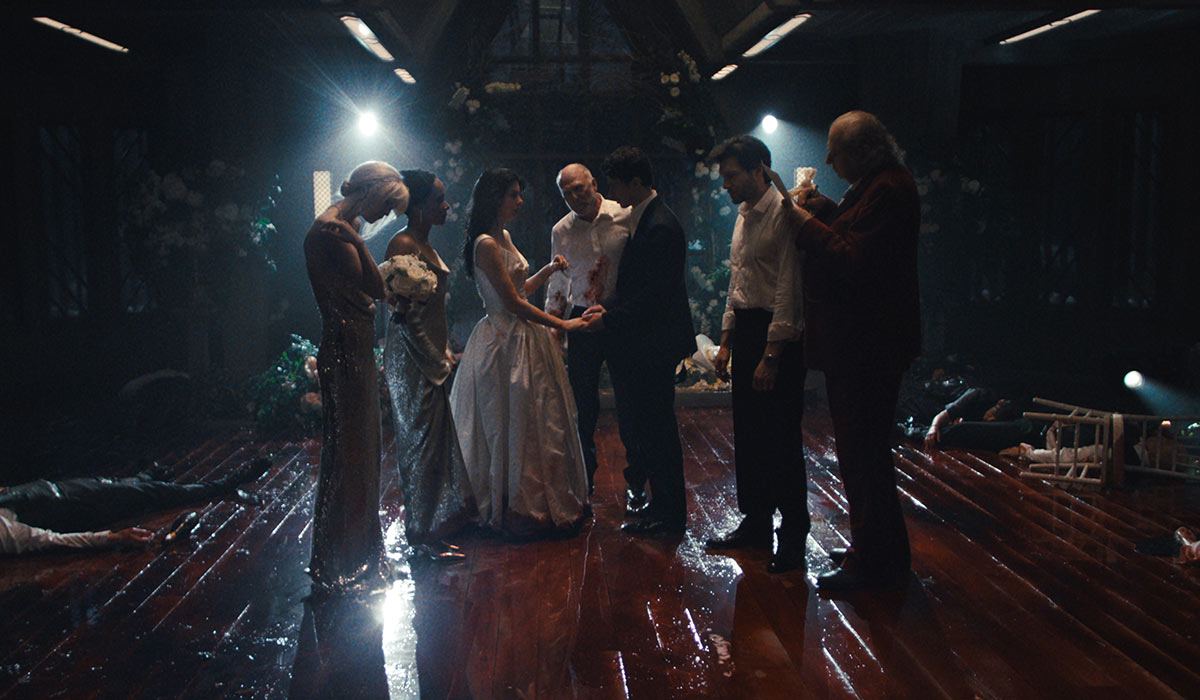
Well, I think there’s a lot of blood-related foreshadowing, and blood was definitely a theme. And we were very careful about use of red in general and the use of blood. So, when you watch the first episode, it’s used very sparingly. It’s like Rachel has a red scarf, but that might be basically it. And there are a lot of gruesome things, but there’s obviously the fox in the toilet moment, which has some of the blood. But again, it’s not necessarily that kind of blood that you see at the end of the show. So, we were kind of careful about it. At the same time, it is emotive. Her nose starts to bleed. In the second episode, there is a moment when there is a champagne bottle being smashed, and there’s a bit more blood, and we’re kind of building up to it.
What did you think Camilla and Adam brought to the roles? Why did you think they were right for this series?
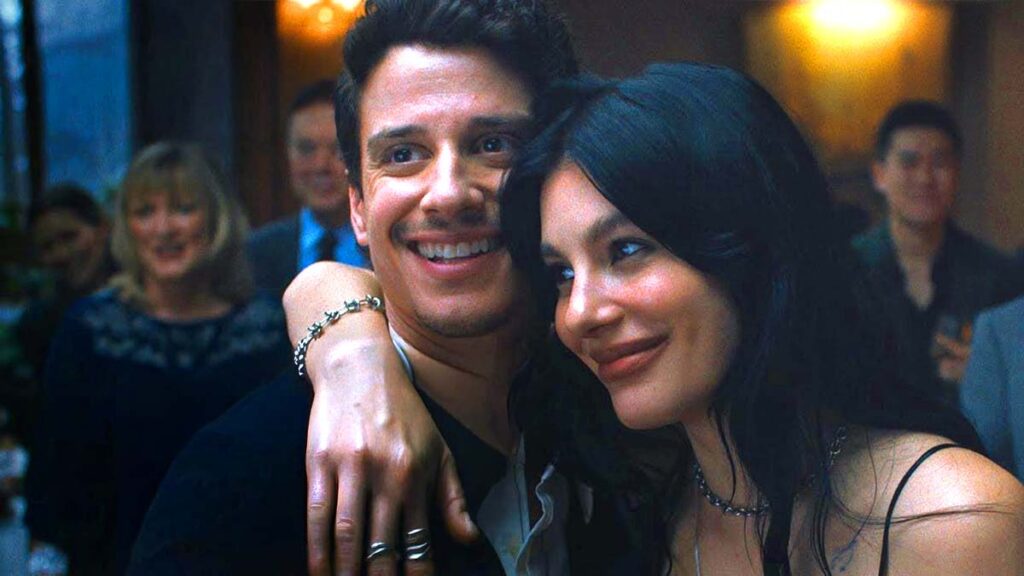
This is a very interesting question, especially with Camilla, because it was written in such a way that really was the rhythm of the language, and you had to feel very natural in someone’s, like the way that she was speaking. And obviously we saw a lot of people. We had Carmen Cuba. She’s an amazing casting director, and she brought some very interesting people, but Camilla was the only one who just felt like this is how she speaks. And this is the combination of actually feeling quite modern, the way she speaks. It’s quite natural, sometimes a bit messy, but there are still kind of jokes written in it. There are still kind of quirks that are very specific to this character, and she was selling it. It didn’t feel tagged on, and she just kind of owned it. It felt like it was her, although she’s actually quite different in real life. It was really a no-brainer at this point, because for me, what I loved about Haley’s script as well is that it’s this kind of heightened world, but the characters entering it are very from this era. They’re very young, very natural. And so the weird is around them, but they’re not. I think that’s what was really important with those two characters, that the family’s extremely strange, but actually their relationship, there’s something very relatable and kind of almost normal about it.
It’s a misdirect that the family may be the crazy ones, but they’re really not. But how did you work on the tone with those actors, Jennifer Jason Leigh, that whole crew, to make sure it’s weird and strange, but it’s not so over the top that it became too comical? Was that a rehearsal thing or did you have them do a wide range of takes and then just shape it in the editing room?
Not really. You know what? I think that the camera is the key here because what I didn’t want to do is for them to act in a way that they wouldn’t, because these characters are acting a different story. They have a different story that she’s putting a very different narrative onto their story. The story is about Victoria dying and grief and them hiding that from Rachel and Nicky. And what she sees is the family playing games with her and lying to her and then potentially trying to kill her. And obviously they can’t be playing that because that’s not what these characters are actually doing. So in a way, I was trying to combine those two things together. So, they’re still playing. If you rewatch it, knowing what the ending of the episode is, hopefully it still makes sense that this is about grief for them, but the way I filmed them, the way Krzysztof or DP filmed them, is sort of like someone looking at someone with a paranoid lens. And therefore something that perhaps the film in a different way would come across a bit more natural. I think it’s exaggerated. So for example, when Ted Levine is talking to her about what you’re doing in her dress, it really is like a husband seeing a young woman in his dying wife’s dress. Obviously he’s kind of heartbroken, but for her it comes across as extremely threatening just because he’s in the shadow and the camera is quite POV-like, and there’s quite a wide lens on it. But if we were filming it more with him, if we had a close-up of him and a longer lens, we wouldn’t be able to see that. So, it’s really a game of perspective and perception.
Was there one sequence or one scene that was the most challenging or that you were the most concerned about pulling off?
There were several. I think I can definitely name the ones that were definitely the most difficult. In episode two, the dress scene, which perhaps on the page it doesn’t seem like an extremely challenging scene, but because again, in Haley’s script, it was written so well how she feels inside this dress, how they’re cutting it off her, how they’re kind of all around her. And so in the script, it’s sort of like four pages of dialogue, so you could probably do it quite fast, just do coverage and et cetera. But we just really wanted to have this feeling that we’re inside the dress with her. So we had to build a mannequin without a head, hang the camera from the top, have two hands standing, have the actors kind of playing to the lens. We did this kind of circular motion around the whole scene. And actually, to be honest, what was great about the production designer, Dick Lunn, as well, was that we were talking about the scene from the beginning, so the room is really built for this scene. There’s a light from the top so we could go around, and the mirrors that are kind of helpful there as well. So it was really one of the most challenging scenes, but also my favorite to play with because the actors were so great and it was like a really lovely kind of orchestra almost. It was something very musical about it. And then obviously the finale was a completely different set of challenges and multiple deaths and blood rigs and a hundred people running around in the blood. I could probably talk about it for an hour, but it was a challenge for sure.
Did you go home bloody that night?
Oh, we had a meeting about what we should wear on the day, and I had a raincoat on. Yeah, people were completely covered with different kind of protective clothing, and we had booties on because we didn’t want to put the blood into the other parts of the set. And it was a whole thing.
After the success of “Baby Reindeer,” what does it mean to you that “Something Very Bad Is Going To Happen” was also such a hit?
I just think you can never predict what people will want to watch. There’s definitely a “Netflix Effect,” which is that, for some reason, shows that somewhere else wouldn’t be able to bring people to the TV screens Netflix does. I think for me, there’s two things that maybe these projects are sharing, although they’re very different. One is that there’s something very interesting about watching people that you perhaps haven’t seen thousand times on screen before, new faces. And also, I don’t want to be controversial, but I think people do like dark stories. If they’re not relentlessly dark and if they’re not grim, if they’re not depressing, if there’s other kind of colors in there, if there’s lightness, if there’s humor and if there’s surprise, people really crave those stories. And I think when you get that, people do watch. And it’s not for everyone, but I think it’s still really great.
“Something Very Bad Is Going To Happen” is available on Netflix
Follow Gregory Ellwood on Bluesky
Follow Gregory Ellwood on Threads
Follow Gregory Ellwood on Instagram
Follow Gregory Ellwood on TikTok
Sign Up For The Breakdown Newsletter

Editor-at-Large Gregory Ellwood is one of the entertainment industry's most respected journalists and critics. Based in Los Angeles, he's the only current awards expert who previously worked on Oscar campaigns at a major movie studio. Over the years, he has written for the LA Times, Variety, The Hollywood Reporter, and Vox, among others. He also co-founded the entertainment news site HitFix, which spawned a legion of influential Emmy and WGA Award-winning alumni.


