


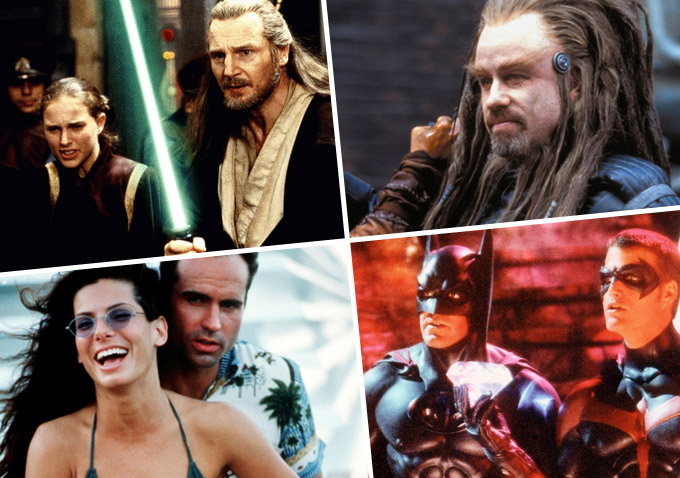
“The Avengers” (1998)
No, not that “Avengers.” Back in the the mid-1990s, the revival of the Bond and “Mission: Impossible” franchises saw studios raiding the vaults for other 1960s and 1970s spy franchises that they could bring back to life, and Warner Bros landed on “The Avengers,” a cult and stylish TV series that had made pop culture icons out of Patrick Macnee and Diana Rigg. The film, helmed by “Benny & Joon” director Jeremiah Chechik, played up the English eccentricity of the original, with a miscast Ralph Fiennes and Uma Thurman donning bowler hat and catsuit respectively to take on Sean Connery’s weather-controlling madman, and throws all kinds of lunacy at the screen, from teddy bear henchmen to bubble suits. But in the aftermath of “Austin Powers” the year before, it all seems forced and ill-conceived. It’s possible there’s a better version out there—the studio lopped nearly half an hour off the film, which explains why it makes no sense. But what remains on screen suggests that we were better off without the extra 30 minutes.
Nadir: Happy Mondays frontman Shaun Ryder turning up as a henchman.
“Green Lantern” (2011)
At a time when even characters like “Thor” and “Captain America” were proving to be the stars of massive movies, you’d have thought that the multiplex audience could have stretched to Green Lantern, one of the most popular of DC’s characters, whose screen debut had been in the works for decades (Jack Black was attached at one point). But despite a throng of writers, and “Casino Royale” director Martin Campbell, and likable star Ryan Reynolds, “Green Lantern” tanked hard. The galactic scope was at least laudable, but a lousy, superhero-origin-template script, a ludicrous villain in Peter Sarsgaard’s swollen-headed Hector Hammond, a dreadful-looking CGI outfit, and noisy, dull action sequences all failed to make much of a case for the big-screen viability of the character. Still, Reynolds and Blake Lively hooked up on set, so they at least got something out of it.
Nadir: The climax, in which our hero battles a giant fart-cloud.
“Sex And The City 2” (2010)
Almost every film on this list, and indeed, almost every film released as a summer blockbuster, are aimed principally at teenage boys, so it’s almost a shame that we have to include one of the rare exceptions. But given that “Sex And The City 2” made “Sex And The City: The Movie” look like “Sex And The City” the TV series, we’d be remiss in not including it somewhere. Reteaming the famous Cosmo-sipping quartet from the hit HBO series for a trip to Abu Dhabi for no reason in particular, it suggests that writer-director Michael Patrick King never really knew what made the series works, because this is a gaudy, pandering nightmare, that saw Carrie and co. acting less like the women loved by millions, and more like Marie Antoinette, complaining about their nannies on a beach and offending entire cultures as the audience grew more and more murderous. Maybe it might have been bearable at 85 minutes, but at nearly 150, it’s something that comes close to violating human rights.
Nadir: The first-act wedding sequence, a monument to lack of taste, seemingly based on your grandparents’ idea of what gay people are like.
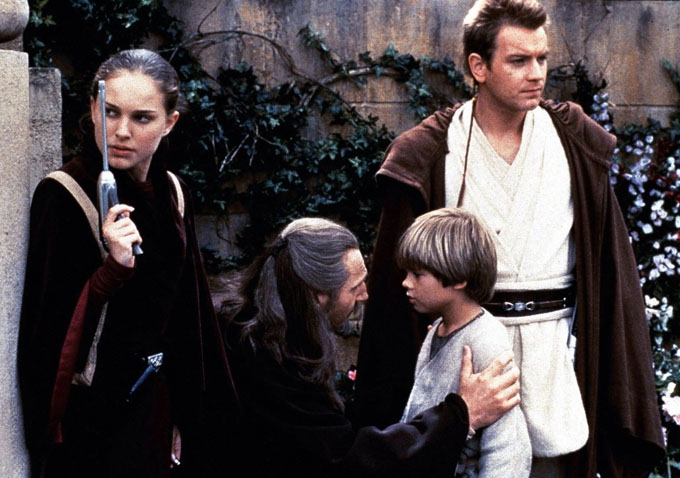
There’ll probably never again be a film with the feverish level of anticipation of this one. The revival of the biggest franchise in film history, after nearly twenty years, rode the tail of hugely successful re-releases, and came just as the internet, and sites like Ain’t It Cool News, were coming of age. Even the trailer felt like a massive event. Which all meant that the film just felt like a bigger let down. Unlike some of these films, it has a couple of redeeming features–the podrace sequence is an outstanding set-piece, and the fight at the end is one of the best in the series, thanks in part to Ray Park’s striking villain Darth Maul. But the rest is a sterile bore (a trade embargo, you say? How THRILLING!), with very little of the grimy, playful joy of the original films, and way more casual racism (Jar-Jar gets the press, but the Asian-accented villains, and Arab-ish scrap dealer Watto are worse). And the performers, even ones more talented than young Jake Lloyd, are tangibly drowning in green screen. All of the prequels are bad, but this rivals the Christmas Special as the absolute low watermark for the entire franchise. Plus side: it gives J.J. Abrams a lower bar to clear come December 2015.
Nadir: Every excruciatingly stiff line-reading. It seems no one on set had the balls to echo Harrison Ford, and tell the director “you can type this shit, George, but you sure can’t say it.”
Though “The Amazing Spider-Man 2” makes a pretty good fist of getting close to it, it feels unlike we’ll ever see a worse superhero movie than “Batman & Robin,” a monumentally ill-conceived disaster zone that still astonishes with how entirely unsuccessful it is at every single level. After the darkness of Tim Burton’s “Batman Returns” unnerved Warner Bros. executives, Joel Schumacher gave the franchise a fresh-lick of kid-friendly paint with 1995’s “Batman Forever,” presumably to their delight, because whatever was wrong with that film is doubly so in the follow-up. Every costume and set seems designed as a toy first and as something to be shown on screen second, Akiva Goldsman’s screenplay appears to be inspired by a deranged child’s retelling of a plot from the 1960s TV series, and even the action is atrocious. The dark and gritty way of the subsequent Christopher Nolan films isn’t the only way to paint the character, but the pantomime of “Batman & Robin” is certainly the worst of all possible scenarios.
Nadir: Mr. Freeze’s puns are legendary, but George Clooney’s Batman bidding on Uma Thurman’s Poison Ivy with his Bat-Credit Card is pretty much unbeatable.

