


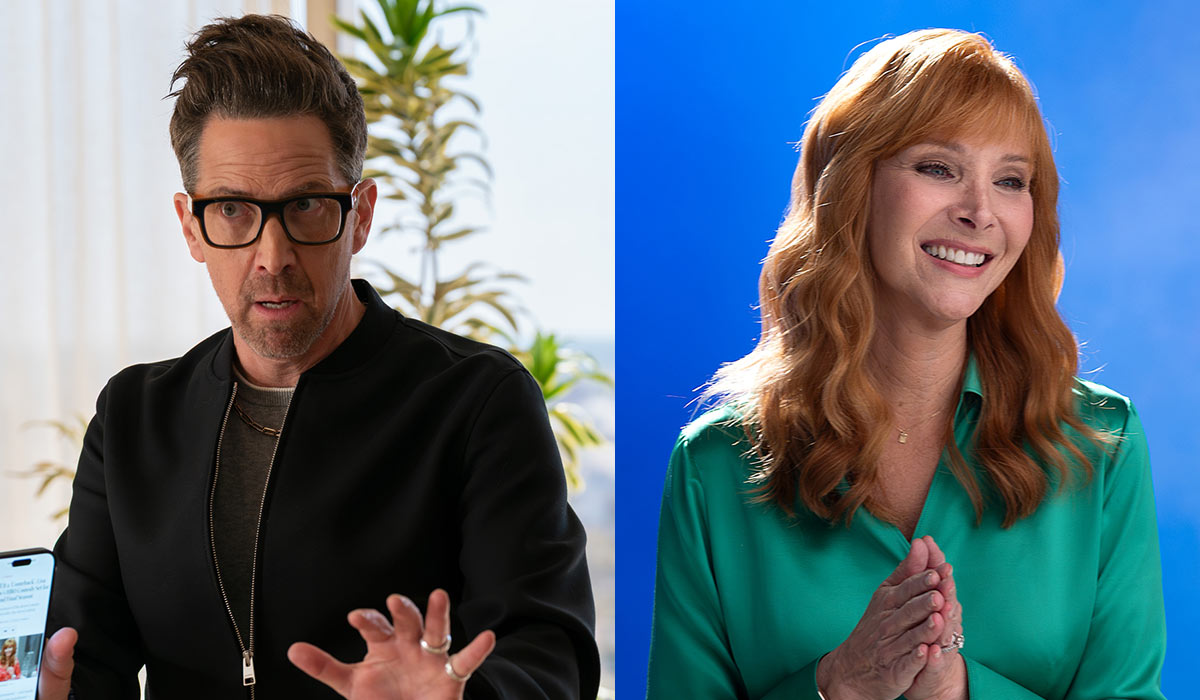
Hollywood is sort of at a zeitgeist moment. From “Hacks” to “Bait” to “Wonder Man” to “The Studio,” the industry has looked in the mirror and not always liked what it’s seen. Over two decades and three distinct seasons, “The Comeback” has become a similar and unexpected Hollywood touchstone. The third and final season came to a close with arguably one of the most poignant endings of a series this decade. And for executive producer and cast member Dan Bucatinsky, it’s as thrilling to go out on such a high as it is bittersweet to say goodbye.
READ MORE: Best Actress In A Comedy Series Predictions And Contenders
Created by Michael Patrick King and Lisa Kudrow, “The Comeback” began in 2005 by following Valerie Cherish (Kudrow), a moderately successful sitcom actor struggling for her next gig. When she’s cast in a new comedy program, she’s required to have her daily life chronicled by a documentary crew. By the second season of “The Comeback,” in 2014, Valerie has the reality bug and is trying to produce her own reality show, which she hopes will sell to Bravo. This latest season, Valerie is recruited to star and ends up showrunning the first AI-written sitcom. A scary sentence for many, which King, Kudrow, and everyone involved are utterly aware of.
A constant in Valerie’s life has been Billy (Bucatinsky), a one-time struggling, second-rate publicist who has stuck by her and become her manager. Except, like everyone else in Valerie’s orbit in season three, he’s got his own narcissistic shine to focus on. A topic among many others, Bucatinsky discusses in our interview.
And yes, some of the answers are long, but when your subject has this much to say, you can only edit so much. That being said…
This interview has genuinely been edited for length and clarity.
_____
The Playlist: When did you first get an inkling that Michael and Lisa had another idea, another storyline for Valerie Cherish?
Dan Bucatinsky: Well, I’ll say this. It never really goes away. Ever since we were able to come back for season two, and once that aired ended so beautifully, I was so impressed by the two of them and the way in which season two ended in such a filmic, emotional, satisfying way. I mean, it’s one of the best hours of television ever, I think. Not that I’m not biased. But a couple of years after that, maybe just before COVID, the questions would start to come from every angle, from everywhere. “Is there going to be a season three of ‘The Comeback’?” And it wasn’t really something that had been talked about, but the questions kept coming. And so anytime we would all get together, they would be like, “What would be the story? What do you think she’s doing?” But all that to say that about two years ago, maybe a little bit longer, I was at a Christmas party at the home of one of our original writers from “The Comeback,” and Lisa and Michael pulled me into a corner very hush-hush. And they were like, “We had lunch, and Lisa was talking…imagine Valerie on the picket line.” Valerie’s interaction with the strike was sort of the beginning. What was the strike about? The strike really was about AI. And then this notion, “What if Valerie was on the first-ever AI-written sitcom?” That’s got to be it. And at the time, it was Christmas of 2024? And she was doing a show for Netflix, and he was finishing “And Just Like That.” So, it wasn’t like there was any kind of urgency. But I was so delighted because over the years, it really just takes the two of them to be in lockstep about an idea, about a big concept. It’s one thing to imagine Valerie in this circumstance, or that circumstance, and all of them are funny. “Wouldn’t it be great if Valerie were on a book tour? Wouldn’t it be great if Valerie did a TED Talk? Wouldn’t it be great if Valerie were on ‘Bridgerton,’ in London?” All of them are delightful. Valerie on Broadway has been something we’ve talked about for 15 years, 20 years. But an idea that’s big enough, important enough, current enough, and has real stakes like this was palpable. And then a conversation with HBO where Casey [Bloys] was like, “If you’re going to do it, you have to do it right now.” I mean, it couldn’t be more right now. And as it turns out, that’s right. The two of them started writing. They wrote all eight episodes. We started shooting in August. We wrapped in November, started cutting right away, and we’re on the air in March. So, once it was pitched and accepted, it was off and running.
That’s an endorsement for putting deadlines and pressure on people in entertainment. You mentioned how you thought the finale of the second season was one of the finest hours of television. I actually think this series finale is one of the best I’ve seen this decade. It feels timely in a way that doesn’t feel like it’s trying to be timely. When you finally got the scripts, what was your reaction? Also, what struck you the most about where Billy’s character went?
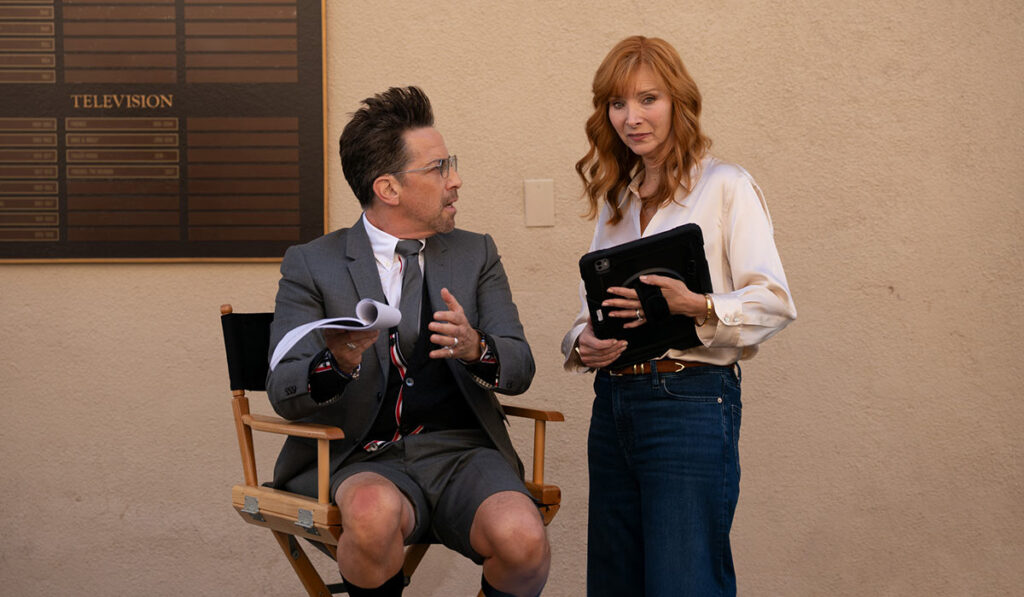
I’m going to be totally honest with you. The two of them were off writing for a good chunk of time, and every episode that they would sort of crack, break? Lisa was one of my best friends for 30 years. Lisa would call me and be like, “I’m not allowed to tell you what’s happening, but ‘Oh my God. Oh my God.'” Stuff that they hadn’t particularly put in ink yet, they didn’t really want to talk about. But she would say, “This thing’s going to happen.” And then, “Oh my God, the Tom Browne skirts.” And I would get little dribs and drabs about Billy for sure. But I will tell you the truth, when they told me what the season was going to tackle, and when I thought about how are they going to write character story arcs for documentarian Jane (Laura Silverman), for Billy, for Valerie’s husband Mark (Damien Young), and at the same time, have Valerie on the first ever AI-written sitcom and the ramifications of that and people finding out about it, I was like, “It’s too much. You can’t possibly do it all in eight episodes. It’s just not possible.” And then the scripts came, and I remember reading the first one, first of all, being absolutely delighted and pleasantly surprised by the first 15 pages, taking place two years ago in rehearsal for “Chicago.” Nothing made me happier because it was a dream to see Valerie on Broadway. But to see it set up the way it was and to have it tackle as much as it did, I was so in awe of my partners in such a big way because every episode was a piece in and of itself. The first one really does what it needs to do, which is take us back a couple of years, jump to the present, and let us know how the inciting incident is going to occur. And Billy delivers this news to her, which she’s very nervous about, and is like, “It’s too soon. I can’t do it. I’m going to wait till everyone’s doing one. I’m not doing it. ” And then she has an experience being a date player on an independent movie and is like, “All right, set up the meeting.” Some realities are like, “I can’t keep doing this.” And then episode by episode, I was just amazed by the fact that each one was like a chapter in a book. Each one had its own theme, its own drive. It exposed things about Mark and his midlife crisis, things about getting Jane back in episode two.
Three was sort of a tribute to Mickey in the most beautiful way. Four were up and running, and then there’s a hitch. It just unfolded really nicely. And the Billy of it all, I just wanted to make sure that the Billy of today felt believable that in the 22 years since we met him, shoving people out of his way, anytime they crossed him, that he felt like the same human being. And they absolutely delivered. I mean, they created a Billy that was so thirsty and driven and using this opportunity to get his star, to get his light shining on him. And it really builds, I think, to what at least we saw last night, which is the creation of the monster that is Star Billy.
Tell me if you agree with this. During the first two seasons, Valerie’s character is the one who is the desperate center of attention trying to hold onto the fame. And in this season, I’m not saying she’s the “straight woman,” but she’s almost the center of stability. Meanwhile, everyone around her is grasping for fame, including Billy. I don’t remember Billy like this in the other two seasons. Was that something that either Lisa or Michael talked about, or was it just inherent in the scripts when you got them?
That’s a good question about the timing of all that. First of all, in this day and age, everyone is in control of their own narrative and their own ability to be the center of attention, given social media. We didn’t have that in 2005. So, Valerie needed reality cameras to follow her around to give her a sense of feeling seen and heard. Nowadays, the notion that everybody has become Valerie Cherish is a theme that has really taken 22 years to deliver on. And certainly in this season, the idea that Mark winds up on a reality show just as a way of trying to heal himself, the idea that Jane wants to pick up her cameras again to try to tell something to the world, and make a difference, and Billy is looking for any opportunity to finally say, “When is it ever going to be about me?” And, at what cost, by the way? I’m not fond of Billy. It was a blast to play, but Billy is falling down on the job, doesn’t read one script, doesn’t show up to one table read, just comes to the tape nights, fully decked out so that people will see him, and really lets down his partner in a pretty big way. And after 22 years of being really devoted to getting her work, so many people in this season are all about themselves and about their own desperate need to feel seen and heard. And Valerie has this kind of maturity, this confidence that I don’t think she even knew she had, where “I got to get this job done, and however way I’m going to do it.
I don’t have Mickey. I don’t really have Billy because he’s too busy looking at himself. I’m going to have to do this on my own.” And this whole season is about this growth that you see in Valerie. A great example of that is in episode three, when she has that argument with Benito Skinner, who plays the costume designer, and she’s like, “Honey, I’m trying to help you here. I’m trying to play a character, and I’m trying to let the wardrobe be fitting of this character.” She’s not the joke anymore. And she’s speaking from truth, and she’s right. And he’s being totally inappropriate with her. And she stands up for herself, but still wants to be a team player and still wants to be liked. And she then chalks it up to maybe being hangry, and “I’ll try it. I’ll give it a shot.” But you see the makings of a woman who, later, Andrew Scott says to her, “You know what? You don’t need a showrunner. You know more about multi-cams than anybody.” And she’s like, “I do.” It dawns on Valerie that you can drive this train without anybody else. And it’s kind of thrilling to watch. And then in the meantime, Billy is perfectly happy to sit at any fashion show where he is invited to sit because it’s more attention than he’s ever gotten before. And I think that’s all he’s after. It’s a little empty. It’s a little sad, but the inevitable breakup of Valerie and Billy was very hard to play because it was also us saying goodbye to these characters, but it was necessary. And I keep wanting to ask Lisa, if Billy didn’t say that, if Billy didn’t walk away the way he does in the final episode…When she asked me, “Do I have a manager anymore?” And there’s this moment where I don’t think Billy actually thought about it, I mean, another bad sign. He hadn’t really thought about it until that moment, “I guess not.” I wonder whether she would’ve fired him if he hadn’t stepped away. It was time. It was time for them to part ways.


