


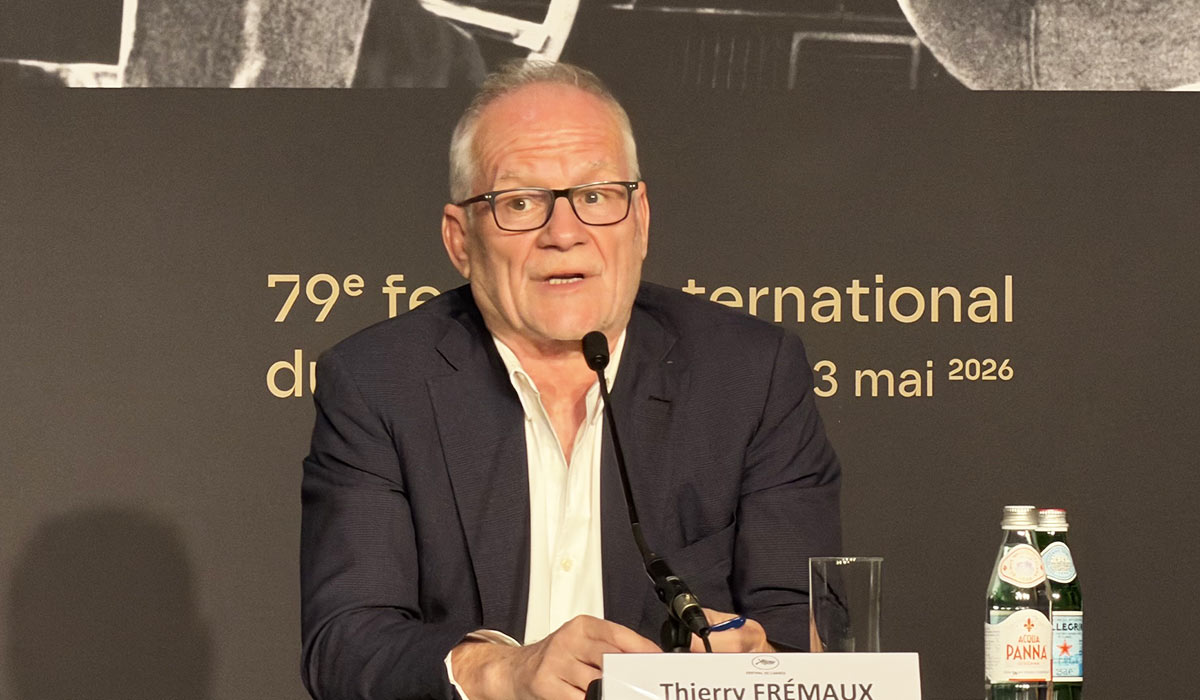
CANNES – Thierry Frémaux has had quite a run. A historic run. As general delegate of the Festival de Cannes, he’s been the festival director for 25 years. And despite all the tough questions he’s received over the decades, there was still a gleam in his eye when speaking to the assembled media at his annual pre-festival press conference today. Or, maybe that was just anticipation of being asked by a Spanish or Italian journalist why there were no films from their nation in the official competition this year (for those keeping track, it’s Italy this time around).
As expected, there were questions over the political nature of a festival such as Cannes. Especially after the criticism, Berlin Film Festival jury president Wim Wenders, a Cannes regular, mind you, received in February for his comment that filmmakers “need to stay out of politics.” These comments caused a swirl of controversy, with creative director Tricia Tuttle having to defend the festival to the government and almost losing her job. Frémaux believes Wenders’ comments were taken out of context, and “I don’t think people wanted to understand what he actually stated.” That being said, he reminded everyone that Cannes’ formation was inherently political.
READ MORE: Demi Moore, Chloe Zhao, Stellan Skarsgard Set For 2026 Cannes Film Festival Jury
The Venice Film Festival had launched in 1932 and headed by a notorious fascist businessman, Giuseppe Volpi. In 1937, Italian dictator Benito Mussolini made sure “La Grande Illusion,” a film rooted in pacifism, didn’t win the festival. Mussolini and Adolf Hitler, yes, that Hitler, then made sure the top prize and foreign film prize went to politically aligned Italian and German films. That spurred the French to begin work at Cannes, which launched on August 31, 1939. Germany invaded Poland the next day, and the festival was suspended. It resumed fully after WWII.
Speaking in French, Frémaux noted that politics at a festival were then often set “aside for Cannes. The Cannes festival was for a long time considered to be a very political fest. Is it more or less than before? Is it hard to change and hard to compare?” And of course, he reminded everyone, that just last year, Jafar Panahi’s “Just A Little Accident,” a stark indictment of the Iranian authoritarian state, won the Palme d’Or. Although Fremaux noted that last year’s jury just liked “Accident” as a movie more than anything else. Fremaux also turned the question back to the journalist, “You can ask the question to directors every day, but do they want to answer? We’ll have to see.”
He was also asked about the new Oscars rule, which will allow specific winners of the Cannes, Sundance, Busan, San Sebastian, Venice, and TIFF Film Festivals to be automatically submitted in the International Film race. Previously, only films selected by their host nations could be considered. Frémaux thinks it’s a positive change as it may help avoid scandals such as Palme d’Or winner “Anatomy of a Fall” being snubbed as France’s selection in 2023. But he did think that perhaps other festivals should be included as arbitrators (this list is “Euro-focused”) and nations should be able to submit more than one film (there are three Spanish films in competition at Cannes this year, he thinks Spain would want in the mix). Notably, our rule is not to talk about films that are not in Cannes. Frémaux also admits he’s changed his tune on The Academy recognizing Cannes films over “American” films. He recognizes that Hollywood and the industry are becoming more open to rewarding international films. It’s a legit trend and not a one-time moment highlighted by “Parasite’s” success in 2020.
Speaking of Hollywood, Frémaux was asked about the lack of studio representation in or out of competition. A talking point on both sides of the Atlantic and, specifically, regarding Steven Spielberg’s “Disclosure Day,” which would have lined up perfectly for a Cannes premiere. Frémaux noted, “We only talk about the films that are in the selection. Each studio, each distributor has his or her own strategy which you have to respect.”
He then volunteered, “Two of the great American films the last year, one by Paul Thomas Anderson and [the other by Ryan Coogler].” He noted, “Coogler showed his first film here, and then he gave a masterclass, but Warner had this strategy.” As for “One Battle After Another,” Frémaux revealed, “Two years ago, the film would be in Cannes. There was a delay and instead of it released in August, it was released in September [which killed a premiere at Cannes].” That being said, he added, “I hope the studio films will come back,” but there are more American films screening than last year, including works from James Gray, Ira Sachs, and Steven Soderbergh.
And with a sly smile, he added, “Nobody knows, if ‘One Battle After Another’ or ‘Sinners’ had they been in Cannes in time, if they would have had even more success.”
Imagine.
The 2026 Cannes Film Festival runs from May 12-23. Look for complete coverage from the 2026 Cannes Film Festival on The Playlist.
Follow Gregory Ellwood on Bluesky
Follow Gregory Ellwood on Threads
Follow Gregory Ellwood on Instagram
Follow Gregory Ellwood on TikTok
Sign Up For The Breakdown Newsletter


