


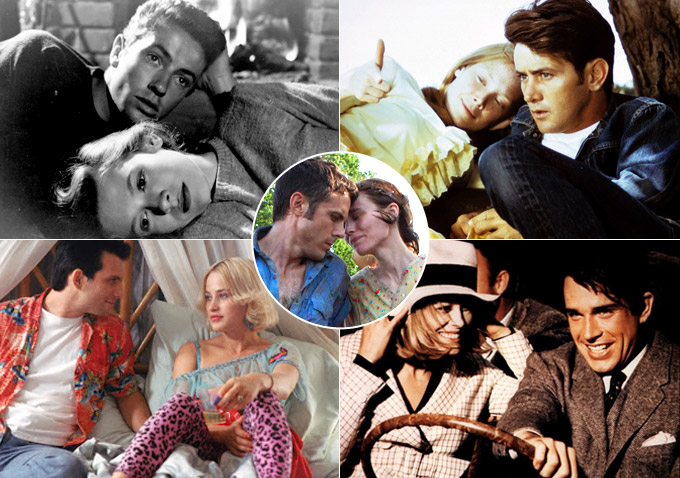
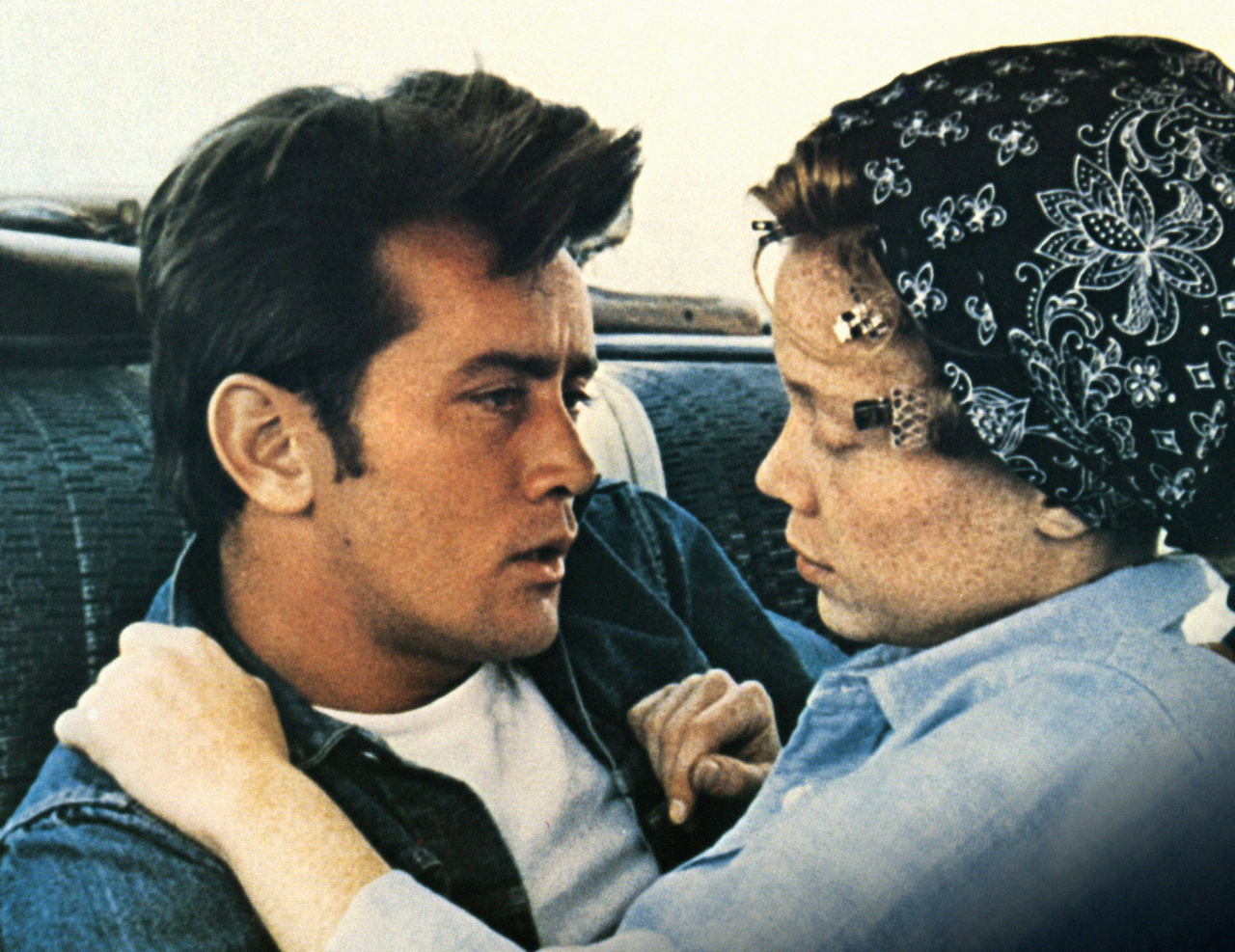
“Badlands” (1973)
Arguably the “lovers on the run” movie to which all others are compared, Terrence Malick’s debut feature, loosely based on the real life homicidal exploits of serial killer Charles Starkweather and his girlfriend Caril Ann Fugate is a singular tour de force of American filmmaking, led by two peerless performances by Martin Sheen and Sissy Spacek. Sheen is a low-rent loser who charms an underage small-town girl, first into killing her father (Warren Oates) and then accompanying him on a murder spree. (The movie, like the actual case, allows you to decide what level of involvement she actually had.) Malick’s trademark dreaminess is in its infancy here, but it does much to emphasize the fairytale nature of the pair’s dark adventure: they travel through the countryside and hide out in an enchanted forest, with him as the knight tasked with slaying the dragons and her as the helpless princess. Lovers sometimes run in the movies because their love is misunderstood or they’re wanted by the authorities; both are true here. There’s a kind of willful ignorance that has to be employed, since she is an underage girl and he is one of cinema’s most enduring, compelling idiots, all swagger and denim and slicked-back hair. You can feel the influence of “Badlands” in so many subsequent movies in this genre, that it might almost seem like it’s more important for the films it spawned and inspired. But then you go back to the original and find it just as compelling and engaging and brilliantly fresh as ever. [A]
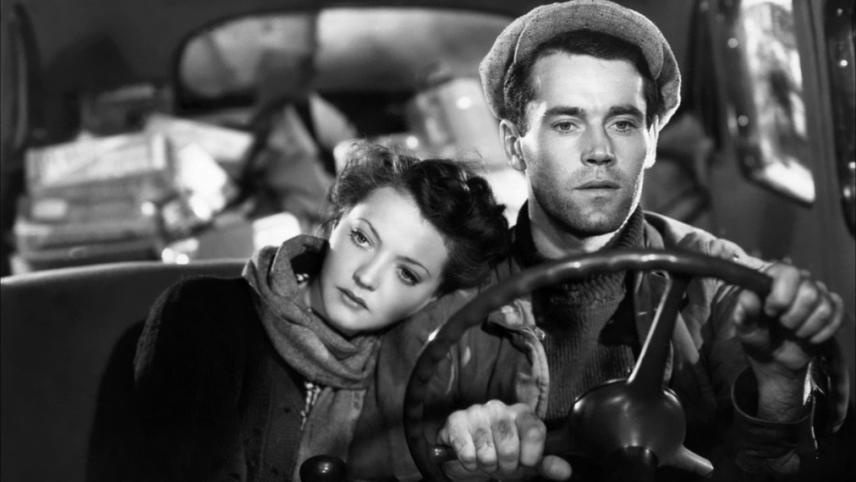
“You Only Live Once” (1937)
Only the second of great Austrian director Fritz Lang’s U.S. pictures (the first being “Fury,” which also starred Sylvia Sidney, as would his next, “You and Me”) “You Only Live Once” is a beautifully shot and crisply acted tragedy in which a smart, beautiful and all-round beloved young woman, Joan (Sidney) falls, with undying and unquestioning loyalty, for petty criminal Eddie (Henry Fonda). Joan’s idealism and decency are revealed as insufficient to save her ex-con husband from the prejudices of a judgmental society and eventually she too, hardens against the outside world, choosing to be with him, on the wrong side of the law, over everything else—job, family, respectability and even, eventually, their baby. Fonda and Sidney are both superb in their roles, with Fonda bringing some of his trademark ambiguity to the character of Eddie, making him a sympathetic but also deeply flawed man whose predicament can’t simply be chalked up to the failings of an uncaring society, while Sidney really sells Joan’s devolution from perky, indefatigable, upstanding member of society to monomaniacal, uncomplaining Girl Friday to a desperate, hopeless, newly minted murderer. The story follows Eddie’s release from prison for attempted robbery, after the constant petitioning of Joan and her boss (who is in love with her), but after Joan and Eddie marry it’s revealed how difficult leading an ordinary life will be for an ex-con, and he is soon back in prison, this time on a much more serious charge. Lang’s skill is on view in every frame of this doomed lovers tale, particularly in a bravura, impressionistic robbery sequence which is shot so cleverly that its ambiguities remain intact until later in the film, and in the very modern-feeling performances he draws from his fine actors—you’d have to be a little made of stone for Joan’s final insistence that she’d do it all again not to move you. It certainly makes us curious for the 100-minute cut which was trimmed to the current 85 due to excessive violence—what remains is a classic already, but we’d be happy to get another 15 minutes of Lang’s distinctive visual flair. [B+/A-]
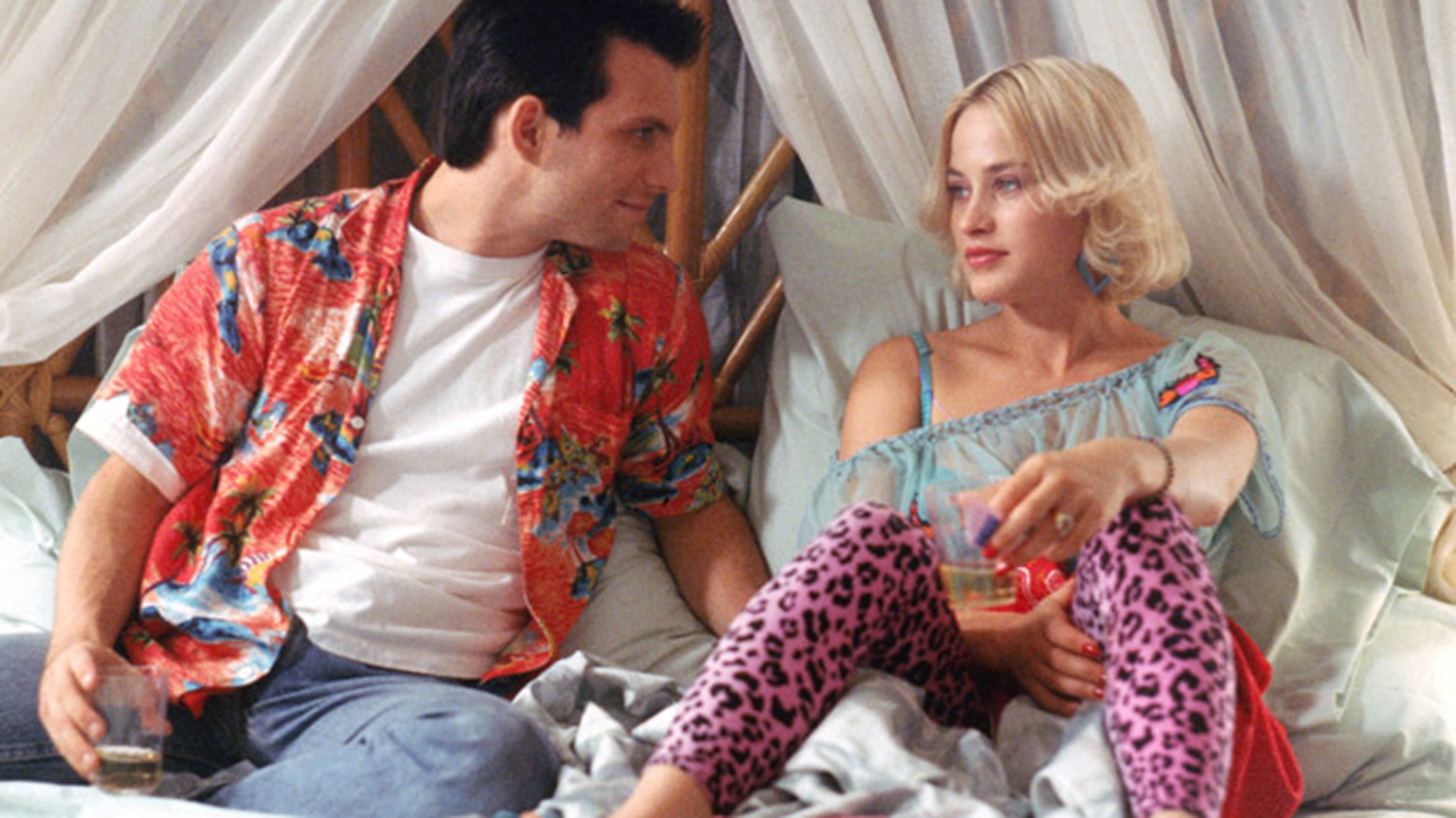
“True Romance” (1993)
One of the late Tony Scott’s best offerings, the Tarantino-scripted “True Romance” is no doubt influenced and inspired by many of the films in our round-up. Clarence Worley (Christian Slater) crosses paths with call girl Alabama Whitman (Patricia Arquette) on his birthday, promptly falls in love and liberates her from vicious drug dealer Drexl Spivey (a memorable Gary Oldman), coming away blood-stained, but with a suitcase full of coke. Their journey henceforth is more memorable for its asides than the actual relationship between the two leads, despite some solid chemistry. Scott’s usual bombastic stylistics don’t overshadow the dialogue and two scenes stand out—Clarence’s face time with Drexel and an instant classic of an exchange between Clarence’s father Clifford (Dennis Hopper) and Vincenzo Coccotti (Christopher Walken), on the trail of the two love birds to recover the drug money. Slater and Arquette are likable enough, but their coupling is not especially memorable – a perpetual honeymoon interrupted by grizzly violence. Tarantino doesn’t so much skimp on character development as he follows the blueprint laid out by similar films—even Hans Zimmer‘s excellent score is a direct homage to “Badlands”—with the exception of writing Clarence as a pop culture enthusiast par excellence. In a (thankfully) alternate universe, it’s not hard to imagine Tarantino playing that role — it is essentially a love letter/fantasy to film geeks worldwide. It’s fizzy, heady fun that neither tries for nor achieves anything else, and if nothing else leaves us with a couple of truly cherishable moments, including the ending: only in a Tarantino script could the three little words that buzz around someone’s head as they watch their beloved get perforated be…”You’re. So. Cool.” [B]
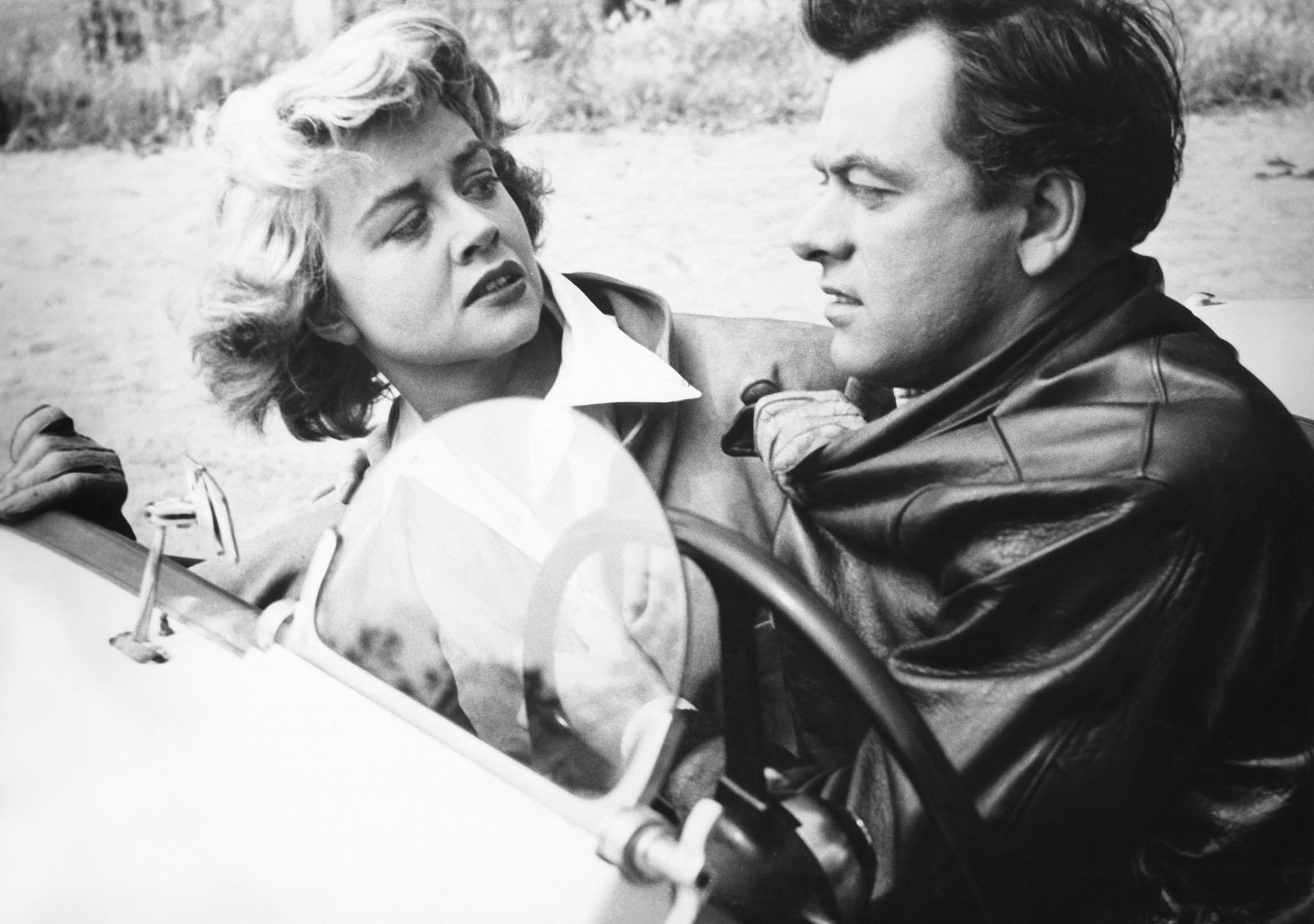
“The Fast and the Furious” (1955)
Yep, before there was Vin, Paul Walker, and even The Rock, there was the 1955 original: “The Fast & The Furious.” But no, the testosterone-fueled series we know and apparently love, doesn’t have anything to do with the original, other than appropriating its name (evidently MGM didn’t ask Universal to change it to “Vin Diesel’s The Fast & The Furious”). Co-directed by Edward Sampson and the movie’s star John Ireland (John Ford‘s “My Darling Clementine” and Howard Hawks‘ “Red River” to name a few, ), the movie was a Roger Corman production—evidently the notoriously thrifty Corman let Ireland co-direct as a way to lower his starring fee. And it really has his fingerprints all over it: he co-wrote, got behind the camera for the first time to shoot second unit and even did some of the stunt driving. It’s a typically efficient premise that wastes no time and kicks its story off in its first five minutes: a prison jailbird commandeers a young woman’s hot rod and they’re off to Mexico! The upper-class broad in distress is Dorothy Malone who cineastes will remember from her Academy Award-winning supporting role in Douglas Sirk‘s “Written On The Wind.” As Ireland’s hostage, Malone’s scrappy character frets and proves to be a difficult kidnappee (and this being a Corman film she gets slapped around for being a pain too), but eventually all the danger, passion, cops on their tail and excitement leads to the two of them falling in love. Furthering the attraction are their not-so-opposite-after-all circumstances: he’s outside the law (though he swears he’s innocent) and she’s an outsider on the race car circuit that won’t let her race (hence the reason she owns the sweet Jaguar that Ireland jacks in the beginning). Shot in nine days, “The Fast And The Furious” is far from a classic, but at a scant 73-minutes, it’s a pretty entertaining little B-movie. Extra Lovers-On-The-Run credit: “The Chase” starring Charlie Sheen and Kristy Swanson borrowed its premise wholesale in 1994 [B-]

