


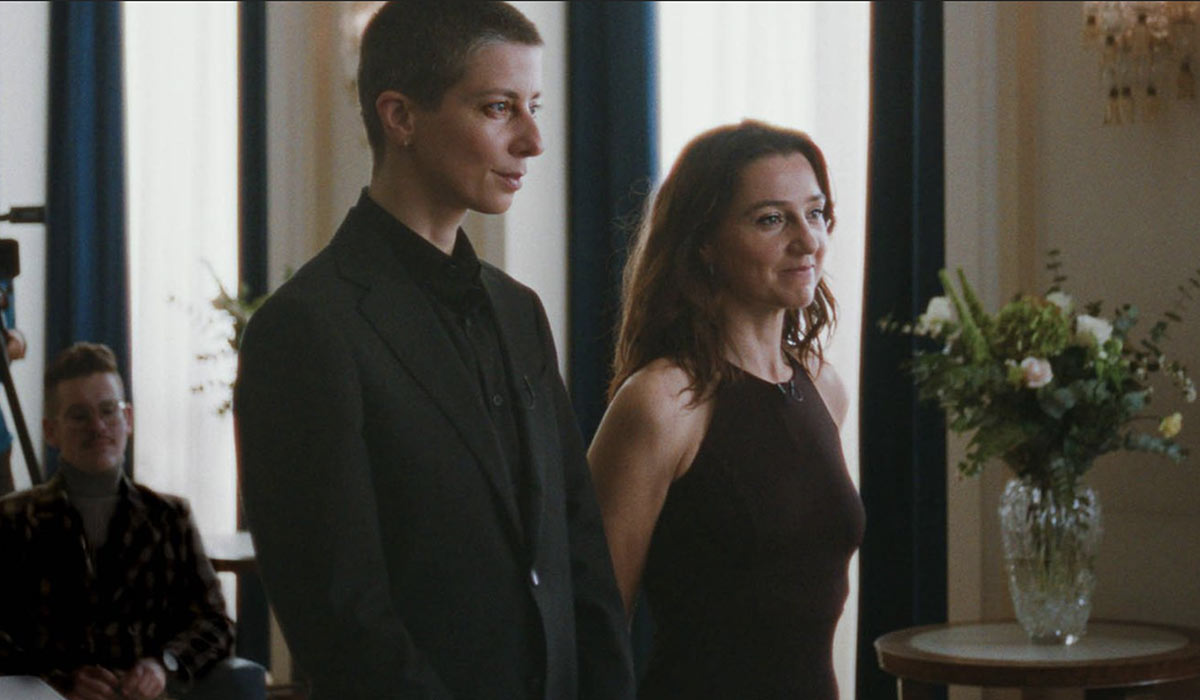
TORONTO – When director Cato Kusters decided to adapt Fleur Pierets’ novel “Julian,” the true story of a queer couple who, after getting engaged, decide to wed in every nation where gay marriage is legal, into a film, she knew it would be timely. In the past year alone, Thailand joined Taiwan as the only two Asian countries to allow same-sex marriage. But as of 2025, there are only 38 countries where it is legal. And, horrifiingly, the country 80 miles south of the Toronto International Film Festival is where it’s seemingly in danger of being lost.
READ MORE: ‘Erupjca’ Review: Charlie xcx Blows Up Her Life In Warsaw [TIFF]
Kusters and co-screenwriter Angelo Tijssens (“Close”) find unique ways to break up the traditional true story genre. The film begins innocently enough. Fleur (Nina Meurisse) is late to a concert and has to excuse herself through a row of people as the performance is already ongoing. One of those people is Julian (Laurence Roothooft), who, in a voiceover, remembers being struck by the black coat Fleur is wearing. Fleur is transfixed by the back of Julian’s long, elegant neck. They are kismet. It is magic.
Their plan to marry in the 22 countries that allow same sex marriage (at that time) is beyond ambitious. A professional writer, Fleur finds herself leaving her magazine after they decline to fund the trips for a feature story. Julian, an ocean cardiographer, will be O.K. She’ll always find work when the journey is over. It’s an endeavor, and before they even leave Belgium, they learn of hiccups along the way. But New York City welcomes them. There are press opportunities. They have fans rooting for them. But in Paris, Julian falls ill, and their dream comes to a grinding halt.
READ MORE: Toronto Film Fest 2025 Preview: 35 Must-See Movies To Watch

Two years later, Fleur is in New York preparing for a public seminar. She’s stressed and nervous. She has endured something traumatic and may not be as ready to tell her story as she hoped.
Kusters plays with the narrative by breaking the timeline, but also using footage Julian chronicles much of their journey on a retro camcorder. The filmmaker no doubt hoped this would create even more intimacy. Instead, it is more of a distraction than an asset. It is an important plot point, at least for Fleur’s story, but in this case, less would have been more. That being said, her overall collaboration with cinematographer Michel Rosendaal inspires some haunting imagery. This is one movie that looks considerably more expensive than its budget, and we’ll always applaud for a club scene that looks like a real club and not a studio soundstage.
Both Meurisse and Roothooft are superb, portraying the character’s love affair with grace and compassion. Meurisse, in particular, is heartbreaking in one pivotal moment that could have been too melodramatic, but endures because of Kusters’ tempered direction.
The ending is somewhat inevitable; you see it early on, but “Julian” somehow still sticks with you. There is a humanity to Kustner’s vision that is impossible not to be swept up in. Considering the familiarity most viewers have with this subsection of the biopic genre, that’s somewhat miraculous. And as for its timeliness, something tells us Fleur and Julian’s joy will speak to many on all sides of the sexual spectrum for decades to come. [B+/B]
Follow along for all our coverage of the 2025 Toronto International Film Festival,


