


“Sometimes other people have to point it out to you.” That’s Will Tracy reflecting, with a slight hint of exasperation, on the consistent themes of massive wealth that permeate his narrative work. From “Succession” to “The Menu” to the HBO movie “Mountainhead,” and, now, to “Bugonia,” the six-time Emmy-winning writer and producer has a pulse on the super-rich and billionaire class in this particular era of the 21st Century. Yet, as a writer, he insists he thinks of all of them as inherently different.
“Now, I can step back, and other people can point out to me this clear through line that runs through everything I do, I guess, about wealth and power,” Tracy says. “To me, ‘Succession’ is always a family show, and ‘Mountainhead’ is kind of a weird show about male friendship. And then ‘Bugonia’ is really more about the kind of atomization and isolation that we’re all feeling in a very divided culture. And I would say probably ‘Yes, I would be quite happy for the next thing that I do to have nothing to do with anything I’ve done before.’ But again, that’s what I thought ‘Bugonia’ was, too. So, sometimes there’s a signature in your work, and there are subjects that you’re preoccupied with, and you may not even be aware of it, but it shows up in the work, and that’s O.K.”
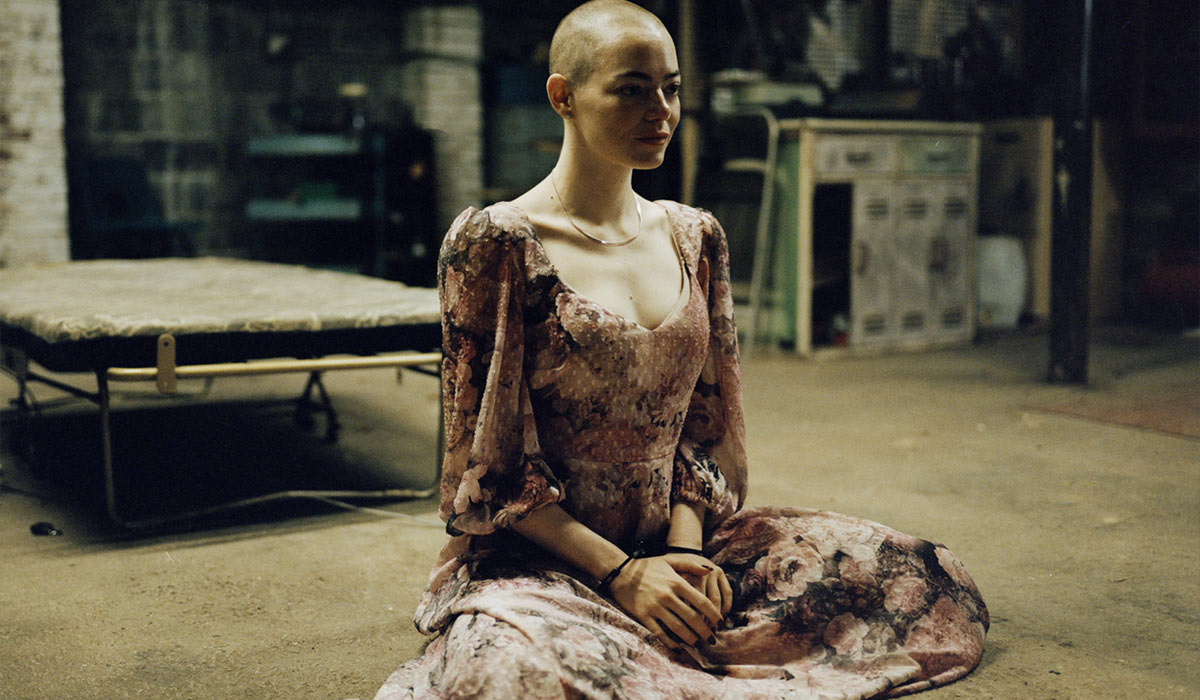
An adaptation of the 2003 South Korean comedy “Save The Green Planet!,” the Focus Features release follows Teddy (Jesse Plemons) and Don (Aidan Delbis) as they kidnap Michelle Fuller, a pharmaceutical CEO they believe is an alien with plans to take over the Earth (Emma Stone). The Yorgos Lanthimos-directed comedic thriller features a few unexpected twists and turns. But those plot points were less important to Tracy than the tense and revealing conversations between Teddy and his hostage, Michelle.
Over the course of our interview right before the holidays, Tracy details how he only watched the source material once, the recent surprise that producer Ari Aster almost directed the movie, a shocking lack of notes from director Lanthimos and Stone, the real-life influence for Stone’s character, and so much more.
Please note: If you have not seen “Bugonia,” there are major spoilers in the context of this interview.
This interview has been edited for length and clarity.
_____
The Playlist: This seems like an unexpected project for you. Did someone pitch this to you? Had you seen the movie and always thought, “Hey, remake this? ” How did it come your way?
Will Tracy: It was essentially pitched to me. I had lunch with my friend Ari Aster, who’s a producer of the film in New York, and he told me about this movie I had never seen or even heard of, “Save the Green Planet!” He didn’t really tell me anything about it. He just said, “Check it out. You might find something that you could do with it. ” So, he sent me a little Vimeo link that I watched on my laptop. I think it was hard at the time to find a quality, faithfully translated version of the film. And yeah, I just immediately saw what he meant that there was something in the premise really that felt like, “Oh gosh,” even though this is a Korean film from 2003 that’s very Korean in its cultural attitudes and its political preoccupations, that there was something in there, if you took that premise and applied it to our current very divided, very freaked out, very, I guess, disassociative culture that there might be something that I could do with that. And so I really just watched the original film that one time. I didn’t want it in my head, and I just started with the premise and a few of the big story beats and then made something that was more about what I was feeling about our current atmosphere, I suppose.
Was there anything specific that Ari or any of the other producers wanted you to keep from the original?
No, I wasn’t given much of a brief at all. I mentioned what I liked about it, and I think Ari said, “Yeah, go towards that. ” I mean, I wrote this five years ago. So, in some ways, I was, I guess, reactive to what I was experiencing at the time, which was the COVID lockdown. That first wave, when I was pretty freaked out and trying to figure out what I believed in and figure out what was happening. And so I think he encouraged me to go in that direction, but, no, I wasn’t given much of a brief at all in terms of what anyone wanted. I think I was given a pretty free hand, which is what I wanted. Certainly, I didn’t want to make a remake, really. I mean, it is, but it’s not sort of a chapter and verse remake at all. I wanted to, in a way of honoring the original film, and honor the work that I was doing. I wanted to make something quite different.
For those of us who haven’t seen the original film, how similar is the plot to the original one, or is it just the basic idea?
It’s the basic premise, but then there are some kind of plot points, and I think I handle them differently, but there’s a version in the original film. I mean, there’s all of the dialogue, and just many of the scenes as they’re constructed are just completely different. And then I think the very ending in terms of what we’re left with is quite different as well. Yeah. But it’s funny, I’m almost one of the least equipped people to answer your question, because I’ve only seen the original film once, five or six years ago, and my memories are quite hazy. I kind of made a rule for myself that when I was writing the script, and if I ever got stuck, I would not allow myself to go back to the original to help and see, “Well, how did they do it?” So yeah, I actually would be curious now to go back and look at the original and see exactly how similar or dissimilar it is.
Did you ever plot out a version where Michelle’s character wasn’t an alien?
I never did. I think you could probably make an interesting version of that that might be saying something slightly different. I think the issue with that for me is that I just feel with those two characters, I feel as though it had to go in that direction. In some sense, I wanted to honor Teddy as a character a bit. It was important to me that he not be stupid or crazy. I wanted him to be mainly right about what he believed, and he’s wrong on certain crucial details around the margins, but in the main, particular details, he ends up being sort of right. And I think that that was important to me to preserve that. Also, it goes from being a story about maybe a kind of internet era culture war kind of story to being this kind of global story about all of us and our relationship to each other and our relationship to the planet that we live on. That kind of scope, I think you can’t get that unless you end it the way that we ended it, or at least that’s what I’ve been telling myself.
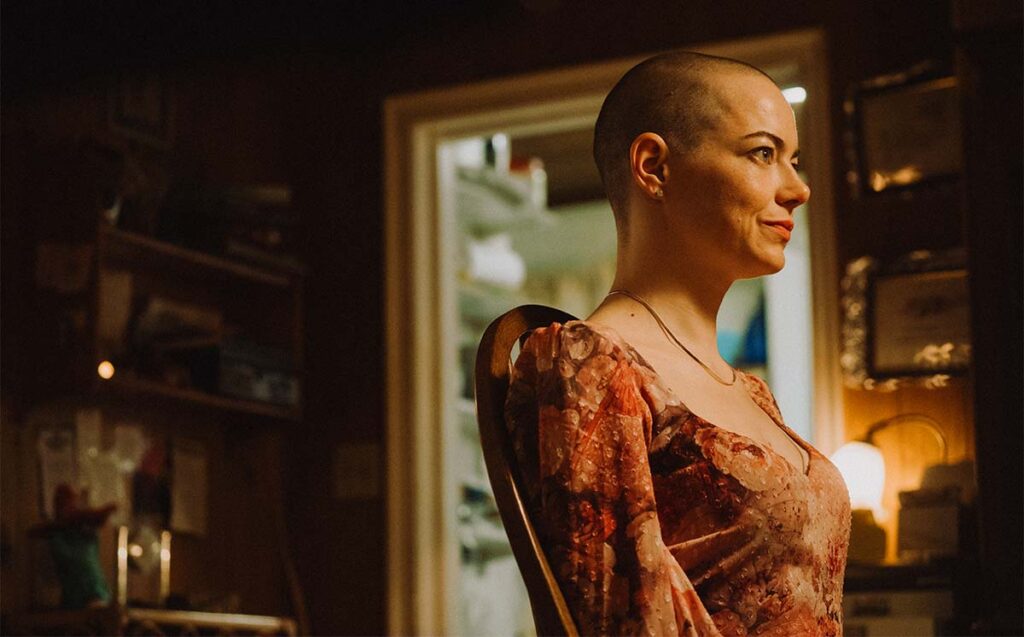
Having seen it twice, and by the way, this could be Emma’s choice in her performance, it appears that the moment the audience is supposed to realize she actually is an alien is when she discovers the secret room that Teddy has, and her reaction to that. She’s not freaked out. She’s a little more calm and more reserved than you might expect.
That’s right.
While working on the script, were there other points where you potentially teased it and pulled back? Were there any other ideas of how to hint to the audience? Did you ever consider making it a cold reveal at the end?
No, I mean, there are a few other moments. I think when they’re having dinner together, there’s a moment when she’s trying to convince him that I know you and I know who your mother is, and we tried what we could to help her. And she says something in that moment, “I’m not happy with myself and the kind of human that I’ve become,” or something like that. She kind of implies that she spent time here, she’s kind of become like us in a way, and that she doesn’t feel great about. There are a few other little moments that are kind of in there, but I think you’re right to isolate that moment is the moment where we start to think, “O.K., wait a minute.” But then also she’s locked down there in that basement, and we’ve seen her be quite clever and quick on her feet earlier in the film. So, there’s still this possibility that she just knows, “O.K., I need to get him something big before he comes back down in this basement.” And so she prepares this kind of wonderful vision of a story. But at that point, once they get back to her office at her company headquarters, and she’s got the calculator, and she’s saying, “Get in the coat closet,” then it all starts to feel like…So yeah, I think to the extent that I was thinking about the twist and hiding the football, I think I was trying to build in these moments of little hints, and then maybe what feels like a bigger hint when she discovers that secret room in the basement. And then we’re kind of thrown and disoriented again when we get in her office, and you kind of second-guess yourself. That was important to me, but really, I tried as best as I could not to focus too much on the big twist or not even think of it as a big twist. Otherwise, I feel like everything in the movie would’ve been every choice I made, every emotional nuance would’ve been geared just towards that twist. And then once you know the twist, there’s no point in seeing the movie again. I wanted it to be more than a surprise that it would reward a second viewing, because you just want to hear those two people talk.
Andyou want to hear her perspective. She’s so manipulative in a way.
That’s right. Exactly. Yeah.
Was there any public figure, anyone in your life, I guess, who was an inspiration for Michelle’s character?
Yeah, I kind of tried to look at various CEOs, particularly women CEOs. I wouldn’t say the character is in any way based on this person, but I remember reading an interview with Mary Barra, who’s the CEO of General Motors and she did say in an interview in a somewhat of a backpadding way, “Well, I remember being in a meeting once, very important meeting, and I realized the meeting, we were creeping close to 5:30.” And I said, “You know what guys? My kid has a soccer game at 5:30, and I have to leave. And in fact, I think everyone should feel that work-life balance is very important. We should all feel like we should be able to leave at 5:30.” And I thought when I read that, I thought, I’m sure she said that, and it sounds very nice, but I bet you that if you talk to some people in General Motors that work for her, they’re not comfortable leaving at 5:30. So, I did steal that a little bit, that idea. And obviously, I made it a much colder, chillier, and scarier version of that.
Was Ari ever attached to direct the movie? Was that ever a plan?
When we did a Q&A together recently, he kind of admitted that he was sort of in the mix. If we couldn’t find the person, or if he felt like we found somebody and he was like, “I don’t want them to do it. I want to do it instead,” then he would do it. I think he had an interest in doing it, which he did not tell me at the time, which is probably wise because I would’ve gotten my hopes up that “Oh, maybe Ari will do it.” But no, it was a while there when we were kind of searching around for somebody. And I just always assumed he didn’t want to do it, but apparently, he did for a little bit, but by that point, “Beau Is Afraid” was written, but not yet made, and then he knew he wanted to do editing after that. So, I think he didn’t want me, and this script to kind of languish on the vine. So I think that’s when he said, “Well, what about Yorgos?”
Oh, so he pitched it as an idea.
Yeah. He said, “How about Yorgos?” I said, “Yeah, that sounds great.” I think I had considered Yorgos, and the script had kind of existed for a year, a year and a half before Yorgos got involved. So, it wasn’t at all written for Yorgos. I think accidentally, I wrote a very Yorgossian script. I think he ended up being the perfect guy for it, but it was by pure happy accident.
As someone who has an esteemed background in television, you are no doubt used to having other people come on board and play with scripts. That’s usually not a big deal. Were you surprised that Yorgos didn’t end up doing a pass?
Yeah, one sense I felt like, “Boy…” but I bet he was making two other movies [including]
writing “Kinds of Kindness.” So the kind of part of myself that’s hard on myself said, “Don’t take that as too much of a compliment. Maybe he’s just really busy.” But he was from the jump. He kind of did say to me, “Yeah, I mean, I usually get involved really early, and there’s a lot of work to be done.” And on this one, we had a couple of really nice, lovely Zooms and chats, which we were mainly just chatting about catching up. And then he would give me a few thoughts that were all very clear. And I would go off and would take me a day or two, and I’d just do a little pass for him. But no, I guess knowing how involved he is in scripts, I think I was somewhat surprised and then a little bit nervous that, well, if he’s not doing a pass, then maybe that means on set he’s going to throw it all out in improvise.
Oh, I don’t think he’s like that at all.
Exactly. No, I learned that’s just not his style at all. And then of course, I also, having never worked with Emma before, I thought, because sometimes it also happens that when a star of that magnitude comes on, you kind of have to do a pass for an actor. So, I would have to go in and do all these things that she would want, and that never came. That sort of like, “Oh, here are her thoughts and here’s what she would like to do. ” That never happened. So they both just completely trusted me, and they both did it. They treated it like a play and just did it. And it was real. I may never get that again as a writer. I may never be that lucky to have people that talented who did that little monkeying with the material. It was just amazing.
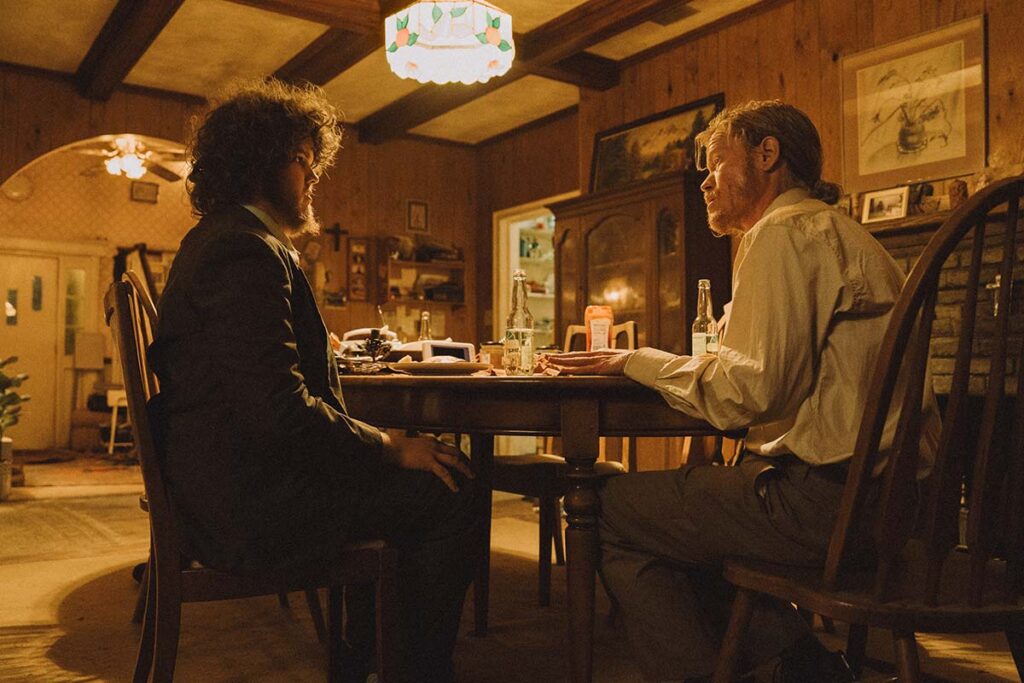
I’ve heard Emma say that there is no improv, that it’s mostly, almost entirely the script. I’m sure you saw a rough edit at some point, but did that surprise you at all? Were you expecting some on-set changes?
I mean, I was on set for maybe 60% of the shoot. And what I saw was just like, yeah, there may not be improv in it, but there’s still the whole world of just the interpretation of the material. And their interpretation of the material was so correct. Not only correct, but it was also so additive and enhanced the material. It’s a pretty extreme script. It’s pretty wild. I think in lesser hands, a different director, especially with different actors, there might be this temptation to go quite big and broad and satirical. And both of them, despite what they were reading and despite the story and those characters, they were just committed to a kind of subtlety on emotional realism that was, for me, like, “Boy, that’s the best when that happens.” I think I come from a comedy background, and so I do write things that have an element of comedy to them, but my hope is that the actors play it straight because it’s going to be funnier that way. And it’s going to have this added dramatic layer.
And that’s exactly what Jesse and Emily do.
I know you were on set, but when you finally saw the finished film, was there one scene that you were most happy with?
It sounds like I’m dodging the question by saying kind of most of them, but I was so focused on those big, I guess, conversation set pieces, the big long chats. They have two of them in the basement and then one of them at dinner. As a writer, sometimes I have this pathological fear of being boring. And so when I see some of those things, they’re long, chatty scenes. And I think I was probably most worried about the dinner table because you’ve taken them out of that pressurized environment in the basement, and they’re sort of meant to be having a civil dinner for a bit, and then it kind of turns. And in terms of page count, it’s quite a long scene. I think as a writer, when I see a scene on the page that’s longer than three and a half pages, I start to get worried that this is going to stretch on too long. And I was not on set for that particular scene. So, when I saw that, even the first cut that I saw of it and didn’t change much in any subsequent cuts, I was quite relieved and exhilarated to find how watchable it was, I think, in large part just because of those actors.
You’ve worked on “Succession,” you’ve worked on “Mountainhead,” and now this. I don’t even know if Michelle’s character is actually a billionaire. Maybe she’s worth 500 million, whatever. But you have gone into the weeds on these rich characters. Do you need a break? Is it getting depressing, or is the material just that compelling?
It’s funny, sometimes other people have to point it out to you. As a writer, I think of them all as being so different. Now, I can step back, and other people can point out to me this clear through line that runs through everything I do, I guess, about wealth and power. And to me, “Succession” is always a family show, and “Mountainhead” is kind of a weird show about male friendship. And then “Bugonia” is really more about the kind of atomization and isolation that we’re all feeling in a very divided culture. And I would say probably “Yes, I would be quite happy for the next thing that I do to have nothing to do with anything I’ve done before.” But again, that’s what I thought “Bugonia” was, too. So, sometimes there’s a signature in your work, and there are subjects that you’re preoccupied with, and you may not even be aware of it, but it shows up in the work, and that’s O.K.
“Bugonia” is now available on Peacock
Follow Gregory Ellwood on Bluesky
Follow Gregory Ellwood on Threads
Follow Gregory Ellwood on Instagram
Sign Up For The Breakdown Newsletter


