

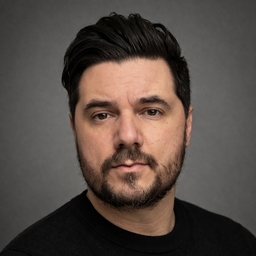

Director Damian McCarthy really loves to hit that dread button, and in “Hokum,” he absolutely wears that thing out, not with loud shocks or cheap jolts, but with the slow, creeping unease that sits there, staring back at you. The longer you watch, the more it feels like the movie isn’t escalating so much as tightening, quietly, deliberately, until there’s nowhere left to go. Then he slaps you across the face for good measure.
Written and directed by McCarthy, “Hokum” stars Adam Scott, Peter Coonan, David Wilmot, and Austin Amelio. The film follows novelist Ohm Bauman, who retreats to a remote Irish inn to scatter his parents’ ashes, only to become consumed by stories of a witch tied to the hotel’s honeymoon suite. Disturbing visions and a sudden disappearance begin to fracture whatever control he has left, forcing him to confront a past that doesn’t stay buried.
On this episode of The Discourse, McCarthy joins the podcast to break down how “Hokum” came together, why he stripped the story down rather than build it out, and how he balances supernatural horror with something far more immediate and human. The starting point was as simple as it gets.
“It began with just wanting to make a haunted hotel movie and just to see, like, would I be any good at that?” McCarthy admitted. “What would my characters look like working in a hotel? It’s like any horror trope. I wonder if I would be any good at that, or what I would do with that?”
That question led him toward one of the film’s defining images, something mundane that slowly becomes anything but.
“What if there was a dumb waiter? And where does that dumb waiter go?” he said. “That seemed to be the thing that kicked off the film visually for me. What could be in there? A dead body? Maybe the guy’s got to get into it.”
From there, the film expands, but McCarthy kept pulling it back toward simplicity, especially when it came to lore.
“There’s always that moment in horror films where somebody will stop and explain what’s happening,” he said. “It’s usually after the midpoint, suddenly the witch starts monologuing, ‘I needed to collect seven souls.’ It’s like, nobody cares.”
Instead, he leans into suggestion.
“If Mr. Cobb tells his little Halloween story about a witch that takes lost travelers off to hell, it’s like, yeah, that’s good enough,” he said. “I’d be happy with that. As a horror fan, I’m on board.”
That restraint gives the film its shape. The horror doesn’t arrive with instructions or rules. It just sits there and waits for you to catch up. At the same time, McCarthy never lets the supernatural do all the work. There’s always something real and dangerous pressing in on the character.
“Any good ghost story usually has a villain that’s still living,” he explained. “Something has to catch up with him. It’s that idea of mixing that real threat that he has to deal with, then also something supernatural. You’re dealing with that on top of something that could physically hurt him as well.”
That balance between the physical and the psychological has been baked into his work from the beginning, shaped in part by a childhood spent around horror films.
“My parents had a VHS store when I was small, so it was always in the horror section,” he said. “That was a huge part of my education, those covers, there’s so much going on, it tells a story on the cover. That definitely fired up my imagination.”
That early fascination carries into one of his most recognizable signatures, turning everyday objects into something deeply unsettling.
“If a character’s alone, it’s like, what is watching him in the room?” he says. “It’s got to be the ornaments, the painting, all the stuff around him, and just how you film them can add this weird feeling.”
Performance is a huge part of that equation, especially with Scott stepping into a much harsher, more abrasive role than audiences might expect. McCarthy didn’t want to soften the character, and, surprisingly, Scott didn’t either.
“I was worried that whoever would play him would be like, ‘Can we make him nicer?’” he admitted. “But he was like, ‘No, his guy is horrible, let’s see if we can get the audience to stick with him.’”
That tension becomes the emotional engine of the film. The character is difficult, often unpleasant, but the film dares you to stay with him anyway.
Looking ahead, McCarthy is aware of the opportunities opening up to him, but he’s not in a rush to leave this lane behind. For now, that means one more swing at the kind of horror he’s been refining.
“I know I want to make one more out-and-out horror film, one location, a haunted house film. I’d be curious to see what I would do with that,” he said. “Because I like the three films we’ve made, but I think now I’m starting to get a grasp of how to do a scare.”
After that, maybe something different. But “Hokum” makes a strong case that McCarthy hasn’t exhausted this space yet. He’s just getting more precise with it, dialing in that dread button until it feels less like a trick and more like second nature.
“Hokum” hits theaters on May 1st. You can listen to the full interview with writer/director Damian McCarthy via the Playlist Podcast Network embed below:
The Discourse is part of The Playlist Podcast Network, which includes Deep Focus, Bingeworthy, and more. We can be heard on Apple Podcasts, Spotify, Soundcloud, and most places where podcasts are found. You can stream the podcast via the embed within the article. Be sure to subscribe and drop us a comment or a rating, as we greatly appreciate it. Thank you for listening.

Mike DeAngelo is a film writer, podcaster, and entertainment journalist whose work has appeared in Variety, The Hollywood Reporter, IndieWire, and beyond. He is the host of The Playlist's podcasts The Discourse and Bingeworthy.

 joins The Discourse podcast to discuss his latest horror film, "Hokum.")