



CANNES – The reaction to Javier Ambrossi and Javier Calvo’s “La Bola Negra (The Black Ball)” had been percolating on la Croisette all week. Especially after marketing screenings that sent distributors buzzing. When the Javis’ epic finally debuted last night, the reaction was euphoric. A 20-minute standing ovation, tying it with “Fahrenheit 9/11” for no. 2 all-time behind “Pan’s Labyrinth,” at 22 minutes. To be fair, these timed ovations are somewhat overblown, but a reaction that long? And among those iconic films? The hype was real.
Less than 24 hours later, the pair is sitting on the rooftop in the city. Spending the afternoon speaking to mostly international press as U.S. distributors battle over what many believe is a potential Best Picture nominee. And lucky us, we were one of the few Americans who got to chat with them.
“The Black Ball” weaves three storylines centered on three different queer men in 1932, 1937, and 2017. It’s a love letter to the famed Spanish poet and author Federico García Lorca and depicts the horror of fascism during the Spanish Civil War. It’s a romance. It’s a musical (a wonderous Penelope Cruz sings not once, but twice). Glenn Close appears in a small role as an expert in queer history (speaking half her role in Spanish). Julio Torres is divine as the boyfriend of a young Spanish historian who discovers he has just lost a grandfather he never knew. There are incredible performances from Spanish recording artist Guitarricadelafuente in his acting debut, as well as relative newcomers Carlos González and Milo Quifes, as well as legendary Spanish actress Lola Dueñas, who you’d recognize from “The Sea Inside” and “Volver.” The movie is epic.
And the Academy will love it.
But now the Javis are smiling, relaxed, and ready to chat.
This interview has been edited for length and clarity.
_____
The Playlist: So first of all, congratulations.
Javier Ambrossi: Thank you so much.
The Playlist: Did you guys get any sleep last night?
Javier Calvo: Yes, we had to.
Javier Ambrossi: It was difficult. It was difficult, but at some point I had to take a pill. [Laughs.]
The Playlist: I’ve been to many premieres at Cannes, and a 20-minute ovation is unbelievable.
Javier Calvo: I think it’s almost the record.
The Playlist: Were you wondering when it would stop? Do you remember what you were thinking while it was going on?
Javier Calvo: I was crying. I was laughing. I was like, what’s my next emotion? I don’t know. Am I going to faint? I was wondering if I was going to faint, actually.
Javier Ambrossi: It was crazy. Totally crazy, crazy. But when you write something, or you direct something, you have faith in what you do, and that faith is what leads you through the whole adventure. So, it was to me like the end of a journey. I felt it so cathartically.
The Playlist: In that context, you spent hours in the editing room, you’ve seen this movie a hundred times, but now you’re in a theater, you’re watching it with a thousand people for the first time. What surprised you the most about how the audience reacted to the film?
Javier Ambrossi: Well, people were clapping a couple of points in the movie when we have this one-shot wonder when the Carlos character is dancing in the tavern, and people were clapping. And also when the title and the black and white photographs. So that surprised me. And of course, hearing all the audience sobbing for the last hour, to me, was a very, very unique experience.
Javier Calvo: You know what? I was surprised that nobody moved. Yeah. I think some people went to the bathroom and came back, but no one left the cinema. Everyone was so quiet. It felt like a community.
Javier Ambrossi: And it’s a long movie.
Javier Calvo: What cinema should be.
Javier Ambrossi: A community.
Javier Calvo: Yeah, community. Something we enjoy together. We live together.
Javier Ambrossi: And it’s a movie that is long, and it’s a movie that is demanding for the audience because it’s full of poetry, and we speak at some points with Atentone Daluth from the south of Spain. So, it’s not like everything is like joy or emotions. You have moments that you need to understand in the tribute to [Federico García] Lorca. So, I was very surprised.
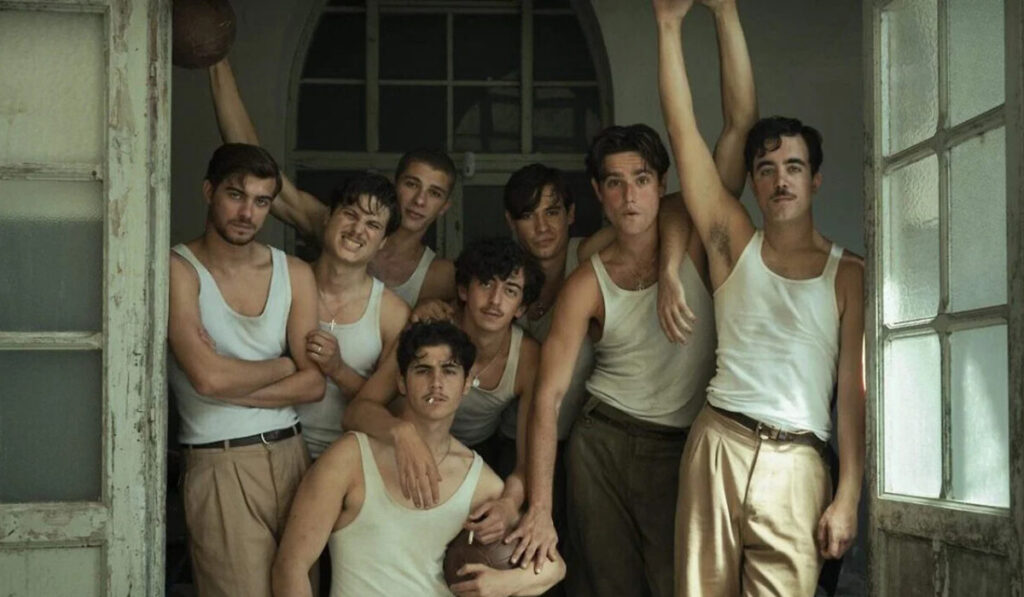
The Playlist: I wasn’t in the room, but afterward, I spoke to a colleague who has been coming to Cannes longer than I have, over two decades, and he’s never seen any audience react like that. He was blown away.
Javier Calvo: I think we don’t get that in our mind. We don’t actually realize how important that was. It’s my first time presenting a movie in Cannes, but I think we should think about it more and treasure it.
Javier Ambrossi: What makes me calm or humble is the idea that the movie is more than us. The movie we came here with this message and honoring a figure like Federico García Lorca and a lot of the people who were killed by Fascism. So when I think, how was the movie? I’m thinking that the message went through, and that’s what really makes me happy.
The Playlist: It’s been 10 years since your first film, and I know you’ve been super busy in the meantime with all your other projects, but why this movie? Why do you think it took this long? Were there other films along the way that just fell apart?
Javier Calvo: It’s been a very intense shooting. I was inspired by a movie that premiered here in Cannes called “Godland.” He shot the movie in terrible climate situations in the mountains, in every place you shouldn’t shoot because it’s not comfortable. And I wanted to do something like that. I wanted to prove to myself that what I like about cinema is the power of images, the power of the moment, live in the moment. I don’t want to see a comfortable set with CGI screens and just pretend we are there. No, I want to take the camera to that cliff to shoot that…
Javier Ambrossi: …real storm.
Javier Calvo: And it was a real storm, and you feel it. It’s vibrant, but it’s not easy. It’s not cheap in any way. You have to resist, and I think that’s cinema, and I think that’s the power of the images, and that’s why it took you so long, because we went to Athens, to the north of Spain, to Granada, to Madrid. It was a very intense journey, and also writing three timelines all flowing in that way, and the editing. No, no, no. It was a very complex journey.
Javier Ambrossi: But in the middle of, between [our first film] “La llamada” and, we created a lot of TV shows. We work a lot in TV, and we are very lucky that we got to experiment with creating TV shows because we are the kind of directors that we want to direct every single episode. The hours of footage on my back are like, I don’t know. [Laughs.] “La Mesias,” for example, is like seven episodes, one hour each, and we directed the whole show. So seven hours, “Veneno,” same, eight hours. So, if you go hour by hour, we direct a lot of movies between the first and the second.
The Playlist: I was going to ask, did that experience help you? One of the remarkable things about the film is that this screenplay, The idea of these stories interweaving so seamlessly is incredibly hard to pull off. It’s something people will bring up right away. “I can’t believe how they pulled off the screenplay.”
Javier Ambrossi: Thank you.
The Playlist: Do you feel as though that experience in television helped, or is that just one of your talents as screenwriters?
Javier Ambrossi: I mean, we have loved crossed stories forever. I loved them as a reader. I love sharp stories, how they mix, and when I read, I don’t know, Raymond Carver or Lucia Berlin, I love that kind of literature, but I think that’s something we like and we know how to do. And our TV shows always mix past and present. In “La Mesias,” we were mixing past, present, and middle time. We also have a very good relationship with our editor, and we have been working with him forever. So, we know we can shoot, and he can understand, and he will help us to put everything together. But surprisingly, the script is very, very, very similar to what’s on screen.
The Playlist: Oh, really?
Javier Ambrossi: Yeah. This script is almost exactly the movie.
Javier Calvo: And you know what? “La Mesias” was six months of shooting. So being able to shoot that long allows you to learn a lot. I feel all those TV shows were training for this movie. We’ve grown up as directors, shooting and shooting and shooting and working and working and working and writing because we wrote like 500 pages of text in “La Mesias” script because it was seven episodes. And that makes you learn.
The Playlist: You sort of hinted the movie’s not cheap, but it’s not expensive either. What was the hardest sequence to pull off for your budget? What was the one where you’re like, “I don’t know how we’re going to do this.”
Javier Ambrossi: We have to fight in order to be able to keep every single sequence. We had to fight. I mean, “I need more extras” all the time, or “I need to do it in this location in the real Granada, in real Cantabria,” and we need this to be Penelope and to sing and the tank. We fought every single battle with ourselves as producers, and we found the money and the help. But I think the biggest challenge, I guess it was the killing of Rafael, because it was a real storm while filming. It was real.
Javier Calvo: And everything was flowing away.
Javier Ambrossi: Yeah. And we were for a whole day in the middle of a storm. Miguel Bernardo was about to die for real. Very cold when very cold. Real rain. Real crying and all the production girls and boys, they were hanging with their hands on the…
The Playlist: On the tents?
Javier Ambrossi: Yeah! The tents by them, the camera people were flying, and we shot it in 35 millimeter. So you have to change every seven or eight minutes, you have to change and put another film [cannister in]. So, it was crazy to shoot in the middle of a real storm.
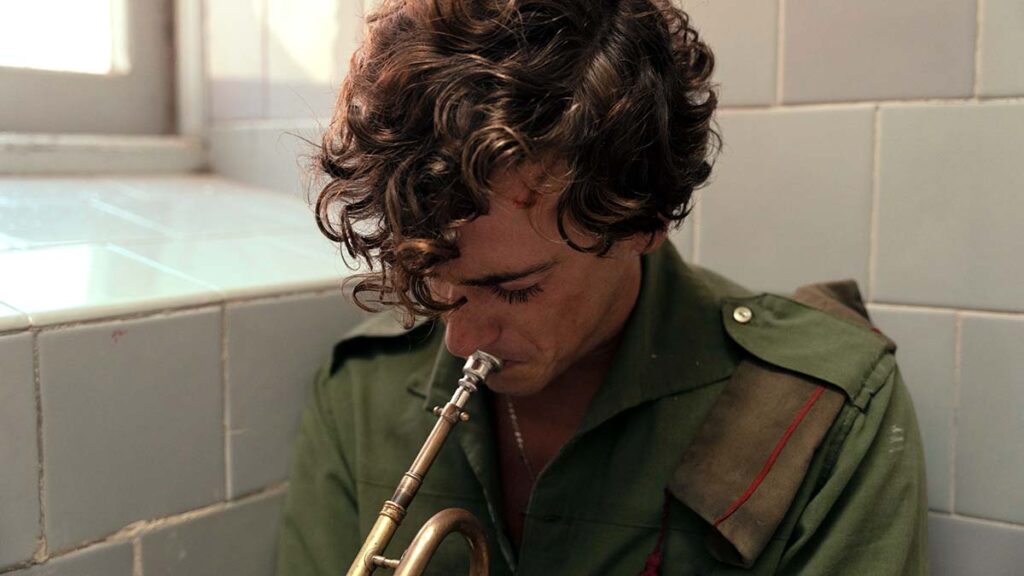
The Playlist: Wait, so time out. You have this ambitious film. It’s a two and a half hour film, right?
Javier Ambrossi: Yes, 2 hours and 30 minutes.
The Playlist: And you were able to shoot on film?
Javier Calvo: Yes.
Javier Ambrossi: And we did a lot of takes.
Javier Calvo: And you know what? My loader, she was like, “You’re spending a lot of negative.” We do a lot of takes, a lot of takes. So she was like, “We don’t have more. We have to ask for more negative.” [Laughs.] So, it was crazy. It was crazy. And when you put the camera in front of the actor, and you hear that “wirr, wirr, wirr,” you feel like money, money, money, money, money, money, money, money, money, money, money. [Laughs.]
Javier Ambrossi: But you’re on point when you say that the movie is big, the biggest you can get in Spain, but it’s not that big. And not only us, the team, the crew. They were doing things that they don’t do in another movie.
The Playlist: Even still, what you guys pulled off is incredible.
Javier Ambrossi: Half of the movies is you want to make it.
Javier Calvo: Yes.
Javier Ambrossi: Desire is the biggest order. Desire is the biggest thing, and then half of the budget is desire, and the other half is money. That’s what I think.
The Playlist: Well, I have two more questions. I read you wrote this for Penelope. Did you tell her you’d written it before you started?
Javier Calvo: No, no. She said, “I had this hunch that this movie is going to be big. Do you have something?” And we were like, “Now you’re talking.” And we had this small role, and we made it bigger for her.
Javier Ambrossi: Yeah. We had the show, the Cuplé singer was going to be just a context. They go, and then someone will sing. O.K., bye. But suddenly we were in the middle of the scene, and she called, and then we were like, “O.K., we need to do the rest of the movie, and we have to give her two musical numbers.” Do we need two musical numbers? No.
Javier Calvo: Are we going to do it?
Both: Yes. [Laughs.]
The Playlist: Were you more nervous she would say no to the singing or to the…
Javier Calvo: No, no, she wanted to sing. When we talked to her, she was like, “And I want to do a musical.”
Javier Ambrossi: And we’re like, “O.K. We have a musical number, or maybe we have two.”
The Playlist: Oh wow.
Javier Ambrossi: So when she was on board, we made it for her. We made it bigger, and I think it was one of the beautiful moments of the movie.
The Playlist: She’s amazing. And last but not least, what inspired you to cast Julio Torres? To bring him overseas for this?
Javier Calvo: You know what? We are huge fans of him in everything he does. We knew we were someone to bring Latin America, we were to bring this other accent to make it rich. And we thought this character was from outside of Spain, and he is kind of lost in Madrid. We wanted to tell a character who has no roots in that city, and the only thing he has is his boyfriend.
Javier Ambrossi: Yeah. And he’s the motor for Alberto to go to Cantabria. He’s the one who tells him, “You have a story. Go find your story.” I thought that Julio would be perfect saying that.
Look for complete coverage from the 2026 Cannes Film Festival on The Playlist.
Follow Gregory Ellwood on Bluesky
Follow Gregory Ellwood on Threads
Follow Gregory Ellwood on Instagram
Follow Gregory Ellwood on TikTok
Sign Up For The Breakdown Newsletter

Editor-at-Large Gregory Ellwood is one of Hollywood's most respected awards journalists, covering the Oscars and Emmys beat with the access and institutional knowledge that comes from decades reporting at the center of the industry. Based in West Hollywood, he has written for the LA Times, Variety, The Hollywood Reporter, HitFix, and Vox, among others.


)