




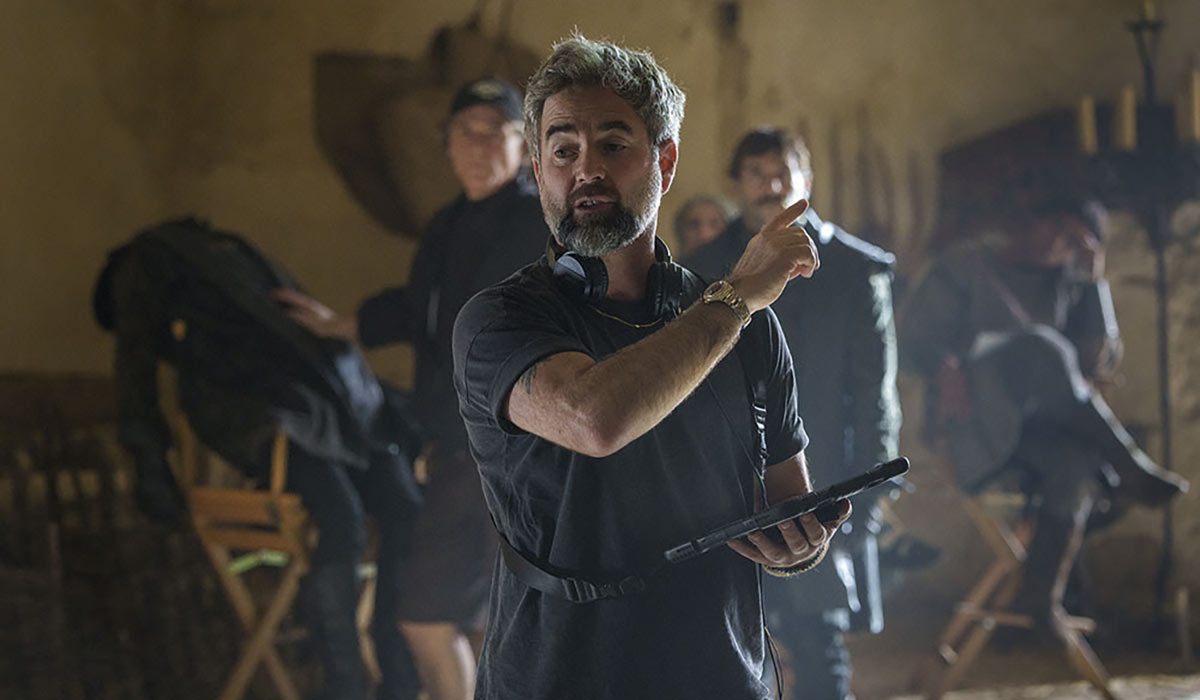
Owen Harris is a talented filmmaker. He demonstrated that by helming the seminal “Black Mirror” episode, “San Junipero.” He even earned a BAFTA Award nomination for it. But tackling three episodes of a “Game of Thrones” spin-off is another matter entirely. And with “A Knight of the Seven Kingdoms,” not only did he set the aesthetic for the series, but he also directed the critically lauded fifth episode, “In the Name of the Mother.” An episode that was at one time the highest-rated of all time on IMDB. But that’s a story for another day.
This particular morning, Harris is zooming in from the production offices of the “Kingdom” where he is halfway through tackling four of season two’s six episodes. During our conversation, he reflects on his collaboration with showrunner and creator Ira Parker, when he knew relative newcomers Peter Claffey and Dexter Sol Ansell had pitch-perfect chemistry as the aspirational Knight Dunk and his squire Egg, the amount of work that went into directing “In The Name of the Mother,” the inherently different tone of season two, and much, much more.
This interview has been edited for length and clarity.
_____
The Playlist: How are you feeling now that the first season has come out and people have sort of digested it all?
Owen Harris: Yeah, great. We’ve been thrilled with the response. It’s been lovely. It’s everything we could have hoped for. You go into something like this where you are shifting the tone, and you’re trying to do something a little bit different in this very beloved universe. So no, we’re super happy with how it’s been received. It’s been really, really great.
You had not worked on “Game of Thrones” or “House of the Dragon.” How did this come your way, and were you pleasantly surprised they asked for you to participate?
It was probably the last thing I was expecting to be asked to do was something in this universe. Yeah, it was. It was a complete surprise. It sort of took a moment for me to figure out how I fit into this universe. How I do what I like doing in this universe and whether I could do a good job of it. When I was reading the script, there was just a lot of humanity, which I really latched onto. And it was sort of like I suddenly thought it was a really wonderful opportunity to do something a bit different in this sort of universe and do it in a way that had a sense of humor and a bit of soul and change the perspective of what you were expecting.
You directed the first two episodes, and you obviously worked with Ira to set up how the visual look of the show would be, what its aesthetic would be. What were the most important aspects of that to you when you first began working on the series?
Going back to what I first saw in the script, which was its integrity and its honesty. And the fact that we are in an era where there are no dragons, and I thought it’s a great opportunity to do something that’s very in camera and very earthy and alive, but still retain lots of what you’d expect a “Game of Thrones” world to look like. So, it’s still classical, but you’re relying on the landscapes and the natural beauty to create the cinematic quality. And yeah, I think it was sort of that. Making it earthier, grittier, and honest. I think there were the core values that I really wanted to bring to this. I thought it was a great opportunity to tell a story that had that sort of heart and soul, I think.
Were you trying to contrast in a way how quiet the early part of the season is to the events later on?
No, not at all. I think it’s actually a bit of both. I think these are novellas, and so they’re quite intimate. So, the beginning is about embracing this new character you’re going to go on a journey with and getting a feel for him and getting a sense of this guy that is this giant of a guy that is funny, but has this slight imposter syndrome and has anxiety. All these little nuanced bits that later on feed the story and connect you to him when it becomes grander and bigger and the stakes get higher. And also, I think that it starts more quietly and then suddenly, when we discover Egg’s identity, then it takes that first shift, and it moves up another level. And then by episode five, you’re sort of in the ship with him, but by that point you know him inside out, and it’s because you’ve spent this sort of time getting to know him and sort of wearing his clothes with him quite literally.
You’re starting off introducing characters played by two actors who have never led a series like this before in Peter and Dexter. And Dexter is obviously super young, and the show is putting a lot on his shoulders. How did you approach working with them overall?
I’ll be totally honest. When I first read about the project and saw the script and started reading it, there was definitely a part of me that thought I’ve got to find a seven-foot-tall giant and a nine-year-old kid who’s going to be bald. And this has got banana skin written all over it in the “Game of Thrones” universe. So if we fail, we’re going to fail very publicly. Those challenges end up being the fire in your belly, and then whether it’s serendipity or fortune favors the brave, but on top of that, wonderful casting and being relentless, but we all joined hands and unearthed these wonderful characters, these wonderful actors. And then I think in answer to your question, it’s about helping them reveal what we’ve seen in them. I think in castings, they come in, and sometimes they’re nervous, or they show different sides of themselves. And what you want to do is create environments where they can give the best of that. And what we discovered was that, actually, and this was not just for Peter and Dexter, although mainly for them, but we cast them because there was something inherent in them as human beings just in a room before they read the scene that we wanted to pull out into the show. And that was definitely the case with Peter, who is just naturally very charming, very charismatic, anxious, all of the things that Dunk is. And we were like, “Brilliant. Let’s just bring that to life.” And he was very generous and incredibly trusting. And the same with Dexter. And I think a lot of it is just building that trust and allowing them space to have a bit of fun with it and to gain that confidence as they go on. But they both did. I mean, they were amazing. And then beyond that, beyond the show itself and beyond the scenes themselves, they went the extra mile, and they forged a lovely relationship. They went and went bowling and went to arcades together. It’s a lovely relationship. And I think we benefit so much as a show from them getting to know each other and getting on in the way they do.
Was there either a moment on set or during rehearsals when you realized, “Oh, we’re O.K., they’re going to work together”?
Yeah. It was the day we had to decide who Dunk was and who Egg was. And we had a few little permutations leading up to that. But when we had Peter and Dexter in a room, and I sat with Ira, we finished doing a little skit with them. I think Dexter told a little joke and a story, and they walked out the room, and we looked at each other, and we were like, “We’ve got our show.” And it felt great. It felt really, really like they were both doing something on their own, which was fantastic, but then together there was just this thing going on, and it was great. So yeah, it was in the casting. And then obviously you then have to think to yourself, “We’ve now got to do this. We’ve now got to get that, what we’ve seen on screen and do all of that.” But yeah, it was that early on.
The “In the Name of the Mother” episode is a spectacular episode of television. You knew what you had to do with that episode. You knew what was on the page. How did you approach it compared to the other parts of the series?
It’s probably the one we storyboarded the most. I’d say out of all of the scenes, it’s probably the biggest team effort because you’ve got so many parts going on there. Everything from a fantastic stunt team working, choreographing the fight, the horse masters, all of that. And it’s not just Dunk’s fight that’s got to work. It’s all the fights that are wrapping around it. Even though they’re not featured, they all exist within the same thing. So, it’s just levels of that. And I just think, but every department has to be filling into that wardrobe weapons. Yeah. Everything has to be supporting each one of those little beats. And even though there’s a sort of deliberate simplicity to the way that that fight, it’s meant to feel blunt. You’re not meant to be wowed by a sudden moment of action or whatever. You’re meant to feel sort of dragged through the mud with Peter, and that was all deliberate. But to actually create that sensation was possibly even more difficult than just pulling off a fantastic-looking stunt. It was just sort of like figuring out all of those components and how you stick with him and how you stay with him. So that was the biggest part of that episode was just, yeah, all of those elements coming together, definitely.
Did you have more time for that episode than other ones? Was there more time in the schedule to shoot it?
I suppose only insofar as there were days that were extra days that were for the stunts themselves. But, even in episode two, we had the big nighttime joust, and that was another sort of layer to that episode. So, it’s a show that possibly looks quite intimate and quite contained, but there’s a hell of a lot going on. Certainly by episode five, lots of storyboarding, lots of talk about tone and how to keep that in the pocket and to not let the action run away with it. So, it’s always exciting to film action and to do all of that, but really and truly, what you’ve got to keep doing is pulling it back to what you’ve set out to sort of achieve, which is this first-person POV, this sense of being connected and sticking with literally inside this guy’s helmet. And so that was a big part of it. Joining those two bits together.
What was your reaction to the fan reaction to that episode, which was sort of incredible, especially what happened on IMDB?
I had no idea about the IMDB thing until my wife told me about it. When a show comes out, I try not to look at anything. And then slowly someone says, “Oh, check the or whatever.” And then you do, and then you open yourself up to it. But literally the day after, my wife said, “It’s all kicking off on IMDB.” And what was brilliant was that it was “Breaking Bad,” a show that I’m a massive fan of, and I’m like, “Hang on, wait, I should be voting against my show.” But no, it’s both a blessing and a curse. It’s sort of great that it did so well and a little bit of bad luck that then you get taken down for it. But no, listen, we were super happy with the response to it. It was amazing. Everything we set out for that episode, it felt like we landed lots of it, so it was good.
Are you working on season two? Are you part of the team?
I am. I’m in Belfast. We are halfway through season two, slugging away. We are about to go off to Gran Canaria to shoot a part of it, and we have been shooting. We started shooting in November, I think, end of November. We’ve shot it in chunks.
Are you doing three episodes? Is it another six-episode season?
Another six episodes, and I’m doing four of them.
When I spoke to Peter, he said the second season was a different tone because the second novella is quite different than the first. How would you describe the tone of season two compared to the first?
I don’t think we could have gone back and done another season one because it was specific to its environment. The second book has a different tone. It’s a different story. It’s really quite like the polar opposite environment. And that in itself flavors it. I think that we’ve now established them as this awkward sort of couple. I love awkward couples. Shrek and Donkey, Laurel and Hardy, all of these. So that’s been established. And now it’s taking them off on an adventure where they’re going to learn more about themselves, about each other.
You’ve done some sci-fi fantasy stuff in the past, but what about working on “Knight of Seven Kingdoms” have you loved? What do you love about this or enjoy about it enough to want to commit so much time to it?
I think a big part of what I loved about season one, bizarrely, was the thing I was most afraid of, which was bringing this couple to life, this seven-foot-tall guy, this young kid. You’ve all got to invest in each other, and you’ve all got to go on the journey, and you don’t know where it’s going to end up. And I loved working with Peter and Dexter. It’s a lovely thing to see actors flourish on screen and to come to life and to find themselves and to, in the end, knock it out of the park. Working with Ira, working with George [R.R. Martin]. It’s a wonderful team here. Yeah, you form a sort of connection with everyone, don’t you? And I think, but yeah, I would say largely it was Peter and Dexter and going back to continue what we’d started, I guess.
“A Knight of the Seven Kingdoms” is available on HBO Max
Follow Gregory Ellwood on Bluesky
Follow Gregory Ellwood on Threads
Follow Gregory Ellwood on Instagram
Follow Gregory Ellwood on TikTok
Sign Up For The Breakdown Newsletter


