


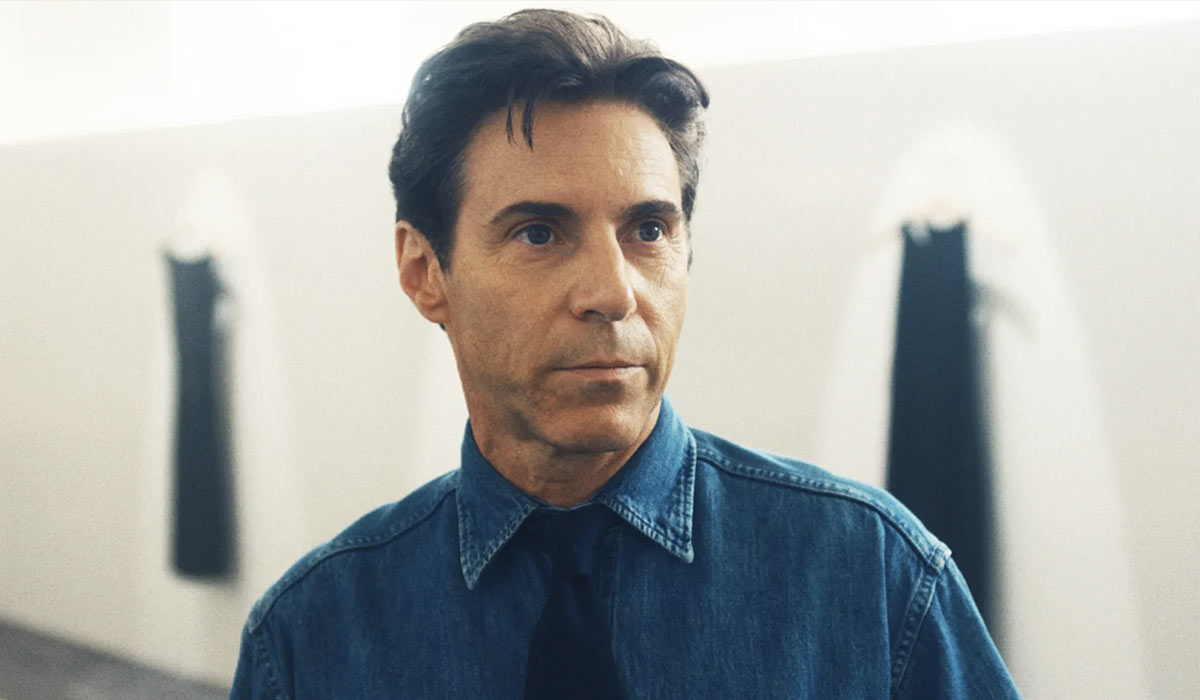
You could argue it was too long. You could argue not all the performances made complete sense. But, at the heart of FX’s “Love Story: John F. Kennedy Jr. & Carolyn Bessette,” are fantastic performances from Sarah Pidgeon as Bessette, Grace Gummer as Caroline Kennedy and, yes, Alessandro Nivola as the legendary fashion designer Calvin Klein. Bessette’s career blossomed in Klein’s New York headquarters in the early ’90s. It’s a professional relationship Klein rarely, if ever, discusses.
Last month we caught up with Nivola, who is up for an Outstanding Supporting Actor in a Limited or Anthology Series or Movie Emmy nomination for his performance. He discussed how important research is for all his roles and what he learned about Klein that not only informed his performance, but this specific moment in history. Oh, and how he’s knee-deep in it again for his latest film for Netflix.
This interview has been edited for length and clarity.
_____
The Playlist: Before this came your way, first of all, had anyone ever said, “Hey, you look like Calvin Klein, you should play Calvin Klein” at any time in your life?
Alessandro Nivola: No, I didn’t know what Calvin Klein looked like.
Me either, really. I didn’t really know until I looked.
Yeah. I mean, I didn’t know what he looked like. I didn’t know what he sounded like. I didn’t know anything about his life at all. And yeah, the offer kind of just came out of the blue. I mean, he’s an icon, obviously, and so that comes with its own set of challenges. But I was more just curious to know what he looked like and sounded like. And I think I just remember the day that the offer came in. I didn’t even read the script. I just went on YouTube and looked up an interview with him. And he just had such a particular way of behavior and voice and just look and way about him that it was obvious to me that it would be something that would be fun to explore. And then of course, that comes with its own set of challenges because you are dealing with the technical side of the performance, which is, to some extent, an impersonation, obviously it’s filtered through me as an actor, but I was trying to capture his particular way of talking, which was unique to a certain time and moment in New York City and had all these influences of the Bronx and his sexuality and his cosmopolitan world that he was living in and his self-reinvention and all that. And then of course, the way that he walked and the way that he moved and used his hands and the way that he touched people or didn’t, or didn’t like to be touched. These were all things that I was keenly observing in lots and lots of kind of video interviews and things that I watched of his. That needs to be there, but it can’t overwhelm the life of the person and the feeling of it being a sort of living, breathing, spontaneous thing. And not a kind of “SNL” sketch or whatever.
When you’re doing research like this, you always find something out you didn’t know about someone. You just said, “I had no idea he didn’t like to be touched.” Was that one of the things you discovered that was surprising to you?
I mean, look, anytime that you’re dealing with a real-life story that’s been adapted for television or film, of course there’s artistic license with it. And there’s obviously a gray area once you start to get into slander or whatever. And I never felt like there was anything in this that was at Calvin Klein’s expense. I mean, I think he comes across well in it, but at the same time, you’re making your best guess at a lot of things and filling in a lot of blanks because I’ve never met him and I’ve never heard it from the horse’s mouth, what exactly his experience was, what exactly his relationship with Carolyn Bessette was, what exactly his marriages were like, how he felt about things like that, like people touching him. But I talked to a lot of people who worked for him at that time and were working in that building, and a lot of what you see in there did square up to the descriptions that I got of how incredibly controlling he was over that environment, both aesthetically and in terms of people’s comportment and stuff. And I read things in books. That one moment where he sort of flinches when she touches him. But that may not be true, but it’s more about a bigger picture of a man who, in my mind, had to fight for his place in the world. He grew up in public school in the Bronx, a Jewish son of Hungarian Jewish immigrants, not a lot of money, loved to learn to sew when he was very young. And I don’t think that may have gone over so well in school, and then fighting his way through the garment district in the 50s and 60s.
And it was rough and tumble. So, I think that I was aware of him having to sort of really impose himself on that world in order to stake the claim that he did. At the same time, sort of feeling that he’s a vulnerable person and that he’s human and that that needed to be there too, that he wasn’t sort of some “Devil Wears Prada” character who’s just kind of looming over things in some imperious way, that he’s also … In particular with this relationship with Carolyn, to me, it was kind of like a platonic romance between them, and it has its own little kind of romantic story that has a beginning and middle and an end where it’s kind of love at first sight with her. He meets her at that fitting and then sort of invites her in more and more. He allows her in more and more to become a kind of intimate, and there are even, in fact, scenes that didn’t make the cut where he’s quite confessional to her. I imagine there’s not time for everything in a series with a bunch of characters, but there were scenes where he kind of is confessional to her about his life in ways that he’s not to anybody else. And so when it finally comes for her to leave, it really hurts. And I think I played that scene as it was informed by those other scenes prior, but I think that you kind of have a feeling of that, that he’s both enraged by it and then also really hurt and then also loves her and wants the best for her all at the same time.
I just rewatched that scene, and from what I’ve read, it might actually have been much more contentious in real life than how you played it. Do you think he thought your version of Calvin, that he still needed her professionally, or was it just the personal betrayal by leaving? I don’t even think in that scene they talk about the wedding dress, do they? Maybe they do.
No, he brings out a drawing of it after she leaves, so the audience realizes that he’s been working on a design for her, and he had found out that day that she’d asked Narciso Rodriguez to design her dress, and he was kind of Calvin’s protege. So, it’s like a real knife in the heart that she’d asked him and not me. And he doesn’t tell her that he was planning, that he had a design for her, but he had it kind of tucked away in his drawer. I think on the one hand, he felt just proud, and that it was just like he was just naturally defensive because he’s not somebody who’s used to being quit on. It was not something that he could accept easily, and it was embarrassing, and that was a feeling that he just loathes. So, his first reaction is just to kind of like shut it down ruthlessly. And on the other hand, I think he felt that, yes, that he really did, that they had a kind of symbiotic relationship somehow. I’ve seen video footage of them working together in the offices, and it really is kind of amazing. They have a shorthand, and they’re photographing models together with a Polaroid or something, and they’re handing pictures back and forth, and they’re like in the thick of the heat of battle, basically, like designing stuff and figuring out a show or whatever. And they clearly have an easy way with each other and understand how to work together and are relying on each other. I mean, she’s sort of ditching him, but despite all that, he can’t help but want the best for her and not wish her some kind of like sad end. And so, there’s something kind of touching about that, that he can’t help but feel that way about her. The intention was to sort of have all that just at the same time and kind of like flicking across his face in quick succession.
I also did want to ask, because correct me if I’m wrong, I think you either are in production, or you wrapped “The 99’ers,” a Netflix movie about the women’s soccer team, am I correct?
I’m in the thick of it right now. We’re shooting till mid-June.
But another real person, another real figure…
Yes.
Do you get more excited about the challenge of playing a real person or would you prefer to play a character you can really create from the ground up?
Well, I go about it pretty much exactly the same way in either case. I kind of alluded to it before, but there’s a whole technical side to it. And voice is like a big, big part of my preparation for every role. And I work with this dialect coach named Kohli Calhoun, who I’ve worked with for many years on almost every role I do, fictional or non-fictional, whether it’s playing Northern Irish like I just did in the film before this one, or a voice just very similar to my own. Everybody has influences on their vocal patterns and where they place their sound and how they make the shape of words and things. And it’s all to do with childhood experience, geographical background, socioeconomic stuff, education, all that is in the voice. And so that’s usually a kind of starting point for me is that. And if it’s a real person and they’re well known enough that there’s existing footage of them, then it kind of makes your life easy in a way because you have that to go on. And if it’s not, then I usually fixate on someone’s voice who I think is a model, and I’ll have that in mind, and I’ll do the same thing, which is just be like listening and listening and listening and hearing things that start to draw out details of character. And then if there’s physical stuff, and then of course the sort of building out of the world and everything, which comes from all kinds of research. And a lot of that is the joy of it. I mean, I’ve had a whole separate education in my life just through research of characters that I’ve played. And in the case of a real person, the one thing I’d say is that real life is usually more interesting than fiction. Sometimes when you’re reading scripts about fictional characters, I don’t know, they can be more prone to cliché for that reason. So you have to try and find the specificity in those characters for yourself. But with real people, it’s usually provided for you just because everybody is so unique, like a snowflake.
The good news is, you will have no snowflakes over the next couple months, because I’m guessing you’re going to be outside on a lot of soccer fields in the sun.
Yeah. Well, you’ll see when you see me. I probably can’t give away too much of that. I have to wear something in it that is very hot.
Wait, is this a transformative role? Will you appear much different than most audiences are used to seeing you?
Yeah. I mean, truth be told, I’ve spent my whole career kind of doing that. So, I don’t know if most audiences were asked exactly what I looked like, if they’d be able to describe me because there are often things that…I don’t know. I mean, not all the time, but a lot of times my face or things have changed from role to role, and this is no exception.
Oh, well, now I can’t wait to…
I mean, you can look the guy up. He’s a wonderful man. His name is Tony DiCicco, and you’ll see he’s got a very strong look.
I was going to say that his family would be very excited that they cast you because you were a conventionally more handsome man than perhaps he was. But now you are going through a transformation for this, which sounds exciting.
No, no. I look like him. I look like him.
“Love Story” is available on Hulu.
Follow Gregory Ellwood on Bluesky
Follow Gregory Ellwood on Threads
Follow Gregory Ellwood on Instagram
Follow Gregory Ellwood on TikTok
Sign Up For The Breakdown Newsletter


