

Raising a daughter in 2026, as women’s rights are being regressed by developed nations around the world and the Neanderthalic “manosphere” continues hoovering up cultural oxygen, is an anxious prospect; raising a son in the same environment is a sobering one. This isn’t a “better or worse” proposition, but a “bad in different ways” proposition, which Nick Antosca and Apple TV’s “Cape Fear” miniseries seems attuned to on a level its predecessors–respectively, J. Lee Thompson and Martin Scorsese’s 1962 and 1991 films, and their source material, John D. MacDonald’s 1957 novel–were not.
Chalk that up to Scorsese, perhaps, who serves as one of the show’s executive producers. His film makes a greater investment in the perspective of Danielle (Juliette Lewis), the teenage daughter of his protagonist, public defender Sam Bowden (Nick Nolte), than either Thompson or MacDonald does in their own texts; as such, his version of “Cape Fear” emphasizes how parents and children break from one another as they grow old and grow up. Secondarily, it’s about youth in revolt against their authority figures. Antosca carries that thread into his miniseries, but ties it to Bowden’s (Patrick Wilson) son, Zack (Joe Anders), instead of his daughter, Natalie (Lily Collias). (She is actually his stepdaughter, a detail referenced enough times in dialogue to feel like an ode to “The Royal Tenenbaums.”) Both kids have their own dramatic arcs, of course, reflecting the textures of 2020s teenhood, but Zack’s greater proximity to male violence whiffs of intent.
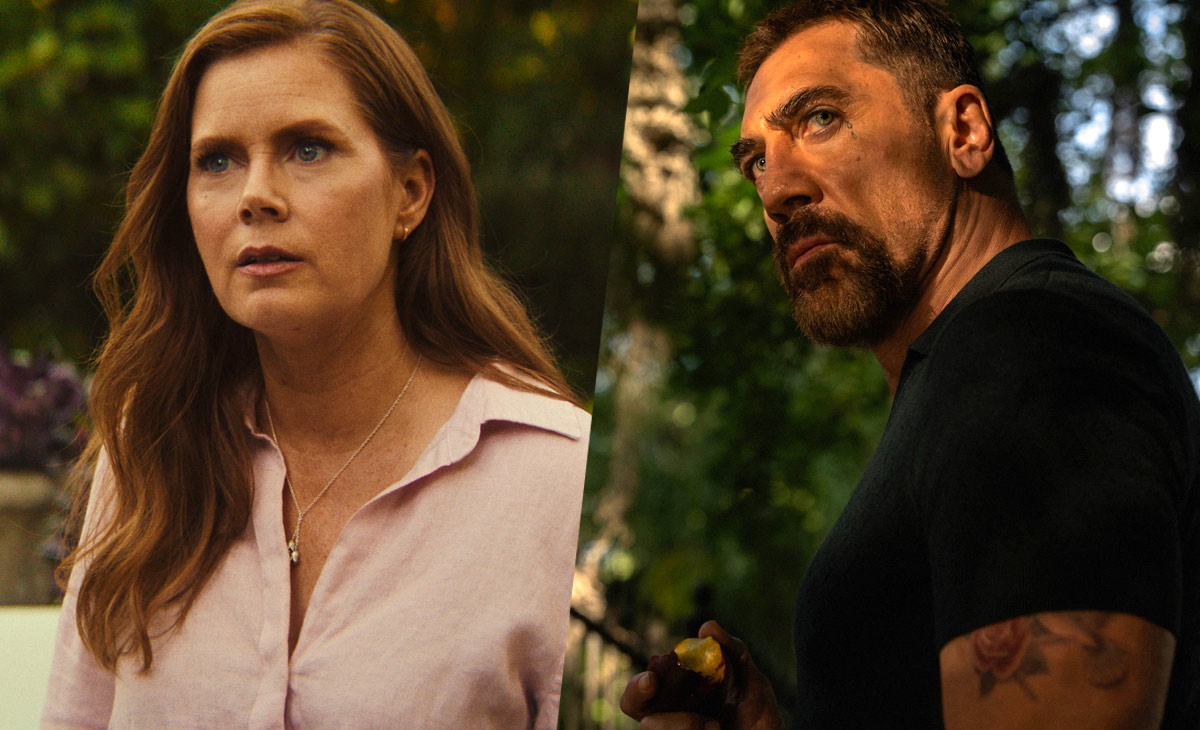
Whether or not Antosca means “Cape Fear” as a comment on the many avenues that misogyny, machismo, and patriarchal cruelty have for reaching and influencing young men, the subtext is certainly there, baked into the overarching narrative. As with each previous version, “Cape Fear” focuses on the collision between the Bowden family and Max Cady, played here by Javier Bardem as an unhinged, brooding hunk and magnet for ill-advised attention from the media as well as misguided groupies; 17 years before the series’ events, the Bowdens, here named Tom (Patrick Wilson) and Anna (Amy Adams), half-assedly represented Cady in court, leading to his imprisonment for the murder of his wife and unborn child. In the story’s present, Cady is exonerated and goes about tormenting the Bowdens without leaving a shred of evidence to his culpability.
Like Robert De Niro’s Cady in the Scorsese film and Robert Mitchum’s in the Thompson film, Bardem’s Cady knows the law well enough to know where, in the sand, legal lines are drawn. A family of four skunks drowns in the Bowden’s pool; missing the symbolic meaning is nigh-impossible, but there’s no proof Cady had anything to do with it. He later interrupts a gala celebrating the efforts of Anna and her law firm in securing the release of an innocent man from prison, which anyone would read as an attempt to intimidate her and Tom, save for the impromptu speech he gives, forgiving them for failing to spare him jail time during his own trial. He’s a new man! He’s a humble man! There’s no way he could be responsible for the Bowdens’ house alarm going on the fritz, or inviting two drunk strangers (Ethan Embry and Sunny Mabrey) to swim in their pool, or other, worse things that befall Tom, Anna, Zack, and Natalie as the episodes breeze by.
“Cape Fear” is keenly aware of pop culture’s contemporary obsession with true crime, and Bardem’s Cady is well-positioned as an object for TV journalists, admirers, and even Anna’s boss (CCH Pounder) to cling to–for ratings, for sexual thrills, and for image maintenance. (Firms like Anna’s, which specialize in wrongful convictions and fighting the good fight against the United States’ for-profit prison system, need all the donations they can get.) Bardem is so charming and relaxed in conversation with his co-stars, and so chafed in solo sequences where we watch him struggle to maintain his grip on reality, that we, too, are seduced by his pathos. He’s a man misjudged, believed responsible for the worst thing that’s ever happened to him; he’s a victim of childhood abuse, too, at his father’s hands. Antosca and his directing team, which includes Morten Tyldum, S.J. Clarkson, Reed Morano, and Trey Edward Shults, never reveal the full truth to the viewer. More than that, they establish their audience as voyeurs, watching the family from afar, an aesthetic choice that seems to indict true crime as ethically compromised at best and exploitative at worst.
People watch true crime; in turn, studios and podcasters make more true crime content. That’s the way of the market. “Cape Fear” mercifully spares its audience a lecture on the subject, being more content getting elbow-deep in the morass of Cady’s psyche as well as the Bowdens’ interior troubles: Zack has an unwholesome reputation after an incident at school, undisclosed to start with but revealed in the first few episodes; Natalie struggles to feel she belongs as Tom’s stepdaughter while wrestling with her sexual identity; Anna rightly worries about Zack’s mental health while showing no regard for his boundaries; and Tom, like Nolte’s character in Scorsese’s film, fights the temptation of infidelity with a colleague.
It’s possible to take this mounting pile of problems as emblematic of television’s “more is more” philosophy, in which so much happens with each member of an ensemble cast that the production becomes cumbersome. But if “Cape Fear” can be seen as a reaction to true crime mania, and if it also can be taken as a cautionary tale of how easily brutal masculinity can reach our boys, then the show’s sprawling structure is as necessary as its sudden bursts of bloodshed and intense menace. This is the “Cape Fear” our culture deserves. [B+]

Boston-based pop culture critic who has been writing about film and television online since 2009, with bylines at Paste Magazine, Slant, The Hollywood Reporter, Polygon, and The Playlist. A member of the Online Film Critics Society and the Boston Online Film Critics Association.

