


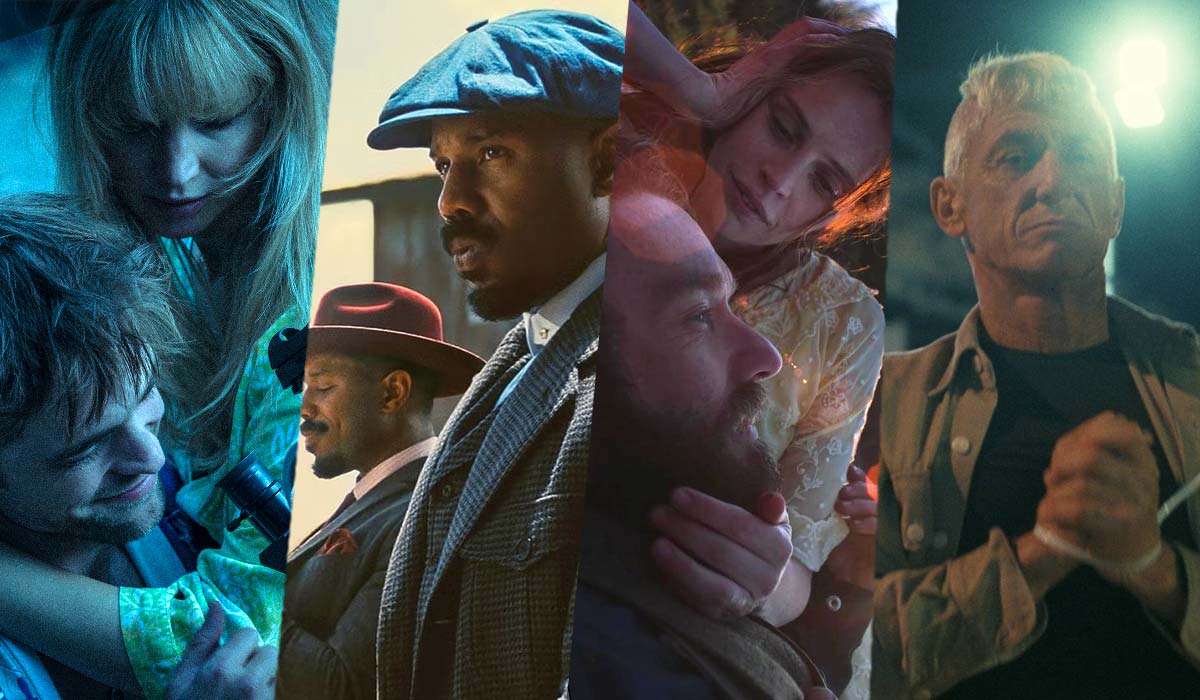
Cinematography is the only department that can make the world look inevitable. Acting can persuade, writing can argue, editing can seduce, but the image—light arranged into meaning simply is. A good shot doesn’t announce its intelligence; it slips past the brain and lands in the body. That’s why the laziest compliment people give movies (“it’s beautiful”) is also, in its blunt way, the most accurate: what the camera decides to keep, what it refuses to show, and how it moves (or doesn’t) is the movie’s nervous system laid bare.
READ MORE: The 150 Most Anticipated Films Of 2026
2025 was, as usual, a year of contradiction. We’re living in an era where entire platforms seem engineered to flatten images into “watchable” mush, where every frame is optimized to survive on a phone screen, and every camera move is pre-processed for attention spans. And yet—maybe because of that—some of the most exciting work this year came from DPs and directors choosing specificity over safety: stillness where you expected noise, darkness where you expected “clarity,” texture where you expected polish. Sometimes that meant maximalist spectacle that actually knew where to put the money. Sometimes it meant a small film finding its soul in patience, in weather, in a face held one beat longer than comfort permits.
Follow along for all our Best Of The Year and Most Anticipated coverage here.
What follows isn’t a list of the “prettiest” movies of the year. It’s a survey of visual authorship—cameras matching their filmmakers’ freak, lenses that turn genre into mood and mood into meaning, frames that don’t just illustrate the story but complicate it. These are the films where the image does the heavy lifting: it builds dread, it finds tenderness, it makes the air around the characters feel charged, and it reminds you—quietly, relentlessly—that cinema is a visual medium before it’s anything else.
“Train Dreams,” Adolpho Veloso
Let’s go with the easiest possible path for contextualizing Veloso’s lensing on Clint Bentley’s moody period drama, and take our cue from William H. Macy: “Beautiful, ain’t it?” blurts Macy’s avuncular sage, Arn, to Joel Edgerton’s reserved logger, Robert Grainier. “Just beautiful.” Twilight’s falling on the hinterlands, a fitting backdrop for the fading Arn, who in the scene immediately prior suffers a blow to the head from a widowmaker–a falling tree branch. All of God’s glory is beautiful, of course, though we’re better equipped to appreciate it in the moment than the bemused Robert. The brief Bentley gives Veloso for the film is “Terrence Malick lite,” and Veloso indeed stays broadly faithful to his assignment. But there’s a stillness to “Train Dreams” that especially latter-day Malick eschews, and in that stillness, opportunities to appreciate the story’s ponderance about one man’s place in an inexorably changing world. – Andy Crump
“Weapons,” Larkin Seiple
Of course Zach Cregger hired a DP with Seiple’s very particular résumé to shoot “Weapons”; he’s a veteran of bizarro genre cinema, having worked with cheeky directing duo Daniels on “Swiss Army Man” as well as “Everything Everywhere All At Once,” two pinball machines where pessimism and optimism carom around a playfield installed with fart jokes, dick jokes, hot dog finger jokes, kung fu, heartrending unrequited romance, time travel, nihilistic delusion, and bagels. For audiences to fully appreciate the breadth of Cregger’s vision, vacillating as it does between stark terror and screwball comedy, it’s required that the person responsible for realizing that vision through the camera is capable of matching his freak. Through Seiple’s eyes, “Weapons” becomes a potent absurdist representation of suburban American doldrums, where cultural forces primed to trigger parents’ panic responses hold sway. – AC
“The Secret Agent,” Evgenia Alexandrova
Kleber Mendonça Filho either needs guide rails or an enabler; at given moments in just about every movie he’s made, one may perceive him yearning to pull focus from his leads and turn it toward the supporting characters populating their stories instead. It’s innate to Mendonça’s aesthetic. To him, life is made up of chance encounters that, though fleeting and final, enrich our lives, or if not that, at least shape them. Alexandrova shoots “The Secret Agent” with such devoted patience that she quite clearly falls under the “enabler” category, being in lockstep with Mendonça’s philosophical fondness for the little details and transitory interactions. Without that deliberate touch, this would be a much different film–not a worse one, necessarily, but another one altogether, perhaps one that reflects the title with fidelity. There’s no spycraft in “The Secret Agent.” There is, however, life, and to Mendonça, and thus to Alexandrova, life is more precious–and more critical. – AC
“Sinners,” Autumn Durald Arkapaw
Ryan Coogler’s Southern Gothic, maximalist horror film, his first original project after spending the last decade in Franchise Land, decides, to its detriment, to have every idea instead of a singular idea; it’s at odds with itself, speaking to the theme and meaning. But as a display of his gifts as an actor’s director, and as a riveting entertainer, “Sinners” plays, and for as much credit as is owed to his ensemble, an equal amount is likewise owed to Arkapaw. This is a film with a reported $100 million budget, give or take a few. Every dollar of that shows up on screen, plus what feels like another $50 million that Coogler didn’t have. Arkapaw revels in the production design just as much as the patrons of the juke joint where the film’s second act takes place do in literal soul-stirring music: even in the busiest of scenes, from vampire melees to time-traveling, era-spanning dance scenes, she pays utmost respect to the details of the film’s backdrop and copious bloodshed. – AC
“Die My Love,” Seamus McGarvey
A movie like Lynne Ramsay’s “Die My Love” demands intimacy to function. Oddly, among the rest of Ramsay’s work, the film shares the strongest genes not with “Morvern Callar,” likewise an ominous study of an unraveling female psyche (and Ramsay’s personal favorite of her own movies), but with “We Need to Talk About Kevin,” where a teenager’s killing spree is pinned to his mother; as such, it could only ever be that Ramsay would hire McGarvey, her DP for that picture, to shoot this one. “Die My Love” peers not at, but into, Grace (Jennifer Lawrence), a would-be great American novelist in a state of dissolution over maternity and marriage. Part of that is due to Lawrence’s performance. Of the rest, much is to do with McGarvey’s hand at both giving her space to breathe rankled life into her character, and refusing to get out of her space. Like her responsibilities as a parent and burdens as a woman yoked to a weak patriarchal relationship dynamic, Grace can’t escape his camera. – AC


